


The aim of this lesson is to analyse the problems Hitler faced when he became Chancellor in January 1933 and understand why becoming Chancellor did not immediately give him complete control of Germany.
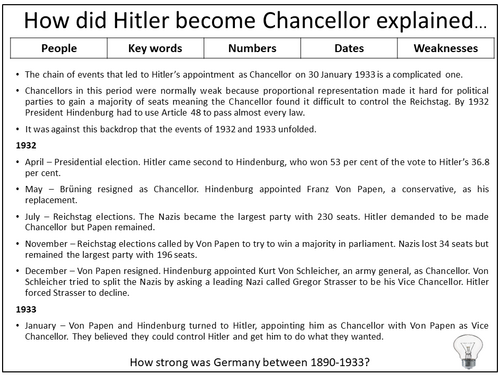
Students develop their understanding of the political events that led to Hitler becoming Chancellor, including the roles played by President Hindenburg, Franz von Papen and General von Schleicher. They examine the complex political situation in Germany in late 1932 and early 1933 and consider why Hitler was eventually appointed Chancellor.
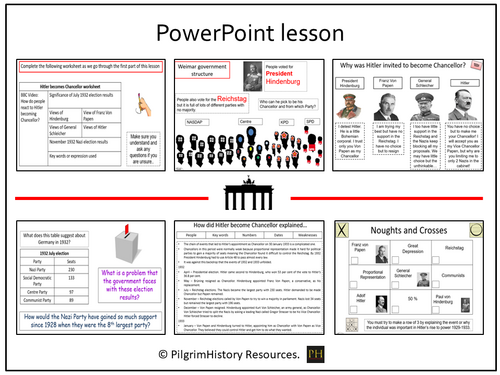
Students investigate the key problems Hitler faced, including Hindenburg, the lack of a 50% majority in the Reichstag, opposition political parties and Papen and von Schleicher. They consider why each presented a potential obstacle to Hitler and his plans to establish a dictatorship.
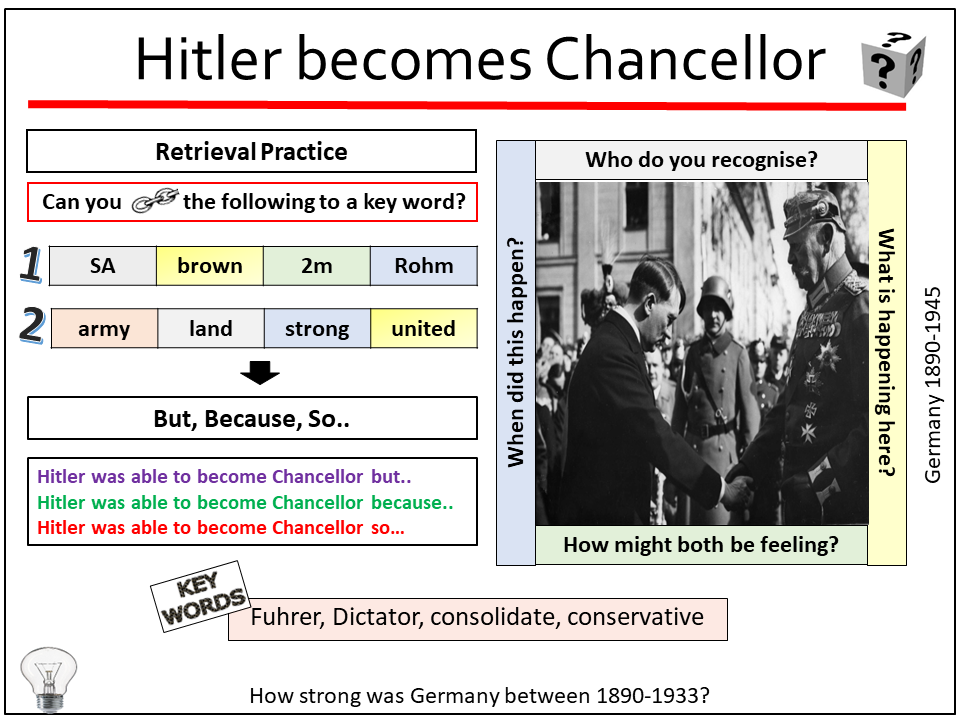
Students then use a revision thinking quilt to match key questions to specific historical keywords and terms, helping them retrieve and consolidate the knowledge needed to understand Hitler’s appointment as Chancellor.
The lesson also includes carefully selected video links, providing additional support and helping students develop a clearer understanding of the complicated political events surrounding Hitler’s rise to power.
Students are then prepared to tackle the GCSE exam practice question: “Describe two problems Hitler faced as Germany’s leader when he became Chancellor in January 1933.” Hints and a model answer are included to help students develop accurate, clearly explained responses using specific historical knowledge.
The lesson is enquiry based, with a key question introduced at the start using a lightbulb prompt and revisited throughout the lesson. This allows students to track their progress and develop a clear understanding of the challenges Hitler faced when he first became Chancellor.
The resource includes:
Fully editable PowerPoint
Context and problems to Hitler becoming Chancellor
Revision thinking quilt
Retrieval practice
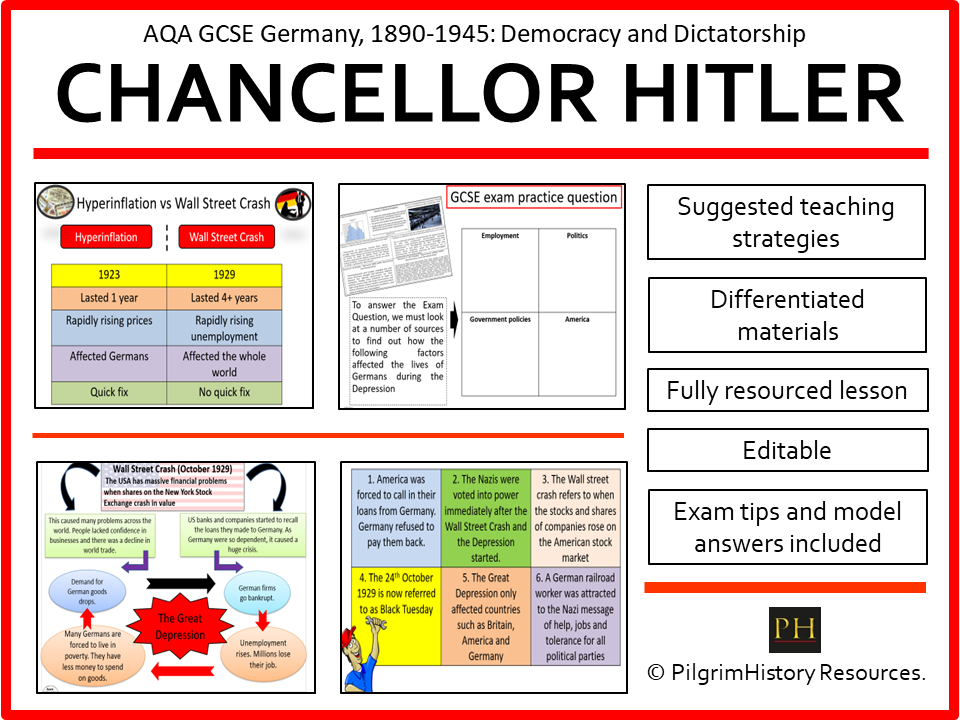
GCSE exam practice question with model answer
Differentiated materials
Suggested teaching strategies
Please leave a review if you find this resource useful. Your feedback will be gratefully appreciated.
Something went wrong, please try again later.
This resource hasn't been reviewed yet
To ensure quality for our reviews, only customers who have downloaded this resource can review it
Report this resourceto let us know if it violates our terms and conditions.
Our customer service team will review your report and will be in touch.
£0.00