pdf, 3.13 MB
pdf, 3.13 MB
docx, 1.92 MB
docx, 1.92 MB

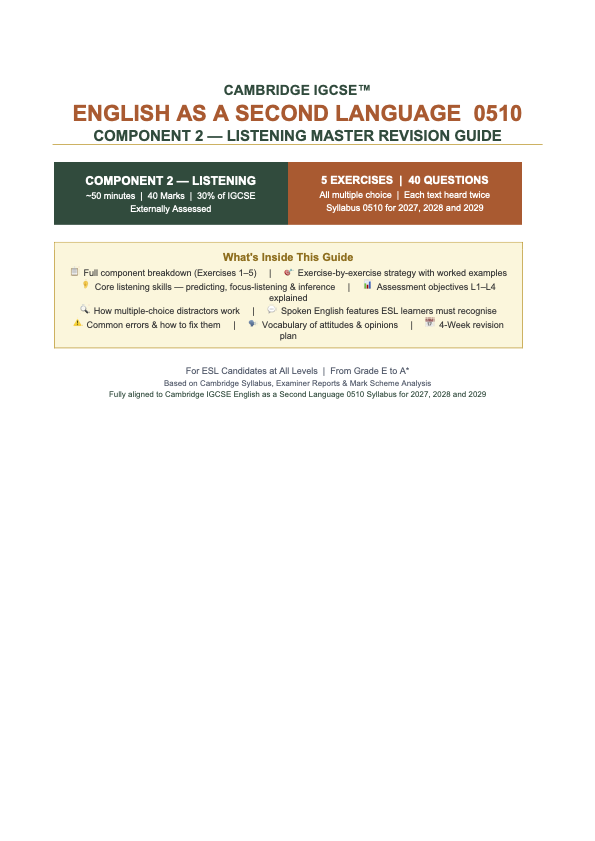
What’s inside – exercise by exercise:

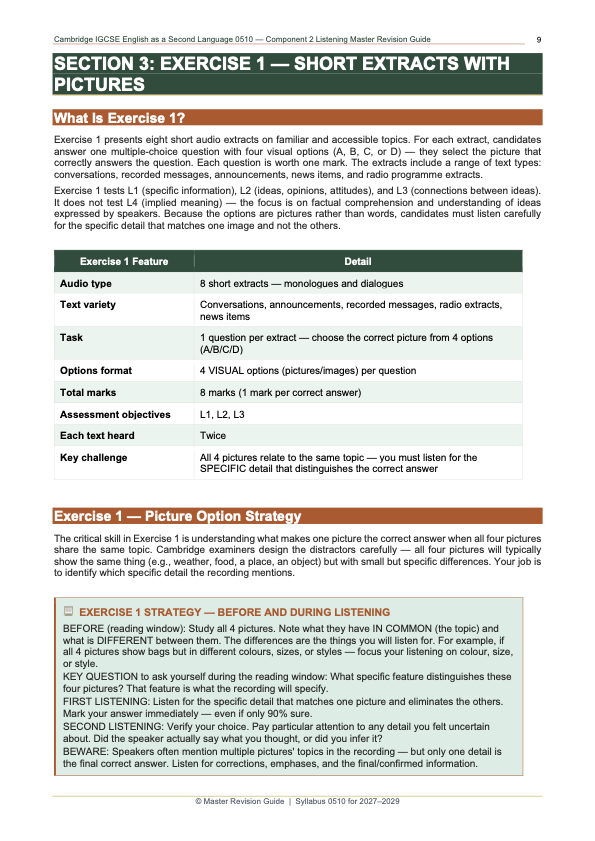
Exercise 1 (short extracts with pictures)

How to study the 4 pictures BEFORE listening – and why noting the differences between them is the key

Common picture topics (weather, directions, time, transport, objects) with essential vocabulary

Exercise 2 (short extracts with written options)

Two questions per extract – how to read both before the recording starts

How to identify L4 (implied meaning) questions before you listen – and what to listen for when you do

Distractor types: familiar word in wrong context, partially correct, too extreme, opposite meaning

Exercise 3 (sentence completion from a monologue)

How to read all 8 sentence stems before the talk begins

Tracking your position during a continuous monologue – and why getting stuck on one gap costs you the next

Exercise 4 (multiple matching – 6 monologues to 8 statements)

Why 2 statements are unused distractors – and how not to force a match

The language of attitudes and feelings: enthusiasm, disappointment, concern, reluctance, admiration, regret (with spoken signals)

Exercise 5 (longer interview)

Focus on the interviewee – the interviewer’s questions are NOT tested

How to handle sentence-length options (break them into parts – every part must be true)

Interview discourse features: topic shifts, clarification, hedging language

Plus:

The three-phase listening approach (pre-listen → first listen → second listen)

Paraphrase recognition – the #1 skill for defeating distractors (the correct answer is NEVER the exact words from the recording)

Spoken English features ESL learners struggle with: contractions, connected speech, reduced vowels, hesitation, hedging

Vocabulary of degree, certainty, and qualification (definitely → probably → I suppose → I’m not sure)

The 6 distractor types – with examples and elimination strategies

4-week revision plan (including daily listening habits and accent exposure)

Exam day checklist and grade boundary targets

Who is for?

ESL teachers preparing students for the Component 2 listening exam

Students who struggle with multiple choice distractors or implied meaning (L4)

Tutors supporting ESL exam preparation

File details:

33 pages

PDF format + Word

Aligned to Cambridge 0510 syllabus for 2027–2029 exam

A small ask: If this guide helps you and your students, please take two minutes to leave a review. It helps other teachers find resources that actually work – and I read every single one. Thank you!

#CIE #IGCSE #ESL #0510 #0511 #ListeningComponent #Paper2 #EnglishAsASecondLanguage #ESLListening #MultipleChoice #GapFill #Matching #Dictation #Synonyms #Distractors #ExamTechnique #AudioAnalysis #Syllabus2026 #ESLTeacher #ListeningSkills #EnglishRevision

Get this resource as part of a bundle and save up to 20%

A bundle is a package of resources grouped together to teach a particular topic, or a series of lessons, in one place.

Bundle

CIE IGCSE English as a Second Language (0510) Complete Exam Preparation Bundle: All 3 Components - Teaching & Revision Guide + Past Paper Analysis + Exam Strategies

We hope these guide series help you plan your review/revision work. These are concise and precisely aligned with the updated syllabus. Many teachers have collaborated in making of these guides. If they are useful in your teaching, please consider leaving a review. It would truly be helpful for us to improve on the process of making. You can also explore other guides at the [store](https://www.tes.com/teaching-resources/shop/samatanicca). Three complete master guides covering every component of the qualification. Component 1 (Reading and Writing – Core), Component 2 (Reading and Writing – Extended), Component 3 (Listening), and Component 4 (Speaking). Buy the bundle and save. What's inside the guides: Reading and Writing (Core & Extended) – Component 1 & 2 (2 hours, 80 marks, 70% of IGCSE): The heaviest-weighted component. Exercise 1 (multiple matching) – how to scan for specific information without reading every word. Exercise 2 (multiple choice) – recognising paraphrasing and synonyms. Exercise 3 (notes/table completion) – selecting exact words from the text, not rewriting. Exercise 4 (summary) – how to identify 5-8 key points and connect them without copying full sentences. Exercise 5 (email/article/report) – format, register, and audience awareness. Exercise 6 (extended writing) – how to develop ideas with reasons and examples, not just lists. Model answers for every exercise type with examiner commentary. Listening – Component 3 (40 minutes, 40 marks, 30% of IGCSE): Authentic or semi-authentic recordings on four topics. Multiple choice, matching, note completion, short-answer questions. How to predict answers before listening. How to identify distractors – Cambridge often puts the word from the recording in the wrong answer. How to spell correctly (markers deduct for spelling errors on answers copied from the recording). Listening protocol: read questions → predict answer type (number, name, time, place) → listen for specific information → check spelling. Speaking – Component 4 (10-15 minutes, 40 marks, separate endorsement): Individual speaking test. Part 1 (2-3 minutes) – general questions about familiar topics (family, school, hobbies). How to give extended answers, not one-word responses. Part 2 (3-4 minutes) – short presentation on a given topic. How to structure: introduction → two or three points → conclusion. How to prepare notes (not full sentences). Part 3 (3-4 minutes) – follow-up discussion. How to express and justify opinions, agree and disagree politely. Sample speaking cards with model answers. Command words decoded for every exercise – Tick, Choose, Match, Complete the notes, Write the letter, Complete the sentences, Answer the questions, Write a word or short phrase. Each with specific guidance for ESL candidates – what the examiner actually expects and what common mistakes they see. Summary writing guide for Exercise 4 – How to select the correct 5-8 points from a passage. How to paraphrase without changing meaning. How to connect points into a single developed paragraph (not bullet points). Bulk copying of whole sentences loses marks. This shows them how to avoid it. Email and article format templates – Email: subject line, salutation (Dear...), opening sentence, body paragraphs (2-3 points), closing sentence, sign-off (Best wishes, Yours sincerely). Article: headline, introduction paragraph, body paragraphs, conclusion. Register guide: formal vs informal vocabulary (request vs ask for, assistance vs help). Example email and article with annotated feedback. Extended writing development guide for Exercise 6 – Many ESL students write lists. This teaches them how to turn a point into a paragraph: state your point → give a reason → add an example → explain the result. PEEL structure for ESL writers. Listening prediction protocol – Before each extract: read the question, underline keywords, predict the type of answer (number? name? date? place? time?), listen for specific information, ignore distractors. Common distractor types explained with examples. Speaking presentation structure – 2-minute presentation that works: introduce your topic (10 seconds) → point 1 with example (30 seconds) → point 2 with example (30 seconds) → optional point 3 (20 seconds) → conclusion (10 seconds). Sample presentation cards with model responses for Part 2. Topic-based vocabulary banks – Family and friends, school and education, work and careers, free time and hobbies, travel and transport, media and technology, health and fitness, environment and pollution. Each with collocations and phrases, not just single words. 4-week revision plans for each component – Daily schedules for reading, writing, listening, and speaking. Timed practice with self-marking using mark schemes. Everything follows the Cambridge 0510 syllabus for 2026–2028. No fluff. Just what earns marks in the exam. Grab the bundle and save – Three complete guides. One price. All the planning done for you. A small ask: If this bundle helps you and your students, please take two minutes to leave a review. It helps other teachers find resources that actually work – and I read every single one. Thank you! #IGCSE #CambridgeIGCSE #EnglishAsASecondLanguage #ESL #IGCSEESL #0510 #ESLBundle #ReadingAndWriting #Listening #Speaking #SummaryWriting #EmailWriting #ArticleWriting #ListeningProtocol #SpeakingTest #ESLTeacher #CIE #ExamPrep #RevisionGuide #TeachingBundle

£10.25

Reviews

Something went wrong, please try again later.

This resource hasn't been reviewed yet

To ensure quality for our reviews, only customers who have purchased this resource can review it

Report this resourceto let us know if it violates our terms and conditions.
Our customer service team will review your report and will be in touch.