


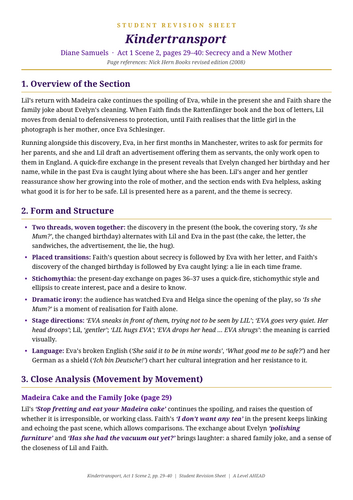
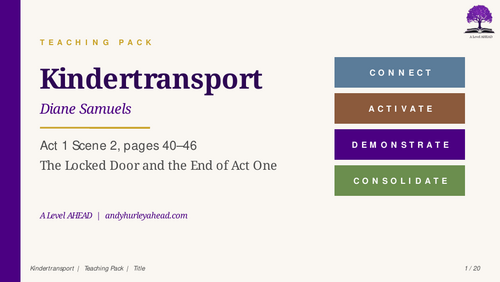
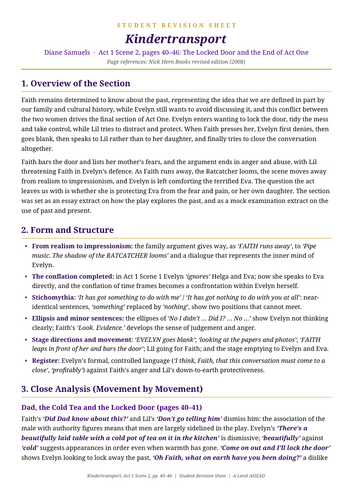
Three teaching PowerPoints and three student revision sheets covering the whole of Act 1 Scene 2 (pages 22–46), from Eva’s arrival in England to the end of Act One.
This bundle covers Act 1 Scene 2 of Diane Samuels’ Kindertransport in three sections: pages 22–28, 29–40 and 40–46. Each section has its own teaching PowerPoint and student revision sheet. Andy Hurley, a former Principal Examiner, HMI Inspector and Headteacher, wrote them all.
The Teaching PowerPoints
Each 20-slide deck follows a four-phase learning continuum: Connect, Activate, Demonstrate, Consolidate. There is no lesson framing, so you can sequence the slides over one, two or three lessons. The presenter notes hold full teacher instructions, timings, prompt questions and the points to steer discussion towards.
Activities include:
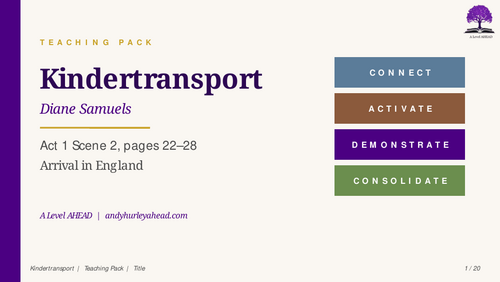
Pages 22–28: arrival and what happened next; lost in translation; the brave face; authority in England, with the Organiser; letters across time; hot-seating the Organiser; class and culture, comic or about loss?; creative writing: Eva’s first letter home.
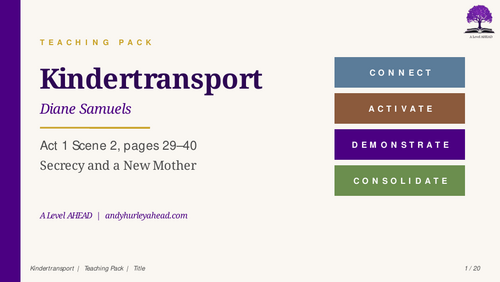
Pages 29–40: servants and permits; stichomythia at speed; reading the advertisement; who knows what?; Lil on trial; the child as parent; testimony and drama; creative writing: Faith’s diary.
Pages 40–46: can the past be locked away?; realism to impressionism; freeze frames of power; one pronoun; three mothers; Debate and Defend: cruel or surviving?; the end of Act One, drawing together its motifs and themes.
Essay challenges cover adapting to a new culture, Lil as a parent, and how the play explores the past. Each deck also includes check-your-understanding challenges and motif-log entries.
The revision sheets
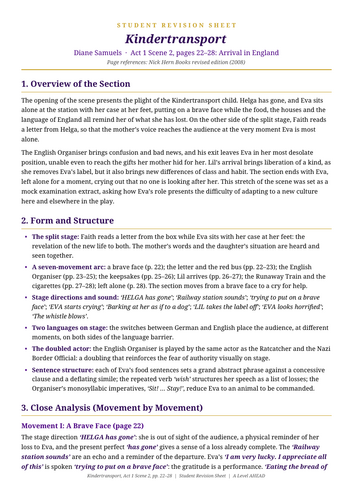
Each five-page sheet has seven sections: overview, form and structure, close analysis, key themes, context (AO3), critical perspectives (AO5), and study questions with extension activities. A Quote Quilt on its own page maps the key quotations against voices, themes and contexts.
Good to know
Page references follow the Nick Hern Books revised edition (2008). The play is not reproduced, so students will need their own copies. Pages 40–46 contain strong language, which is flagged in the materials.
Something went wrong, please try again later.
This resource hasn't been reviewed yet
To ensure quality for our reviews, only customers who have purchased this resource can review it
Report this resourceto let us know if it violates our terms and conditions.
Our customer service team will review your report and will be in touch.
£5.00