


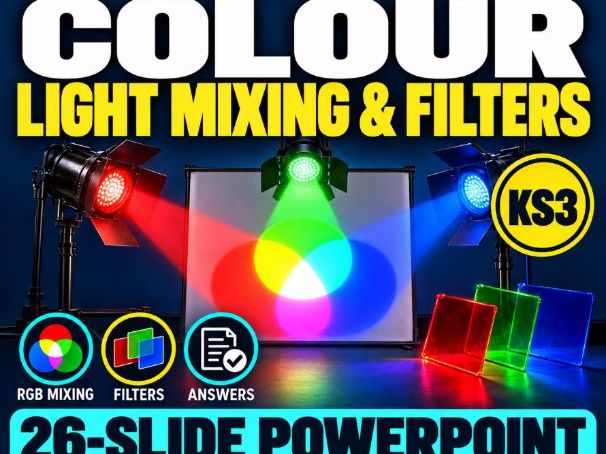
KS3 Colour: high-ability PowerPoint with RGB light mixing, coloured filters, practical investigations and exam-style questions with answers.
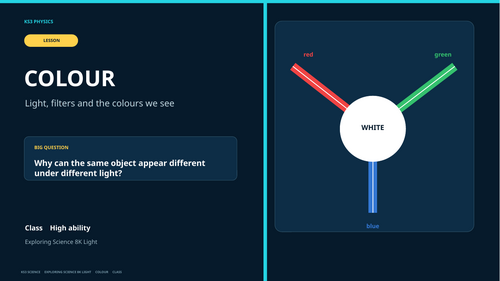
Why can the same object appear different under different light? Help students explain colour using reflection, absorption and transmission, then apply their understanding to light mixing and combinations of filters.
This 26-slide editable PowerPoint is designed for higher-attaining KS3 learners. Suitable for Year 8 and use alongside Exploring Science 8K, it includes a suggested 60-minute lesson sequence with practical activities, checks for understanding and independent assessment.
What’s included?
- Ten-question retrieval starter with answers, revisiting light, dispersion, absorption and colour.
- Changing-illumination visual puzzle, exploring why a red shirt can appear black under blue light.
- Primary and secondary colours of light, explaining additive RGB mixing and how it differs from mixing paints.
- RGB light-mixing practical, with predictions, instructions, safety guidance and an observation table.
- Coloured objects, white and black surfaces, explained through selective reflection and absorption.
- Primary and secondary filters, including red, green, blue, cyan, magenta and yellow.
- Five mini-whiteboard checkpoint questions with answers.
- Two-filter investigation, with prediction and observation tasks followed by expected results.
- Colour logic matrix, comparing object appearance under red, green, blue and white light.
- Stage-lighting challenge, applying colour reasoning to a magenta costume.
- Nine-mark exam-style application question with a mark scheme for self-assessment.
- Exit-ticket colour mystery with an answer.
Challenge for higher-attaining learners
Students track which light components are available, transmitted, absorbed and reflected before deciding what reaches the eye. Extension tasks introduce overlapping filter passbands and ask whether reversing two filters changes the final colour.
Practical discussion considers why real RGB mixtures may appear tinted rather than perfectly white. The lesson addresses misconceptions, including the idea that filters turn incoming light into their own colour.
Classroom use
Suitable after introductory work on light and the visible spectrum. Activities develop prediction, observation and scientific explanation, with opportunities to compare practical results against an idealised RGB model.
Format: one editable PowerPoint. Tasks, practical guidance, observation tables and assessment answers are included within the slides.
Equipment: red, green and blue LED sources, a white screen, a suitable white-light source and coloured filters, including cyan, magenta and yellow for extension work.
Something went wrong, please try again later.
This resource hasn't been reviewed yet
To ensure quality for our reviews, only customers who have purchased this resource can review it
Report this resourceto let us know if it violates our terms and conditions.
Our customer service team will review your report and will be in touch.
£3.00