


Comedy Writing: Complete 6-Week
Teach students how to write genuinely funny stories and scripts with this complete six-week comedy-writing course.
The unit builds towards an original comic story or short script, which students plan, draft, edit and evaluate.
Week 1: Introducing Comedy
- What comedy is and why writers use it
- Incongruity, exaggeration, misunderstandings and surprise
- Expectations and unexpected outcomes
- Original model-scene analysis
- Writing a scene entitled The Expert
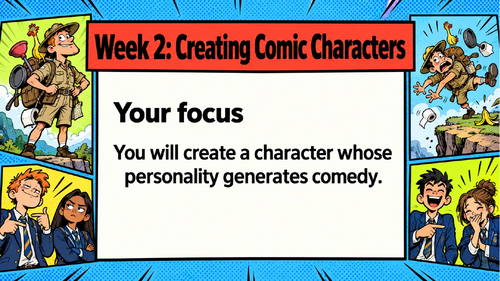
Week 2: Creating Comic Characters
- How personality can generate humour
- Character goals, strengths, flaws and habits
- The contrast between self-image and reality
- Revealing personality through actions and dialogue
- Creating likeable but flawed characters
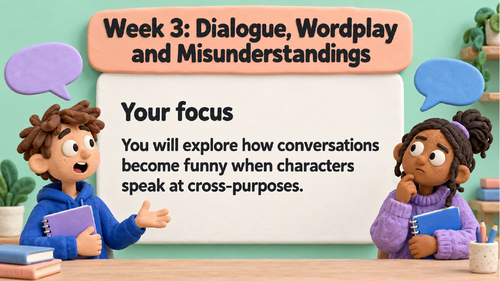
Week 3: Dialogue, Wordplay and Misunderstandings
- Ambiguity and literal interpretations
- Characters speaking at cross-purposes
- Distinctive voices
- Developing misunderstandings without confusing the reader
- Direct-speech punctuation and script conventions
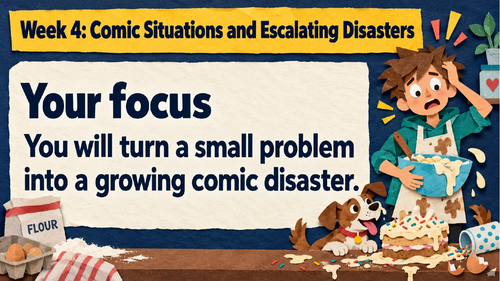
Week 4: Comic Situations and Escalating Disasters
- Turning a small problem into a comic disaster
- Linking actions and consequences logically
- Exaggeration and playful physical comedy
- The escalation ladder
- Using the rule of three
- Writing It Was Supposed to Be Simple
Week 5: Comic Timing, Reversals and Callbacks
- Setup and payoff
- Controlling timing through sentence and paragraph length
- Saving information for maximum impact
- Reversals and changes in power
- Planting details and bringing them back as callbacks
- Planning an effective comic ending
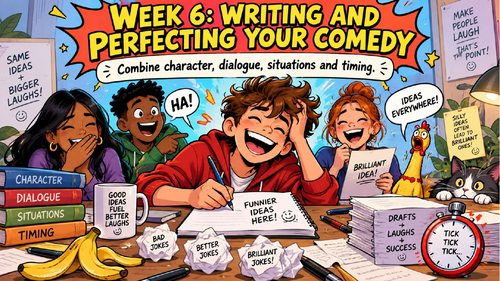
Week 6: Writing and Perfecting Your Comedy
- Planning an original comic story or script
- Combining character, dialogue, complications and timing
- Developing a satisfying reversal or payoff
- Editing stations covering character, clarity, escalation, timing, language and accuracy
- Final assessment criteria
- Student reflection and evaluation
- Create believable characters with clear goals and comic flaws
- Build humour through choices, contradictions and misunderstandings
- Write distinctive and purposeful dialogue
- Link complications so that a situation escalates naturally
- Use incongruity, exaggeration, wordplay and the rule of three
- Control pace and reveal information at the right moment
- Construct effective setups, reversals, callbacks and payoffs
- Analyse how language and structure create humour
- Infer meaning from characters’ words and behaviour
- Edit their writing for clarity, impact and technical accuracy
The resource includes original model extracts, discussion questions, sentence starters, creative challenges, planning frameworks, plenaries, homework tasks and a final assessment.
The lessons also encourage thoughtful, inclusive comedy. Students learn to create humour through fictional characters and situations without using a real person’s identity, disability, vulnerability or embarrassment as the joke.
Something went wrong, please try again later.
This resource hasn't been reviewed yet
To ensure quality for our reviews, only customers who have purchased this resource can review it
Report this resourceto let us know if it violates our terms and conditions.
Our customer service team will review your report and will be in touch.
£5.00