


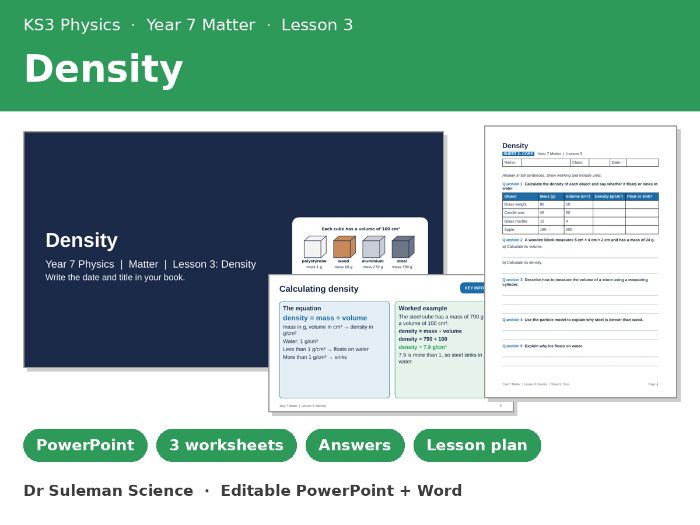
Density lesson for KS3 Physics, Year 7 Matter (lesson 3 of 6): a ready-to-teach PowerPoint, three differentiated worksheets and full answers.
Learning objectives
- Bronze (all): Describe density as how much mass is in a given volume, and predict floating and sinking.
- Silver (most): Calculate density using density = mass ÷ volume, with units g/cm³.
- Gold (some): Measure the density of regular and irregular objects, and explain the anomaly of ice and water.
What’s included
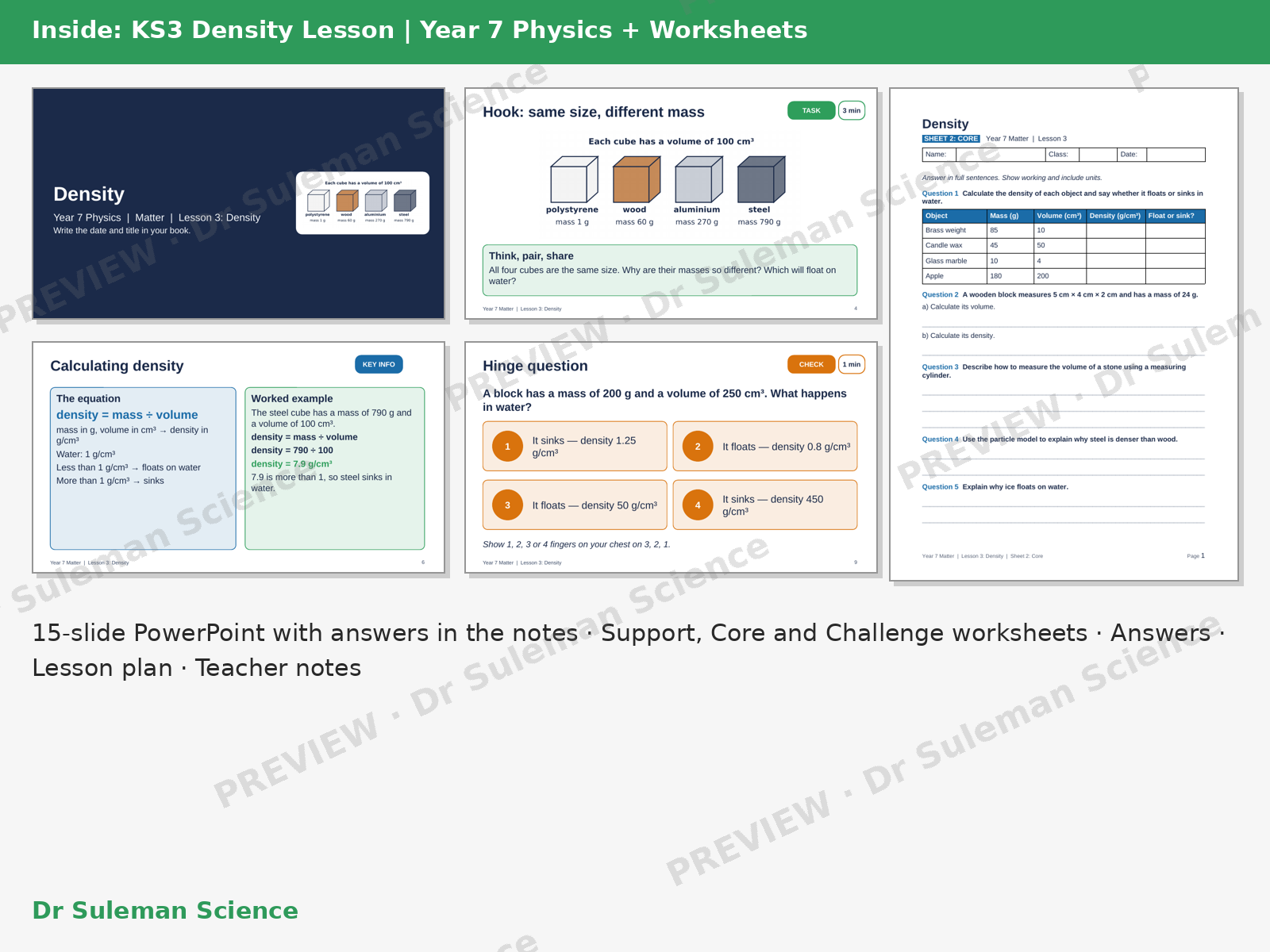
- 15-slide PowerPoint: Do Now retrieval, objectives, hook, key words, teaching slides, we-do example, hinge question, practical or data task, challenge, myth busters, exit ticket and homework, with answers in the speaker notes
- Worksheet 1 Support (word bank, sentence starters), Worksheet 2 Core and Worksheet 3 Challenge
- Answers for every slide and worksheet
- Lesson plan with timings, misconceptions and differentiation
- Teacher notes with subject knowledge, prep list and timing tips
Fully editable Microsoft PowerPoint and Word files, aligned to the KS3 National Curriculum. Ideal for specialist and non-specialist teachers.
Part of the Year 7 Matter unit
- The Particle Model
- Changes of State
- Density
- Diffusion and Brownian Motion
- Temperature and Internal Energy
- Review lesson + 40-mark end-of-unit test
Find the other lessons and the full unit in my KS3 Physics resources.
Last updated: 27 October 2026.
Get this resource as part of a bundle and save up to 43%
A bundle is a package of resources grouped together to teach a particular topic, or a series of lessons, in one place.
Something went wrong, please try again later.
This resource hasn't been reviewed yet
To ensure quality for our reviews, only customers who have purchased this resource can review it
Report this resourceto let us know if it violates our terms and conditions.
Our customer service team will review your report and will be in touch.
£3.50