

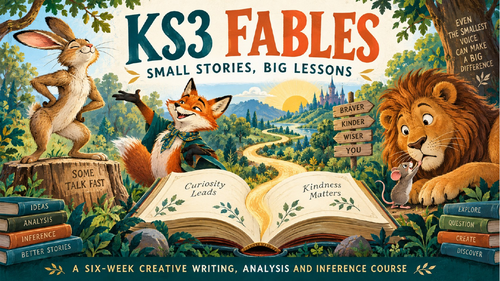

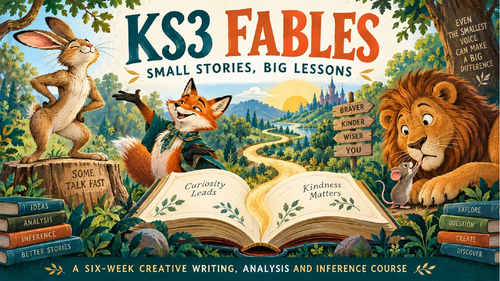
KS3 Fables Creative Writing Scheme of Work | Six Complete Lessons | 52 Slides
Teach students how small stories can communicate powerful lessons with this engaging six-week KS3 fables unit.
Across six PowerPoint lessons, students explore how fables use anthropomorphic characters, contrasting traits, dialogue, conflict, choices and consequences to reveal ideas about human behaviour. They analyse original model texts before applying each technique to their own writing.
The course culminates in students planning, drafting, editing and evaluating an original fable with a thoughtfully developed moral.
What is included?
Six complete PowerPoint lessons
52 visually engaging slides
Clear learning objectives
Accessible starter activities
Original fables for analysis
Structured inference and discussion questions
Creative writing challenges
Detailed planning activities
Sentence stems and reflection prompts
Editing stations
Final assessment criteria
Homework tasks
A complete final writing assessment
Six-week course outline
Week 1: What Is a Fable and What Is Its Purpose?
Students explore the defining features and purposes of fables, including anthropomorphism, character traits, conflict, consequences and morals.
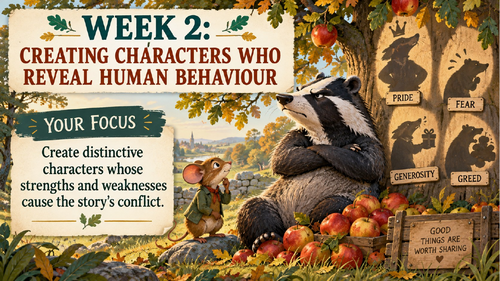
Week 2: Creating Characters Who Reveal Human Behaviour
Students infer traits from actions and dialogue, create contrasting characters and challenge familiar animal stereotypes.
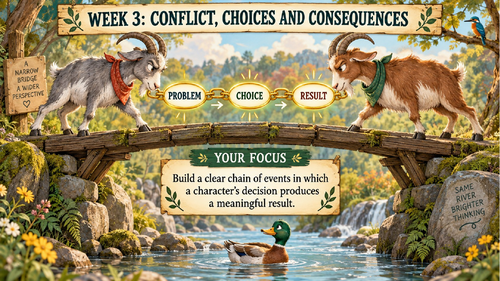
Week 3: Conflict, Choices and Consequences
Students develop logical causal chains and consider how a character’s central choice should produce a believable outcome.
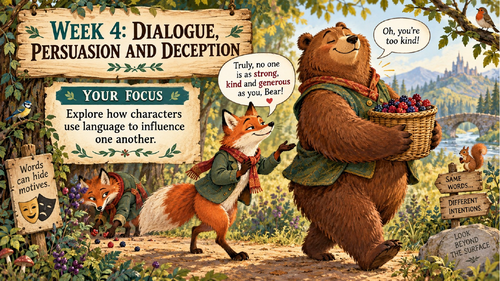
Week 4: Dialogue, Persuasion and Deception
Students analyse flattery, hidden motives and manipulation before writing dialogue that influences decisions and advances the plot.
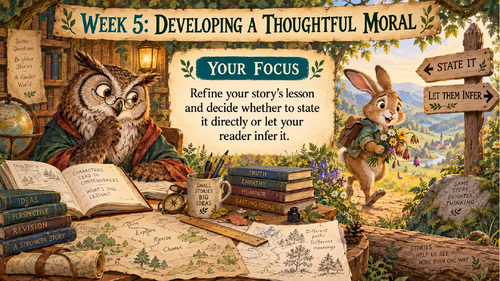
Week 5: Developing a Thoughtful Moral
Students distinguish between themes and morals, improve vague lessons and compare explicit and implied endings.
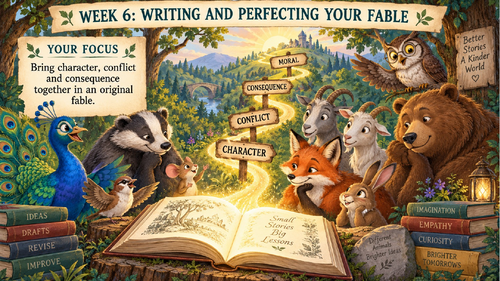
Week 6: Writing and Perfecting Your Fable
Students plan, write and edit an original fable before reflecting on their deliberate language and structural choices.
Skills developed
Infer character traits and hidden motives
Analyse how actions produce consequences
Distinguish between themes and morals
Support interpretations with textual evidence
Reveal personality through behaviour and dialogue
Use persuasion and deception purposefully
Construct a concise and coherent narrative
Create a moral supported by the story’s events
Punctuate dialogue accurately
Edit writing for clarity, precision and impact
Explain their creative decisions
Final assessment
The final lesson includes focused editing stations covering character, cause and effect, moral, structure, language and technical accuracy. A clear assessment grid supports teacher marking, peer assessment or student self-assessment.
Something went wrong, please try again later.
This resource hasn't been reviewed yet
To ensure quality for our reviews, only customers who have purchased this resource can review it
Report this resourceto let us know if it violates our terms and conditions.
Our customer service team will review your report and will be in touch.
£5.00