


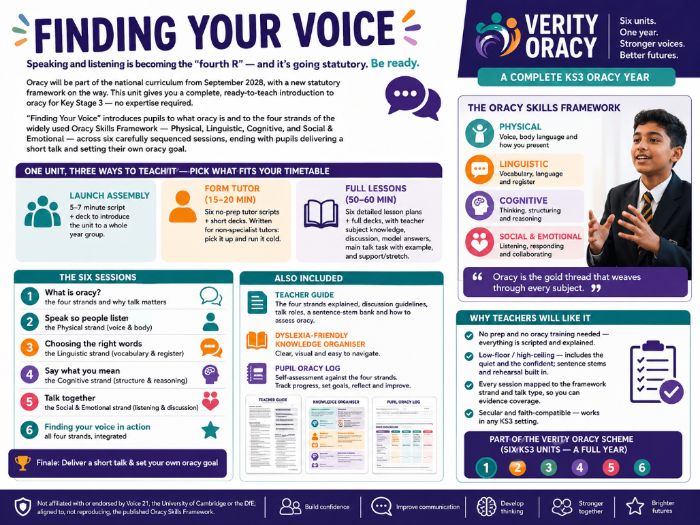

Speaking and listening is becoming the “fourth R” — and it’s going statutory. Be ready.
Oracy will be part of the national curriculum from September 2028, with a new statutory framework on the way. This unit gives you a complete, ready-to-teach introduction to oracy for Key Stage 3 — no expertise required.
“Finding Your Voice” introduces pupils to what oracy is and to the four strands of the widely used Oracy Skills Framework — Physical, Linguistic, Cognitive, and Social & Emotional — across six carefully sequenced sessions, ending with pupils delivering a short talk and setting their own oracy goal.
One unit, three ways to teach it — pick what fits your timetable:
Launch Assembly — a 5–7 minute script + deck to introduce the unit to a whole year group.
Form Tutor (15–20 min) — six no-prep tutor scripts + short decks. Written for non-specialist tutors: pick it up and run it cold.
Full Lessons (50–60 min) — six detailed lesson plans + full decks, with teacher subject knowledge, discussion questions with model answers, a main talk task with a worked example, and support/stretch.
Also included: a Teacher Guide (the four strands explained, discussion guidelines, talk roles, a sentence-stem bank and how to assess oracy), a dyslexia-friendly Knowledge Organiser, and a Pupil Oracy Log for self-assessment against the four strands.
The six sessions
What is oracy? — the four strands and why talk matters
Speak so people listen — the Physical strand (voice & body)
Choosing the right words — the Linguistic strand (vocabulary & register)
Say what you mean — the Cognitive strand (structure & reasoning)
Talk together — the Social & Emotional strand (listening & discussion)
Finding your voice in action — all four strands, integrated
Why teachers will like it
No prep and no oracy training needed — everything is scripted and explained.
Low-floor / high-ceiling — includes the quiet and the confident; sentence stems and rehearsal built in.
Every session mapped to the framework strand and talk type, so you can evidence coverage.
Secular and faith-compatible — works in any KS3 setting.
Aligned to the Oracy Skills Framework (Voice 21 & Oracy Cambridge, University of Cambridge; © Voice 21 and the University of Cambridge, 2018), an openly published framework. This resource draws on the Framework’s four strands but does not reproduce it. Not affiliated with, endorsed by or produced by Voice 21, the University of Cambridge or the DfE.
Something went wrong, please try again later.
This resource hasn't been reviewed yet
To ensure quality for our reviews, only customers who have purchased this resource can review it
Report this resourceto let us know if it violates our terms and conditions.
Our customer service team will review your report and will be in touch.
£6.00