


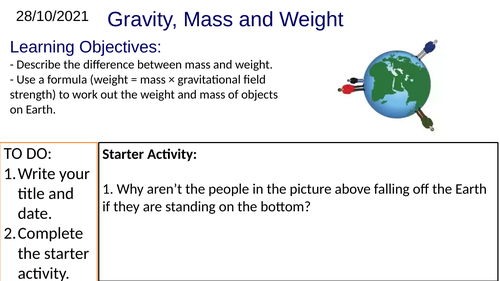
This PowerPoint resource introduces middle school students to the concepts of gravity, the distinction between mass and weight, and how gravitational forces vary across different celestial bodies. It combines theory with practical examples to enhance students’ understanding.
Key learning objectives:
- Differentiating between mass and weight, with mass being the amount of matter in an object (measured in kilograms) and weight being the force of gravity acting on that mass (measured in newtons).
- Understanding the relationship between weight, mass, and gravitational field strength, using the formula: Weight (N) = Mass(kg) x Gravitational Field Strength (N/kg)
- Exploring how gravitational field strength varies on different planets and affects weight.
Resource features:
The lesson begins with a starter activity prompting students to think about why gravity prevents people from falling off the Earth, no matter their position. Core topics are introduced with relatable explanations and visual aids:
What is Gravity?
Explains gravity as a force of attraction between objects with mass, emphasizing that it depends on both the mass of the objects and their distance apart.
Mass vs. Weight:
Mass is constant and measured in kilograms.
Weight changes with gravitational field strength and is measured in newtons.
Students complete guided fill-in-the-blank exercises to reinforce these definitions.
Gravitational Field Strength:
Demonstrates how gravitational field strength varies on planets like Earth (10 N/kg) and the Moon (1.6 N/kg). Students calculate their weight on different planets using the provided formula.
Practical Applications:
Activities include working out weights and masses of objects and comparing gravitational forces on Earth and the Moon.
Interactive tasks include:
- Watching videos on gravitational force and answering guided questions.
- Solving weight and mass calculations, including rearranging formulas for problem-solving.
- Reflecting on how gravity affects astronauts on the Moon compared to Earth.
The plenary activity reviews key concepts, ensuring students can differentiate between mass and weight and apply the weight formula accurately.
File details:
This editable ‘.pptx’ file aligns with middle school science curricula. It includes structured explanations, clear visuals, and interactive tasks, making it an essential resource for teaching gravity, mass, and weight.
Something went wrong, please try again later.
This resource hasn't been reviewed yet
To ensure quality for our reviews, only customers who have purchased this resource can review it
Report this resourceto let us know if it violates our terms and conditions.
Our customer service team will review your report and will be in touch.
£2.00