

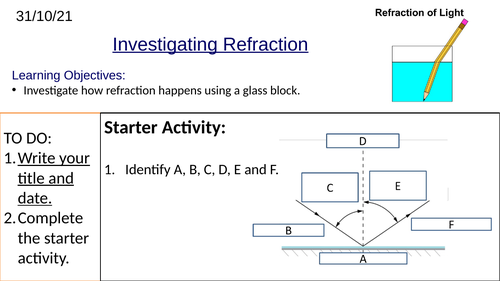

This PowerPoint lesson is designed for middle school students to explore the behavior of light as it passes through different materials. The lesson emphasizes practical investigation, helping students understand the principles of refraction and its dependence on material density.
Key learning objectives:
- Defining refraction as the change in light’s direction when it passes from one medium to another.
- Explaining how density affects the speed of light and the degree of refraction.
- Conducting an experiment using a glass block to observe and measure angles of incidence and refraction.
Resource features:
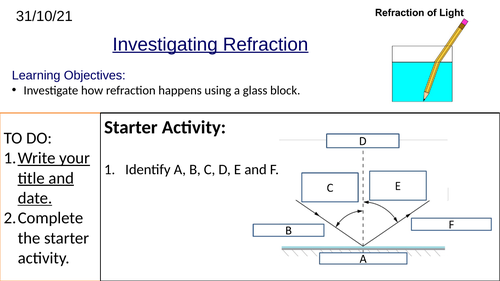
The lesson begins with a starter activity where students identify components of a basic light experiment, such as the plane mirror, incident ray, and normal line. Core concepts are introduced with engaging visuals and guided explanations:
What is Refraction?
Defines refraction and introduces the concept of boundaries between materials.
Uses a visual example of a “broken” pencil in water to explain how light bends at boundaries.
Density and Refraction:
Explains how the density of materials like air, water, and glass affects the speed of light.
Students compare densities and predict the behavior of light in various materials.
Practical Investigation:
Equipment Setup:
Includes a ray box, glass block, protractor, and other tools.
Procedure:
Students measure the angle of refraction for various angles of incidence.
Observations include whether the light ray bends toward or away from the normal when entering and leaving the glass block.
Digital Simulation Alternative:
Students who cannot access lab equipment can use the PhET simulation to explore refraction online.
Interactive tasks:
- Drawing and labeling refraction diagrams, including the normal line, incident ray, refracted ray, and boundary.
- Reflecting on questions such as:
- “What do you notice about the angles of incidence and refraction?”
- “Why is the refracted ray parallel to the incident ray after exiting the block?”
The plenary consolidates learning by reviewing key concepts and discussing real-world applications of refraction, such as lenses and optical instruments.
File details:
This editable ‘.pptx’ file aligns with middle school science curricula. It features structured explanations, hands-on activities, and digital alternatives, making it an essential resource for teaching refraction and light behavior.
Something went wrong, please try again later.
This resource hasn't been reviewed yet
To ensure quality for our reviews, only customers who have purchased this resource can review it
Report this resourceto let us know if it violates our terms and conditions.
Our customer service team will review your report and will be in touch.
£2.00