

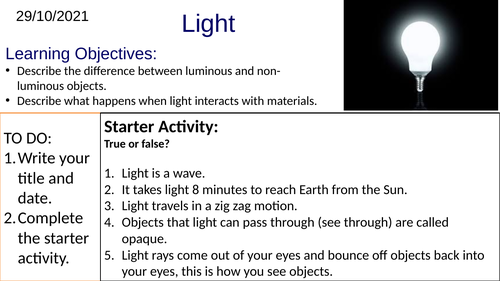

This PowerPoint resource provides an engaging and comprehensive introduction to the properties and behavior of light, tailored for middle school students. The lesson explores luminous and non-luminous objects, light interaction with materials, and key concepts like transparency, translucency, and opacity.
Key learning objectives:
- Distinguishing between luminous objects (light sources) and non-luminous objects (reflectors).
- Describing how light interacts with transparent, translucent, and opaque materials.
- Understanding how humans see objects through the processes of reflection, transmission, and absorption.
Resource features:
The lesson begins with a true/false starter activity to challenge misconceptions and reinforce prior knowledge. Core concepts are introduced with clear explanations and relatable examples:
Luminous and Non-Luminous Objects:
Defines luminous objects (e.g., the Sun, lightbulbs) and non-luminous objects (e.g., books, tables) and explains how we see non-luminous objects by the reflection of light into our eyes.
Light Interaction with Materials:
Transparent objects (e.g., glass): Transmit most light without scattering.
Translucent objects (e.g., frosted windows): Scatter some light, causing blurriness.
Opaque objects (e.g., walls): Absorb all light, preventing transmission.
Light Intensity and Measurement:
Discusses using a light meter to measure light intensity in lux and how different materials transmit or absorb light.
Interactive tasks:
- Drawing diagrams to show how light rays bounce off objects and enter the eye.
- Sorting objects (e.g., clear plastic, frosted glass, black paper) into categories of transparent, translucent, or opaque.
- Answering reflective questions such as:
- “How do we see objects?”
- “Which materials allow the most light to pass through, and why?”
The plenary consolidates learning through a fill-in-the-blank activity and a real-world scenario where students describe light interaction with a bird, a window, and the eye.
File details:
This editable ‘.pptx’ file aligns with middle school science curricula. It provides structured content, interactive tasks, and real-world examples, making it an essential resource for introducing the properties and behavior of light.
Something went wrong, please try again later.
This resource hasn't been reviewed yet
To ensure quality for our reviews, only customers who have purchased this resource can review it
Report this resourceto let us know if it violates our terms and conditions.
Our customer service team will review your report and will be in touch.
£2.00