pptx, 10.39 MB
pptx, 10.39 MB

This PowerPoint resource provides an engaging lesson for middle school students on how electricity is generated using fossil fuels. It emphasizes key processes, the environmental impact of fossil fuel usage, and the concept of renewable versus non-renewable resources.

Key learning objectives:

  • Understanding what fossil fuels are, their origin, and why they are considered non-renewable.
  • Describing how fossil fuels are used in power stations to generate electricity.
  • Exploring the advantages and disadvantages of using fossil fuels for energy production.
  • Recognizing the environmental impact of burning fossil fuels, including the production of greenhouse gases and acid rain.

Resource features:
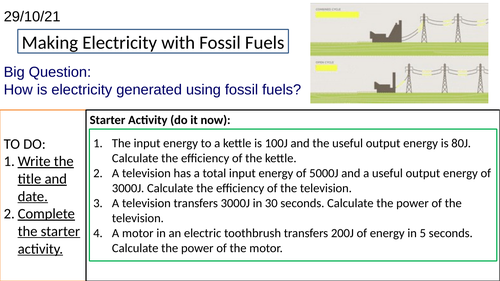
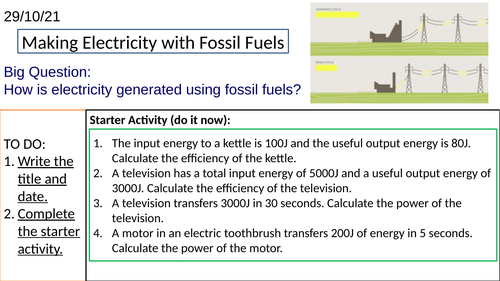
The lesson begins with a starter activity to activate prior knowledge, asking students to calculate the efficiency and power of devices using simple equations. Core concepts are introduced with clear explanations and relatable examples:

What are Fossil Fuels?
Explains that fossil fuels—coal, oil, and natural gas—are formed from the remains of plants and animals over millions of years under heat and pressure.
Combustion and Energy Transfer:
Discusses how the chemical potential energy stored in fossil fuels is released through combustion to generate heat energy, which is converted to electricity in power stations.
Environmental Impact:
Highlights the production of carbon dioxide and sulfur dioxide during combustion, their role in global warming, and the formation of acid rain.
Finite Resources:
Explains the difference between finite and renewable resources, emphasizing that fossil fuels are non-renewable and being depleted rapidly.

Interactive tasks include:

  • Labeling a power station diagram to understand the process of electricity generation.
  • Sorting statements into advantages and disadvantages of fossil fuels (e.g., “release lots of energy” vs. “cause acid rain”).
  • Reflecting on the environmental and societal effects of continued fossil fuel use.

The plenary activity reinforces learning by reviewing the key processes and asking students to consider alternative energy sources.

File details:
This editable ‘.pptx’ file aligns with middle school science curricula. It features clear visuals, structured content, and engaging activities, making it an essential resource for teaching energy production and environmental awareness.

Get this resource as part of a bundle and save up to 64%

A bundle is a package of resources grouped together to teach a particular topic, or a series of lessons, in one place.

Bundle

KS3 Physics Energy Bundle: 7-Lesson Unit

This comprehensive Energy Bundle features seven engaging PowerPoint lessons designed for middle school science students. It introduces key concepts in energy and electricity through interactive activities, real-world applications, and hands-on experiments. Key topics covered: 1. Energy in Food: Learn how food provides energy for daily activities, calculate energy content using food labels, and understand dietary energy needs. 2. Energy in Food Practical: Conduct an experiment to measure energy released from burning different foods, record data, and analyze results through bar graphs. 3. Energy Stores, Transfers, and Conservation of Energy: Explore energy stores (e.g., kinetic, thermal) and transfers, and apply the principle of energy conservation to real-world scenarios. 4. Energy Dissipation and Efficiency: Investigate how energy is wasted (dissipated) during transfers and calculate the efficiency of devices using input and output energies. 5. Power and the Cost of Electricity: Understand power as the rate of energy transfer, practice power calculations, and evaluate the cost of using household appliances based on their power ratings. 6. Making Electricity with Fossil Fuels: Learn how fossil fuels generate electricity, the environmental impacts of combustion, and the concept of renewable vs. non-renewable resources. 7. Energy Resources: Evaluate renewable and non-renewable energy sources, including their advantages, disadvantages, and environmental effects, with engaging activities and real-world applications. Features and benefits: Aligned with middle school curricula: Covers essential energy and electricity topics in an accessible way. Interactive learning: Includes thought-provoking starter activities, practical investigations, and problem-solving tasks. Real-world relevance: Connects theoretical knowledge to everyday applications like calculating electricity costs and exploring energy sustainability. Engaging visuals and structured content: Each PowerPoint is easy to follow, featuring diagrams, charts, and clear explanations. Practical components: Conduct an energy-in-food experiment using accessible lab equipment. Solve energy efficiency and power cost problems. Engage in discussions on sustainable energy solutions. This bundle is an ideal resource for teachers aiming to provide a well-rounded and hands-on introduction to energy and electricity concepts. Updated in January 2025, it ensures students grasp the importance of energy conservation and its role in shaping a sustainable future.

£5.00

Reviews

Something went wrong, please try again later.

This resource hasn't been reviewed yet

To ensure quality for our reviews, only customers who have purchased this resource can review it

Report this resourceto let us know if it violates our terms and conditions.
Our customer service team will review your report and will be in touch.