

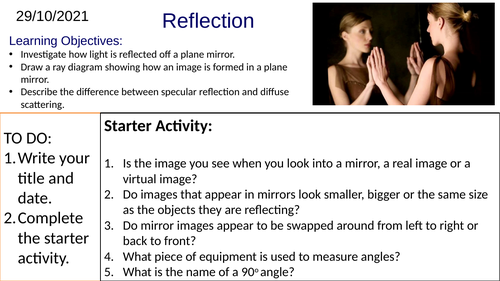

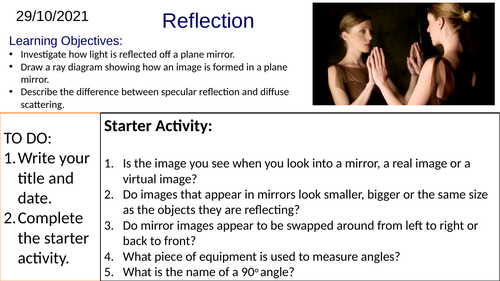
This PowerPoint lesson introduces middle school students to the concept of light reflection, including how light behaves when it encounters different surfaces. It combines theoretical explanations with hands-on activities to enhance students’ understanding of reflection and its practical applications.
Key learning objectives:
- Investigating how light reflects off a plane mirror and understanding the concept of virtual images.
- Drawing ray diagrams to illustrate the reflection of light and labeling components such as incident ray, reflected ray, and normal line.
- Distinguishing between specular reflection and diffuse scattering, and understanding their causes and differences.
Resource features:
The lesson begins with a starter activity prompting students to consider questions such as:
Is a mirror image real or virtual?
Do mirror images appear smaller, larger, or the same size as the object they reflect?
Why do mirror images appear reversed?
Core topics include:
Law of Reflection:
States that the angle of incidence equals the angle of reflection.
Includes tasks where students draw ray diagrams and measure angles using a protractor.
Specular vs. Diffuse Reflection:
Explains that smooth surfaces (e.g., mirrors) produce clear reflections due to specular reflection, while rough surfaces (e.g., snow) scatter light in all directions, causing diffuse reflection.
Includes questions to compare and contrast these two types of reflection.
Interactive tasks:
Practical Investigation:
Students use a ray box and a plane mirror to observe light reflection and measure angles of incidence and reflection.
Reflect on why light reflects differently on smooth versus rough surfaces.
Gap-Fill Exercises:
Fill in key terms such as “incident ray,” “reflected ray,” and “normal line” to reinforce understanding.
Review Questions:
Analyze ray diagrams to identify reflection types and apply the law of reflection to explain observed phenomena.
The plenary consolidates learning by summarizing the differences between specular and diffuse reflection and discussing why some materials are better for creating clear reflections.
File details:
This editable ‘.pptx’ file aligns with middle school science curricula. It includes structured explanations, visual aids, and practical activities, making it an essential resource for teaching reflection and the behavior of light.
Something went wrong, please try again later.
This resource hasn't been reviewed yet
To ensure quality for our reviews, only customers who have purchased this resource can review it
Report this resourceto let us know if it violates our terms and conditions.
Our customer service team will review your report and will be in touch.
£2.00