

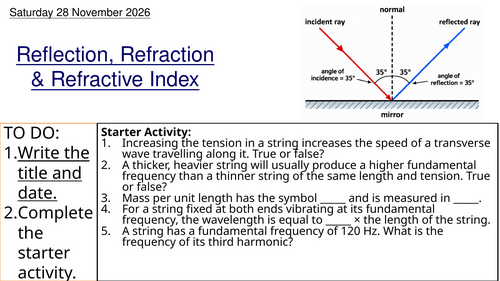

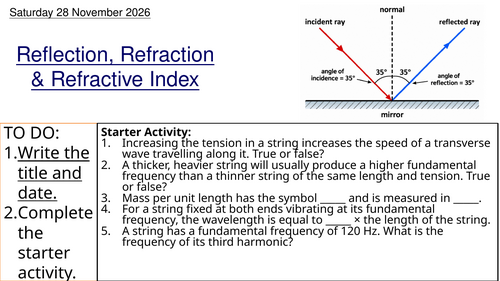
This PowerPoint lesson covers Reflection, Refraction and Refractive Index for Pearson BTEC Applied Science Unit 1 Physics – C2: Waves in Communication. It develops students’ understanding of light travelling between different media, providing essential knowledge for the subsequent study of total internal reflection and fibre optics.
Reflection occurs when a wave reaches a boundary and is directed back into its original medium, while refraction involves a change in wave speed and potentially direction as a wave passes between different media. The lesson introduces the law of reflection, incident and reflected rays, the normal, and the differences between specular and diffuse reflection. Students learn how to construct and interpret accurately labelled ray diagrams.
The resource explores why refraction occurs using wavefront explanations, optical density and changes in the speed of light. Students learn to predict whether light bends towards or away from the normal and explain why light entering a material along the normal does not change direction.
The lesson develops students’ mathematical skills through refractive index calculations, using the equations n = c/v and n = sin i/sin r. Step-by-step worked examples demonstrate how to calculate refractive index, determine the speed of light within a material, calculate unknown angles using inverse sine and combine both equations to solve multistep problems.
This editable 44-slide PowerPoint (.pptx) includes learning objectives, key terminology, a retrieval starter, illustrated explanations, ray diagrams, worked calculations, fill-in-the-gap activities, graph interpretation questions, past paper questions with accompanying mark schemes and 12 end-of-lesson check-your-understanding questions with answers.
Updated in November 2026, this resource is suitable for classroom teaching, revision, cover lessons and independent study within Pearson BTEC Applied Science Unit 1 Physics – C2: Waves in Communication.
Get this resource as part of a bundle and save up to 34%
A bundle is a package of resources grouped together to teach a particular topic, or a series of lessons, in one place.
Bundle
Unit 1 Waves in Communication Bundle Physics Pearson BTEC Applied Science
This Pearson BTEC Applied Science Unit 1 Physics bundle contains 19 editable PowerPoint lessons covering Section C: Waves in Communication (C1, C2 and C3). It provides a comprehensive teaching sequence, progressing from fundamental wave properties to modern communication technologies, with opportunities to develop theoretical, mathematical and practical skills. A wave is an oscillation or disturbance that transfers energy without a net transfer of matter. The bundle explores how waves behave, interact and transmit information, linking scientific principles to everyday and technological applications. C1: Working with Waves (13 lessons) covers wave characteristics, period, frequency, wave graphs, the wave equation, transverse and longitudinal waves, sound, ultrasound and echolocation. Further lessons explore displacement, phase difference, superposition, interference, path difference, coherence, diffraction and diffraction gratings. Students also investigate emission spectra, identification of elements, stationary waves, resonance, musical instruments and waves on strings. C2: Waves in Communication (3 lessons) covers reflection, refraction, refractive index, critical angle, total internal reflection and optical fibres. Students explore analogue and digital signals, signal attenuation, noise, sampling, quantisation, binary encoding, broadband communication and wavelength division multiplexing. C3: Use of Electromagnetic Waves in Communication (3 lessons) covers the electromagnetic spectrum, frequency and wavelength calculations, satellite communication, mobile phone networks, Bluetooth, Wi-Fi and infrared. Students also investigate the inverse square law, wave intensity and signal strength through worked calculations and practical applications. This bundle contains 19 editable PowerPoint (.pptx) presentations. Resources feature structured teaching content, scientific diagrams, worked calculations, student activities, comparison exercises, practice questions and accompanying answers, with practical investigations and examination-style questions included where appropriate. Updated in November 2026, this bundle is suitable for classroom teaching, practical investigations, examination preparation, revision, cover lessons and independent study. It is designed to support the complete Section C teaching content of Pearson BTEC Level 3 National Applied Science – Unit 1: Principles and Applications of Science I.
£24.99
Bundle
C2 Waves in Communication Bundle Unit 1 Physics Pearson BTEC
This Pearson BTEC Applied Science Unit 1 Physics – C2: Waves in Communication bundle contains three editable PowerPoint lessons covering refraction, optical fibres and digital communication. The resources provide a structured teaching sequence, progressing from the fundamental behaviour of light to modern communication technologies. Wave communication involves transferring information between a transmitter and receiver using waves. The first lesson, Reflection, Refraction and Refractive Index, introduces the law of reflection, specular and diffuse reflection, optical density and wavefront explanations of refraction. Students develop mathematical skills through refractive index calculations, equation rearrangement and accurately labelled ray diagrams. The second lesson, Critical Angle, Total Internal Reflection and Optical Fibres, explores the conditions required for total internal reflection, critical angle calculations and the structure and function of optical fibres. Students investigate the role of the core and cladding, signal attenuation and the advantages of fibre optic communication over copper cables. Applications include medical endoscopes, optical fingerprint scanners and automatic windscreen wipers. A practical demonstration using a semicircular Perspex block is also included. The third lesson, Analogue, Digital and Broadband Communication, covers analogue and digital signals, noise, interference, signal regeneration and analogue-to-digital conversion. Students explore sampling rates, quantisation, binary encoding, bandwidth, frequency bands and wavelength division multiplexing (WDM), alongside comparisons between single-mode and multimode optical fibres. This bundle contains three editable PowerPoint (.pptx) presentations, totalling 163 slides. Resources include learning objectives, key terminology, retrieval starters, illustrated explanations, worked calculations, comparison tables, sorting activities, diagram-drawing tasks, scaffolded questions, practice exercises and accompanying answer slides. Examination-style questions support assessment and examination preparation. Updated in November 2026, this bundle is suitable for classroom teaching, practical demonstrations, revision, cover lessons and independent study within Pearson BTEC Level 3 National Applied Science – Unit 1 Physics, C2: Waves in Communication.
£3.99
Something went wrong, please try again later.
This resource hasn't been reviewed yet
To ensure quality for our reviews, only customers who have purchased this resource can review it
Report this resourceto let us know if it violates our terms and conditions.
Our customer service team will review your report and will be in touch.
£2.00