Lesson 28
Subject: Physics
Age range: 14-16
Resource type: Lesson (complete)




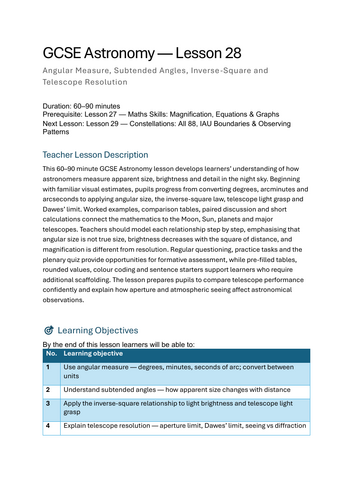
This 60–90 minute GCSE Astronomy lesson develops learners’ understanding of how astronomers measure apparent size, brightness and detail in the night sky. Beginning with familiar visual estimates, pupils progress from converting degrees, arcminutes and arcseconds to applying angular size, the inverse square law, telescope light grasp and Dawes’ limit. Worked examples, comparison tables, paired discussion and short calculations connect the mathematics to the Moon, Sun, planets and major telescopes. Teachers should model each relationship step by step, emphasising that angular size is not true size, brightness decreases with the square of distance, and magnification is different from resolution. Regular questioning, practice tasks and the plenary quiz provide opportunities for formative assessment, while pre-filled tables, rounded values, colour coding and sentence starters support learners who require additional scaffolding. The lesson prepares pupils to compare telescope performance confidently and explain how aperture and atmospheric seeing affect astronomical observations.
A bundle is a package of resources grouped together to teach a particular topic, or a series of lessons, in one place.
Something went wrong, please try again later.
This resource hasn't been reviewed yet
To ensure quality for our reviews, only customers who have purchased this resource can review it
Report this resourceto let us know if it violates our terms and conditions.
Our customer service team will review your report and will be in touch.