Lesson 4
Subject: Physics
Age range: 14-16
Resource type: Lesson (complete)




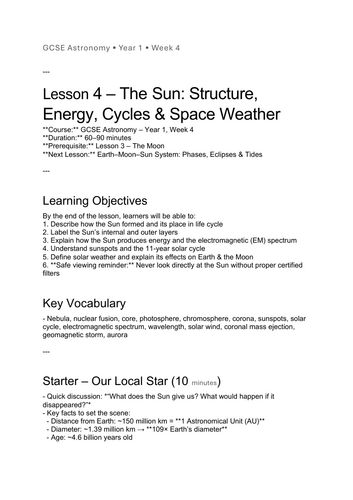
This lesson introduces the Sun as Earth’s local star and develops learners’ understanding from its formation and internal structure through to the solar cycle and the effects of space weather. It is designed as a coherent 60–90 minute sequence in which pupils move from familiar ideas about sunlight and heat to more abstract concepts such as nuclear fusion, energy transfer, magnetic activity and electromagnetic radiation. The lesson should be taught with a strong emphasis on scientific modelling: diagrams, comparisons and carefully chosen analogies help learners visualise processes that cannot be observed directly.
Begin by eliciting prior knowledge through the starter questions about what the Sun provides and what would happen if it disappeared. Use responses to distinguish immediate effects, such as darkness, from longer-term effects on temperature, photosynthesis and life. Establish the scale of the Sun and its distance from Earth, but avoid allowing the numerical facts to dominate the discussion. State the solar-viewing safety rule explicitly at the outset: learners must never look directly at the Sun, and any observation must use approved solar-viewing equipment or an indirect projection method.
During the formation section, narrate the sequence as a cause-and-effect chain: gravity pulls material together, compression raises temperature and density, and fusion begins when conditions in the centre become sufficiently extreme. Reinforce that the Sun is not burning like a fire. When teaching structure, build the labelled diagram from the core outward and repeatedly connect each layer to its function. Learners should be able to explain not only the order of the layers but also how energy moves through them: radiation dominates in the radiative zone, convection carries energy through the convection zone, and radiation finally escapes from the photosphere.
A bundle is a package of resources grouped together to teach a particular topic, or a series of lessons, in one place.
Something went wrong, please try again later.
This resource hasn't been reviewed yet
To ensure quality for our reviews, only customers who have purchased this resource can review it
Report this resourceto let us know if it violates our terms and conditions.
Our customer service team will review your report and will be in touch.