


The Lovely Bones: Chapter 4 (AQA KS5)
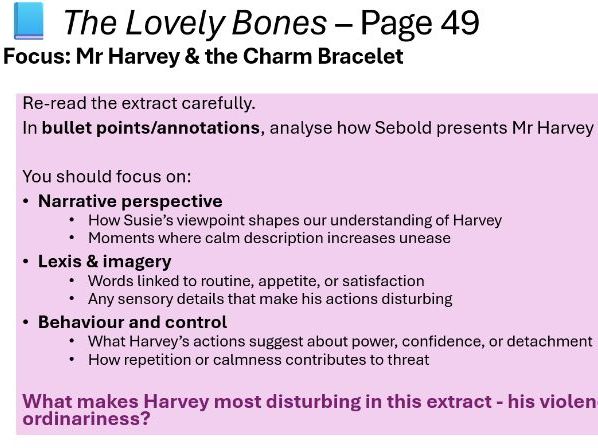
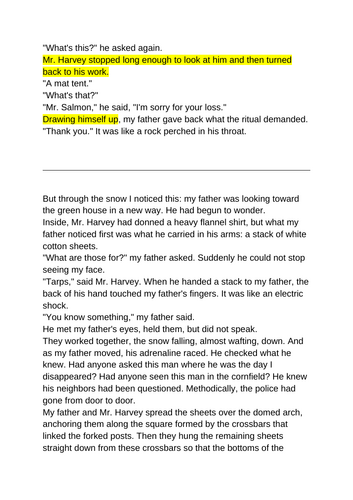
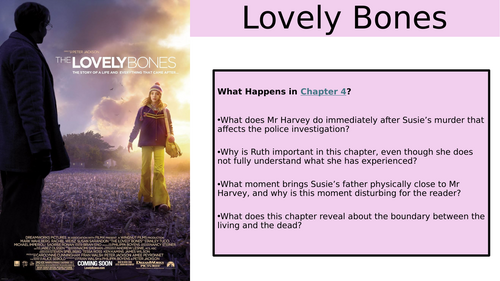
This lesson is designed for AQA A Level English Literature and Language and focuses on Chapter 4 of The Lovely Bones. The lesson builds on prior reading and requires students to have read the chapter in advance. Its focus is on Harvey, the bracelet, and how meaning is constructed through detail, perspective, and symbolism.
The lesson is student-led and task-driven. Students begin by recapping Chapter 4 through a short summary task, consolidating understanding of events and narrative focus before analysis. This ensures students are working from a secure knowledge base rather than re-reading large sections of the text in lesson time.
Students then focus on Harvey as a figure within the chapter, exploring how Sebold presents him through narrative perspective and selective detail. Alongside this, students examine the bracelet and track its significance, considering how it functions symbolically and structurally within the chapter. Discussion of the bracelet’s importance is completed collaboratively after students have worked independently, allowing ideas to be tested and refined.
A substantial proportion of the lesson is dedicated to independent annotation. Students annotate the chapter with a focus on language, structure, and representation, linking their observations directly to meaning rather than technique identification. Short exemplar annotations are provided to support accuracy and depth, but these are not intended to replace student thinking.
The resource also includes an optional annotated document, produced through live modelling with a class. This can be used at the teacher’s discretion to demonstrate effective annotation or to support students who require additional guidance, but it is not essential to the lesson’s core tasks.
This resource is suitable for Year 12 or Year 13 students studying The Lovely Bones for AQA English Literature and Language. It is not a content-heavy PowerPoint and is designed to prioritise independent analysis, discussion, and exam-relevant annotation skills.
Something went wrong, please try again later.
This resource hasn't been reviewed yet
To ensure quality for our reviews, only customers who have purchased this resource can review it
Report this resourceto let us know if it violates our terms and conditions.
Our customer service team will review your report and will be in touch.
£2.50