


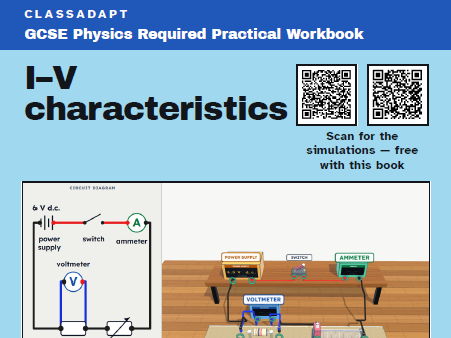
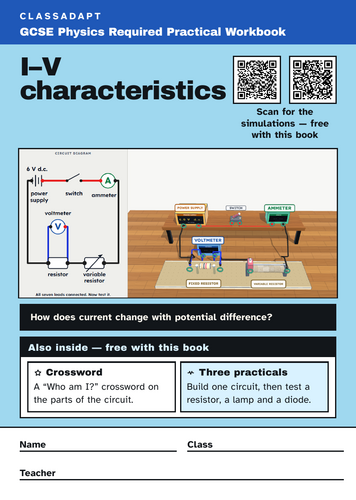
A 24-page printable workbook that takes pupils through the GCSE Physics I–V characteristics required practical one small step at a time. Pupils build one circuit and use it to test three components: a fixed resistor, a filament lamp and a diode. It’s built for pupils who need more structure, with short sentences, a 7-step tick-box method, tables to fill in, word banks and sentence starters throughout.
Includes free lifetime access to two ClassAdapt simulations:
-
ClassAdapt Simulation of I–V Characteristics: the full practical on screen.
-
ClassAdapt Simulation of Parallel Circuit: pupils explore how current and potential difference behave in parallel branches.
What’s inside
Hook (p3): Why does a 15 W LED bulb give more light than a 60 W filament bulb? Pupils come back to the answer once they’ve seen the lamp’s graph bend.
How to use the simulation (p4): A one-page guide to the Adapt settings.
Seven steps (p5): One method that works for all three components, with a key fact on why pupils should read quickly and then open the switch.
Plan the circuit (p6): Pupils trace all seven leads and record what each one joins.
Series or parallel? (p7): A tick-box activity on where the ammeter and voltmeter go, and why.
Results and graphs for each component (pp8–13): Forward and reversed readings, R = V ÷ I for every row, and pre-scaled axes on which pupils plot I against V across all four quadrants.
What do the numbers say? (p14): Pupils use their own results to show that only the resistor has a single fixed resistance.
Read the graph like a physicist (p15): Pupils match each graph shape to its component and its reason, including gradient = 1 ÷ R.
"Who am I?" crossword (pp16–17): Clues on the parts of the circuit, with a word bank for pupils who get stuck.
The variables (p18): Independent, dependent and control variables, plus explanations of why the switch stays open between readings and why the resistor’s temperature has to stay constant.
Conclusion (p19): A supported write-up for each component, using sentence starters and choose-the-word options.
Seven exam-style questions (pp20–21): 18 marks in total, covering method, graph sketching, calculations and explanations.
The answer (p22): Explains the LED bulb’s efficiency and why the filament’s resistance rises as it heats up, linked back to the hook.
Full answer key (p23): Covers every activity, the crossword and the exam questions.
Ideal for: SEND and lower-attaining pupils, catch-up and intervention groups, home learning, cover lessons and revision. It also works for classes that can’t run the real practical safely or don’t have the kit.
Written by a qualified physics teacher, with input from a current GCSE examiner.
Something went wrong, please try again later.
This resource hasn't been reviewed yet
To ensure quality for our reviews, only customers who have purchased this resource can review it
Report this resourceto let us know if it violates our terms and conditions.
Our customer service team will review your report and will be in touch.
£5.00