


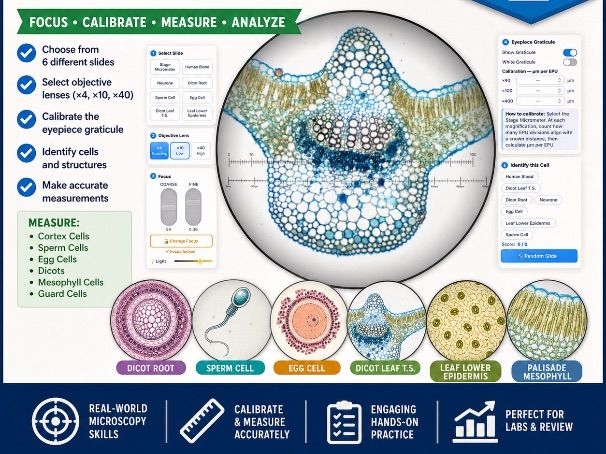
Give your students hands-on microscopy skills without the lab. This resource pairs a free interactive light microscope simulator with a structured worksheet that walks students through calibration, measurement, and data analysis — exactly the skills they need for practical exams.
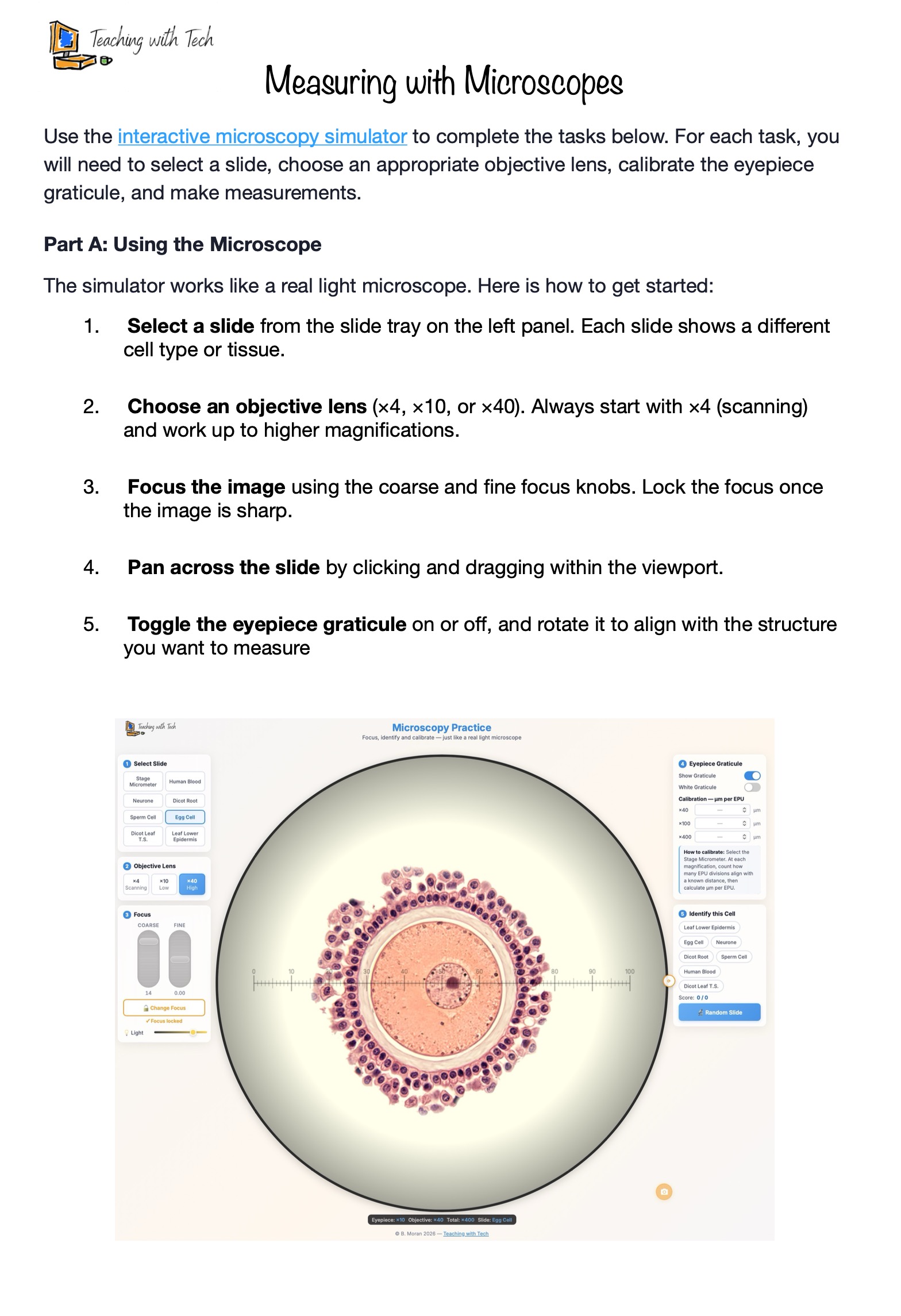
Students use the simulator to select slides, adjust objective lenses, focus, pan across specimens, and measure cells using an eyepiece graticule — just like a real microscope. The worksheet guides them through every step.
What’s Included
Digital Worksheet
Four structured sections covering how to use the microscope, calibrating the eyepiece graticule with a stage micrometer, seven measurement tasks across different cell types, and a stomatal density investigation with extended-response questions. Space is provided for students to paste screenshots of their measurements directly into the document.
Suggested Answers
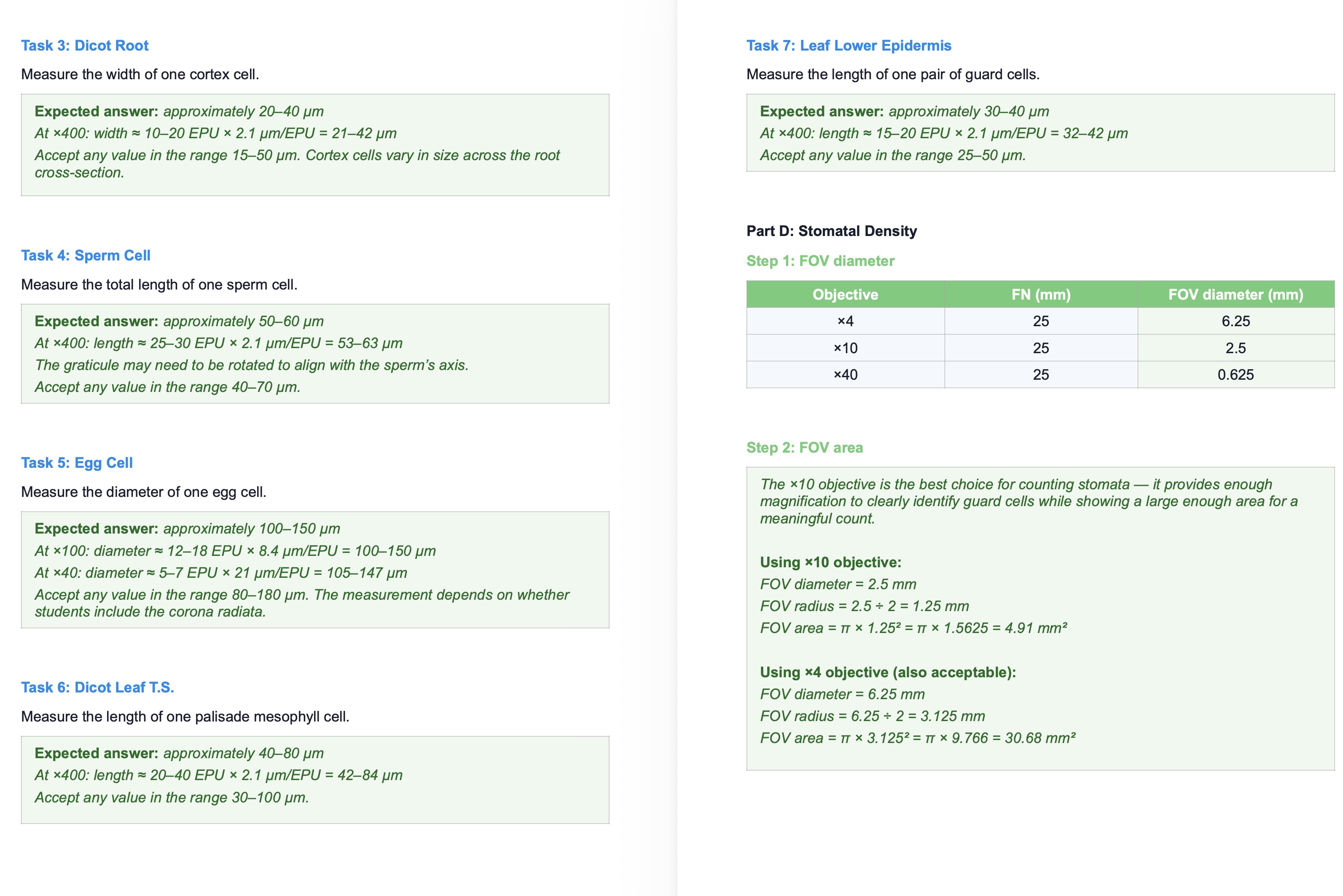
Completed calibration tables, worked calculations for every task, acceptable measurement ranges, model answers for all written questions, and mark allocation guidance for each extended-response question.
The Seven Measurement Tasks
• Human blood — erythrocyte diameter
• Neurone — soma diameter
• Dicot root — cortex cell width
• Sperm cell — total length
• Egg cell — oocyte diameter
• Dicot leaf transverse section — palisade cell length
• Leaf lower epidermis — guard cell pair length
Each task includes a measurement line (EPU × µm/EPU = µm), a hint with the recommended magnification, and a circular space for pasting a screenshot.
Stomatal Density Investigation
The final section teaches students to:
• Calculate field of view diameter from the eyepiece field number and objective magnification
• Calculate the circular field of view area using πr²
• Count stomata across multiple fields of view and calculate a mean
• Calculate stomatal density in stomata per mm²
Four extended-response questions then explore why stomata are on the lower leaf surface, how stomatal density differs in xerophytes and hydrophytes, and how to improve the reliability of the investigation.
Curriculum Alignment
Designed for: GCSE, IGCSE, IBDP, A-Level, and AP Biology
Topics covered:
✓ Microscopy skills and light microscope use
✓ Eyepiece graticule calibration and stage micrometer use
✓ Magnification calculations
✓ Animal and plant cell structure and identification
✓ Stomatal density and leaf epidermis structure
✓ Xerophyte, mesophyte, and hydrophyte adaptations
✓ Practical investigation design and reliability
Something went wrong, please try again later.
This resource hasn't been reviewed yet
To ensure quality for our reviews, only customers who have purchased this resource can review it
Report this resourceto let us know if it violates our terms and conditions.
Our customer service team will review your report and will be in touch.
£5.00