


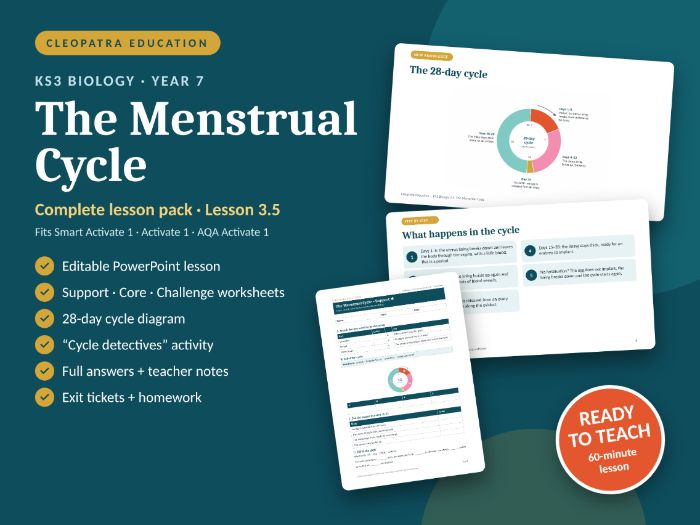
Complete KS3 lesson on the menstrual cycle – periods, ovulation and the uterus lining: editable PowerPoint, 3-level worksheets, activity and answers.
Perfect for Year 7 Biology. Students learn the stages of the 28-day menstrual cycle, describe what happens to the uterus lining and ovaries, explain the link to pregnancy, and use a calendar to predict ovulation and periods. Factual, sensitive and age-appropriate, without details of hormones as required by the KS3 curriculum. Written for the Oxford Smart Activate 1, Activate 1 and AQA Activate 1 courses (Reproduction, lesson 3.5 The menstrual cycle), and suitable for any KS3 scheme of work.
WHAT’S INCLUDED (6 editable files + PDF copies)
- Lesson PowerPoint – 20 slides
- Do Now retrieval starter
- Know / Explain / Apply learning objectives
- Key words with definitions
- Hook: “Getting ready every month”
- Original 28-day cycle diagram
- Step-by-step stages of the cycle
- Periods: the facts (including menopause)
- Myth or fact? slide tackling common misconceptions
- “True or false?” we-do task
- 2 hinge questions with explanations for every wrong answer
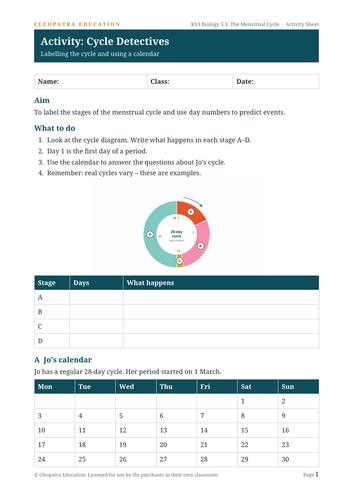
- “Cycle detectives” calendar activity
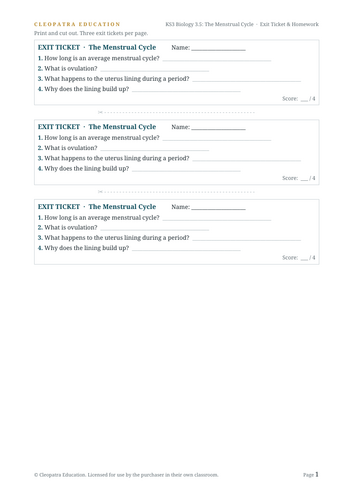
- Exit ticket and summary
- Hidden answer slides (they do not show in slideshow mode)
- Teacher notes on every slide
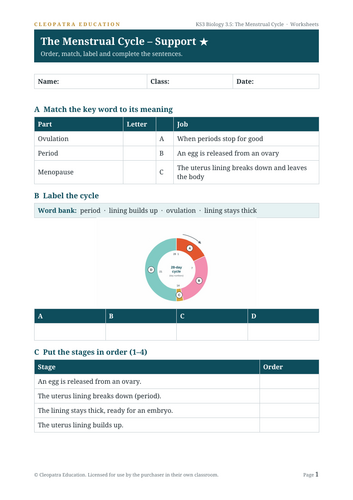
- Differentiated worksheets – Support ★, Core ★★ and Challenge ★★★
- Match key words, label and order the cycle
- Gap fill
- Describe and explain the uterus lining and pregnancy
- Calculate ovulation days and mean cycle length
- Stretch (GCSE preview): how hormones could control the cycle
- Activity sheet
- Label stages A–D of the cycle
- Calendar task: predict ovulation and the next period
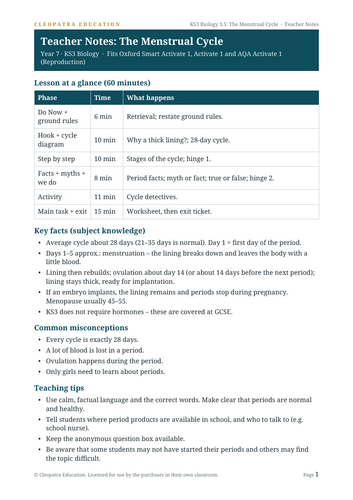
- One-page teacher notes – ideal for non-specialists
- Lesson timings (60 minutes)
- Key subject facts
- Common misconceptions
- Teaching tips
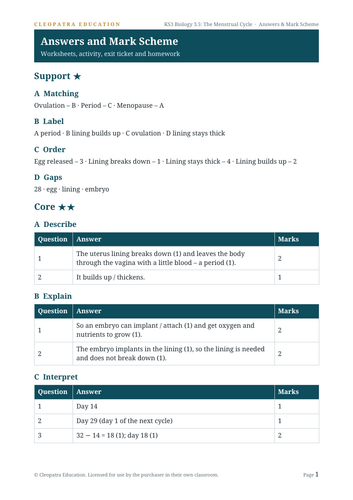
- Full answers and mark scheme
- Every worksheet level, the activity, the exit ticket and the homework, with marks
- Exit tickets (3 per page) + homework
- Homework reading “Period Products and Period Poverty” with questions
CURRICULUM LINKS
- KS3 National Curriculum (Biology – Reproduction): reproduction in humans (as an example of a mammal), including the structure and function of the male and female reproductive systems, menstrual cycle (without details of hormones), gametes, fertilisation, gestation and birth.
- Working scientifically: interpret diagrams; carry out simple calculations; use scientific vocabulary accurately.
FILE FORMATS
PowerPoint (.pptx) and Word (.docx) – fully editable. PDF copies included.
Previous lesson: 3.4 Development of a Fetus. Next lesson: 3.6 Flowers and Pollination.
If you find this resource useful, please leave a review – it really helps! Visit the Cleopatra Education shop for more KS3 Biology lessons.
This resource is independently created and is not affiliated with or endorsed by Oxford University Press or AQA.
Something went wrong, please try again later.
This resource hasn't been reviewed yet
To ensure quality for our reviews, only customers who have purchased this resource can review it
Report this resourceto let us know if it violates our terms and conditions.
Our customer service team will review your report and will be in touch.
£3.00