


This booklet takes the abstract idea of metallic bonding — something students often struggle to connect to real-world properties — and builds understanding from the ground up, starting with vocabulary and working through to structured exam answers. It’s heavily scaffolded with word banks, sentence starters, and labelling tasks, making it particularly well-suited for EAL learners or students who find extended writing in science daunting.
Topics covered:
- Key vocabulary — metal, delocalised, electron, lattice, ion, malleable, ductile, conduct, alloy
- Typical properties of metals — solid at room temperature, high melting point, conductors of heat and electricity, malleable, ductile, strong
- Structure of metals — regular lattice of positive ions, sea of delocalised electrons, metallic bonding
- Explaining properties using structure — why metals are malleable (layers slide), why they conduct (free electrons carry charge), why they have high melting points (strong electrostatic attraction)
- Alloys — what they are, why different-sized atoms disrupt the lattice and make the material harder
Key features:
- Vocabulary-first approach — definitions given upfront in individual flashcard-style boxes, followed by a matching exercise that tests recall before any content begins
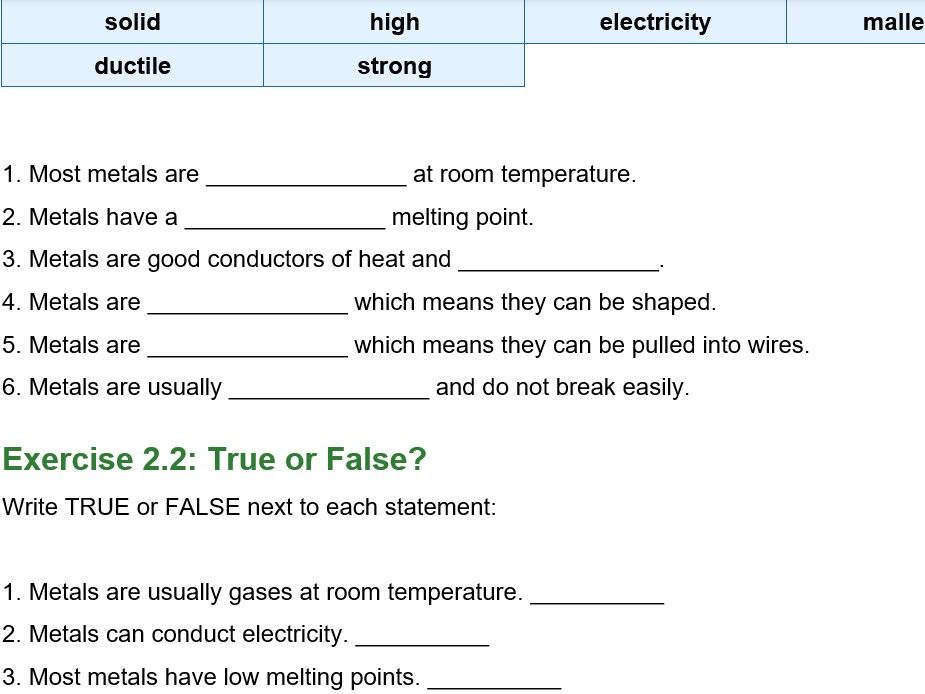
- Word banks for every gap-fill exercise, reducing cognitive load while still requiring students to make decisions about which word fits where
- True or false section that targets common misconceptions (e.g. metals having low melting points, metals being gases)
- Diagram labelling task for metallic structure — students identify positive ions, delocalised electrons, and the lattice arrangement themselves
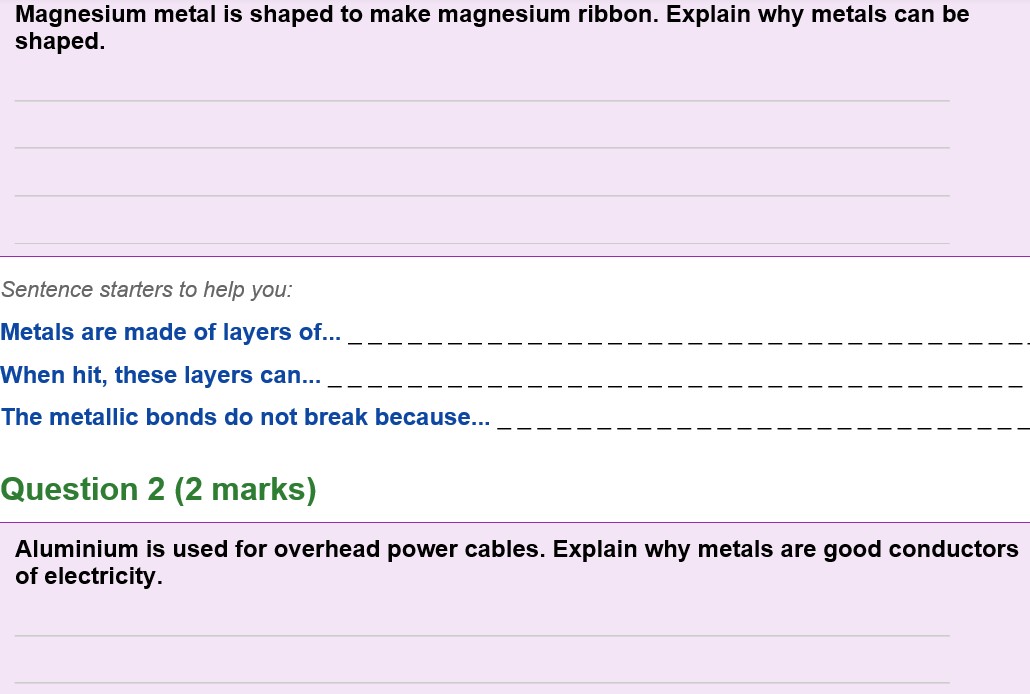
- Sentence starters provided for every extended-answer question — models how to begin an explanation without giving the answer away
- Colour-coded tip boxes guiding students on how to approach each task
- Summary table at the end linking each property to its structural explanation — a revision-ready reference
- Self-assessment checklist with three confidence levels (Yes / Nearly / Not yet) tied to specific skills rather than vague statements
- Quick quiz in the summary section for low-stakes retrieval practice
Something went wrong, please try again later.
This resource hasn't been reviewed yet
To ensure quality for our reviews, only customers who have downloaded this resource can review it
Report this resourceto let us know if it violates our terms and conditions.
Our customer service team will review your report and will be in touch.
£0.00