


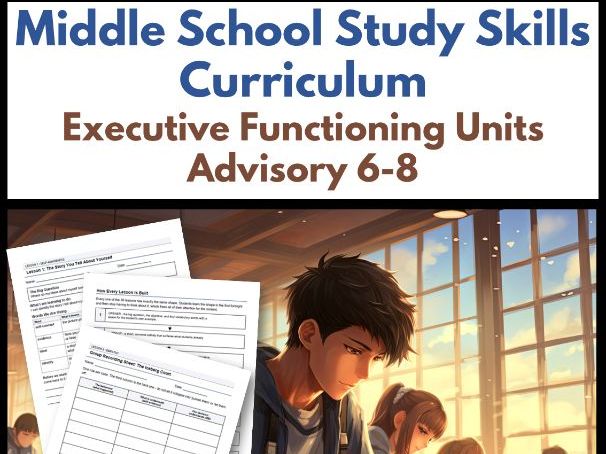
Middle School Study Skills Curriculum for Grades 6–8 is a 10-unit program designed to explicitly teach the systems, strategies, and habits students need to manage multiple classes, deadlines, digital responsibilities, and increasingly independent academic work. Rather than telling students to simply try harder, the curriculum treats organization, studying, attention, and procrastination as skills that can be taught, practiced, and improved.
The resource includes a Facilitator Guide, flexible Scope and Sequence, Student Self-Inventory, 10 complete study skills units, printable tools and trackers, a 30-prompt reflection journal, Family Guide, and assessment and progress-monitoring materials. Topics include organization systems, time management and backward planning, attention and focus, active reading, Cornell note-taking and revision, retrieval practice, spaced practice, interleaving, elaboration, test preparation, error analysis, self-advocacy, and asking for help. Students also learn subject-specific strategies for math, science, humanities, and world languages.
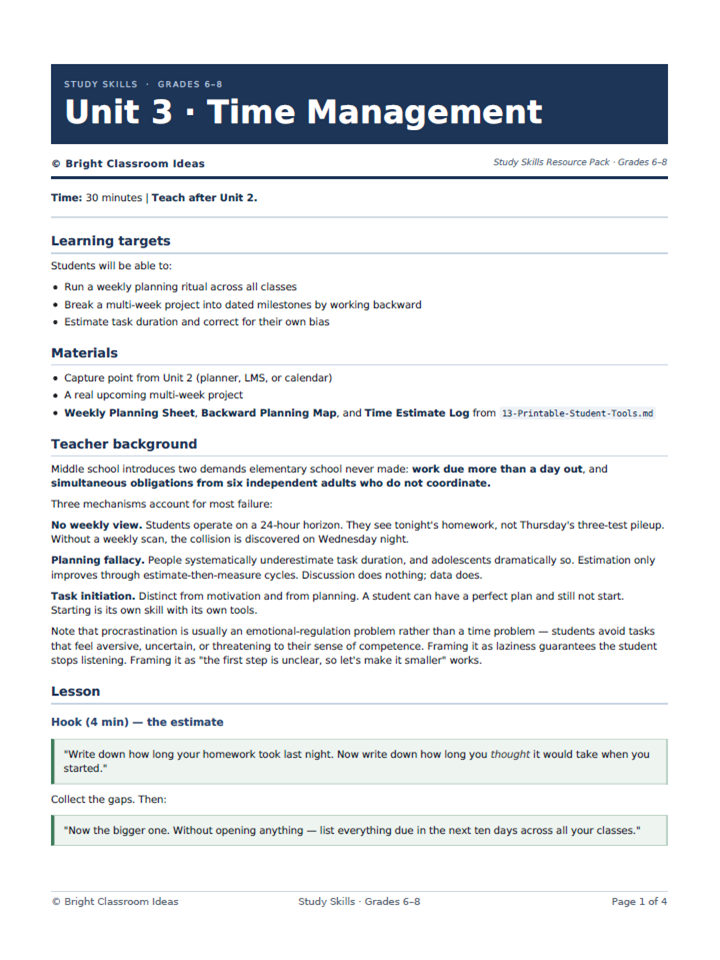
Every lesson follows a consistent 30-minute structure: Hook, Model, Guided Practice, Transfer Task, and Close. Teachers introduce a common student belief or challenge, model the strategy through a think-aloud, guide students through practice, and then have them apply the skill to real coursework. The transfer component ensures students use study strategies with assignments and content from their actual classes rather than completing isolated worksheets.
The curriculum offers flexible implementation options. Schools can use one unit per month for a year-long advisory program, teach two units per week in a quarter-long elective, or select individual skills for intervention and tutoring based on student needs.
Students learn to create reliable physical and digital organization systems, capture assignments consistently, plan across multiple classes, break long-term projects into manageable milestones, reduce distractions, use focused work periods, actively monitor reading, revise notes, study through retrieval and spaced practice, prepare with practice testing, analyze mistakes, and ask teachers specific questions.
The resource supports CCSS ELA, CASEL, and executive-function skills such as planning, organization, task initiation, working memory, metacognition, and self-monitoring. A four-point rubric measures independence, consistency, transfer, and growth without turning study skills into a traditional academic grade.
Overall, this curriculum helps students understand how to manage school successfully and gradually transfer effective systems across classes, preparing them for greater independence and the academic demands of high school.
Something went wrong, please try again later.
This resource hasn't been reviewed yet
To ensure quality for our reviews, only customers who have purchased this resource can review it
Report this resourceto let us know if it violates our terms and conditions.
Our customer service team will review your report and will be in touch.
$13.00