


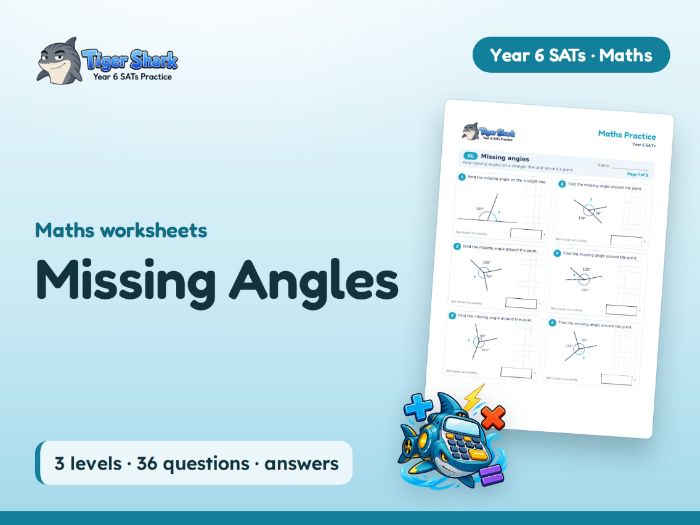
Year 6 maths worksheets on missing angles on lines, around points and in triangles: 36 questions in three levels (All, Most, Some) with answers. Free PDF.
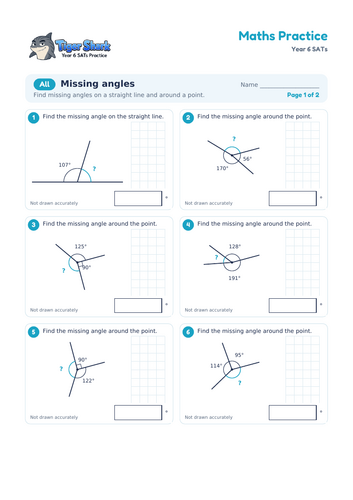
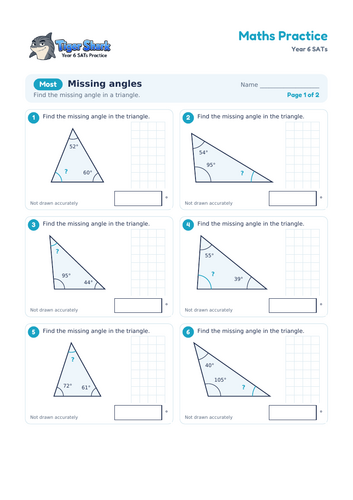
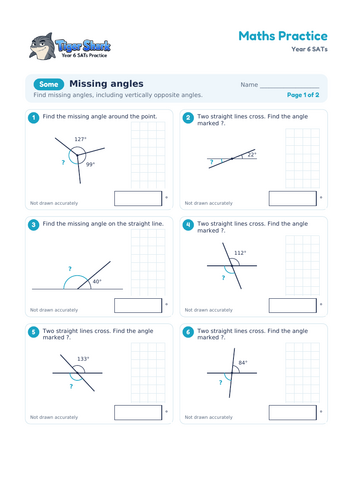
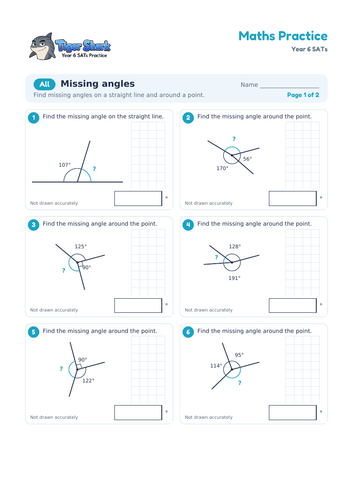
7-page A4 PDF from the Tiger Shark Education question bank. All: Find missing angles on a straight line and around a point. Most: Find the missing angle in a triangle. Some: Find missing angles, including vertically opposite angles. Each level is two pages of six questions, each with its own diagram and space for working, and the last page has every answer, with short working for multi-step questions. Each level is also available as its own 3-page PDF. Example questions from the Some level: Find the missing angle around the point. (127°, ?, 99°) / Two straight lines cross. Find the angle marked ?. (22°, ?).
What are missing angle problems? These problems use known facts to calculate unknown angles: angles on a straight line add up to 180°, angles around a point add up to 360°, angles in a triangle add up to 180°, angles in a quadrilateral add up to 360°, and vertically opposite angles are equal. Year 6 pupils combine these facts to solve multi-step problems.
Common mistakes and tips: Children often use the wrong total (180° instead of 360°) or try to measure an angle that is not drawn accurately. Teach them to identify the fact first, then calculate. Encourage them to label every angle they work out, because multi-step problems usually depend on an intermediate angle.
Questions on this topic appear year after year in the KS2 maths SATs. Because each sheet starts with the core skill and builds to test-style problems, it works both for teaching the topic and for spotting gaps during revision.
Teaching ideas: use the All level to check prerequisite knowledge at the start of a lesson, then move children onto Most or Some when they are ready. Squared working space encourages neat written methods. The answer page includes short working for multi-step questions, so pupils can self-mark and see where they went wrong.
Spotting misconceptions: the mistakes children make on this topic are usually consistent, so look for patterns across their answers rather than marking each question in isolation. A short follow-up on the specific misconception, using concrete resources or diagrams, is often more effective than setting more of the same questions.
Use All for children working towards the expected standard, Most for secure Year 5 skills and Some for SATs-standard practice: three entry points to the same lesson. Suits whole-class differentiation, intervention groups, homework and SATs revision, and upper KS2 generally.
Part of a set of 42 Year 6 maths topics.
Something went wrong, please try again later.
This resource hasn't been reviewed yet
To ensure quality for our reviews, only customers who have downloaded this resource can review it
Report this resourceto let us know if it violates our terms and conditions.
Our customer service team will review your report and will be in touch.
£0.00