


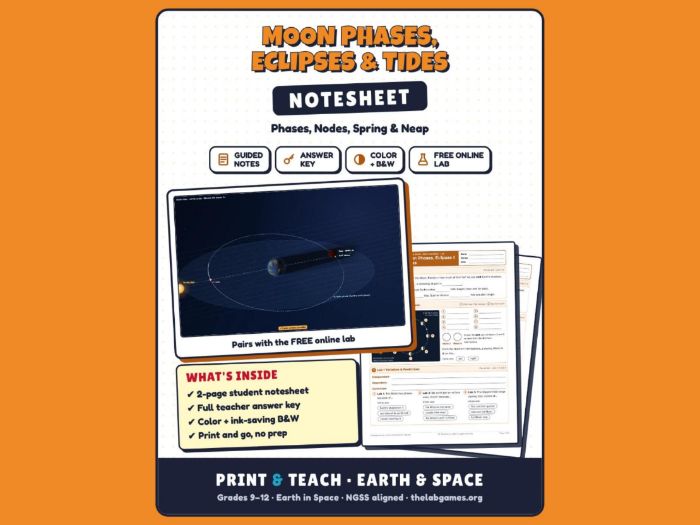
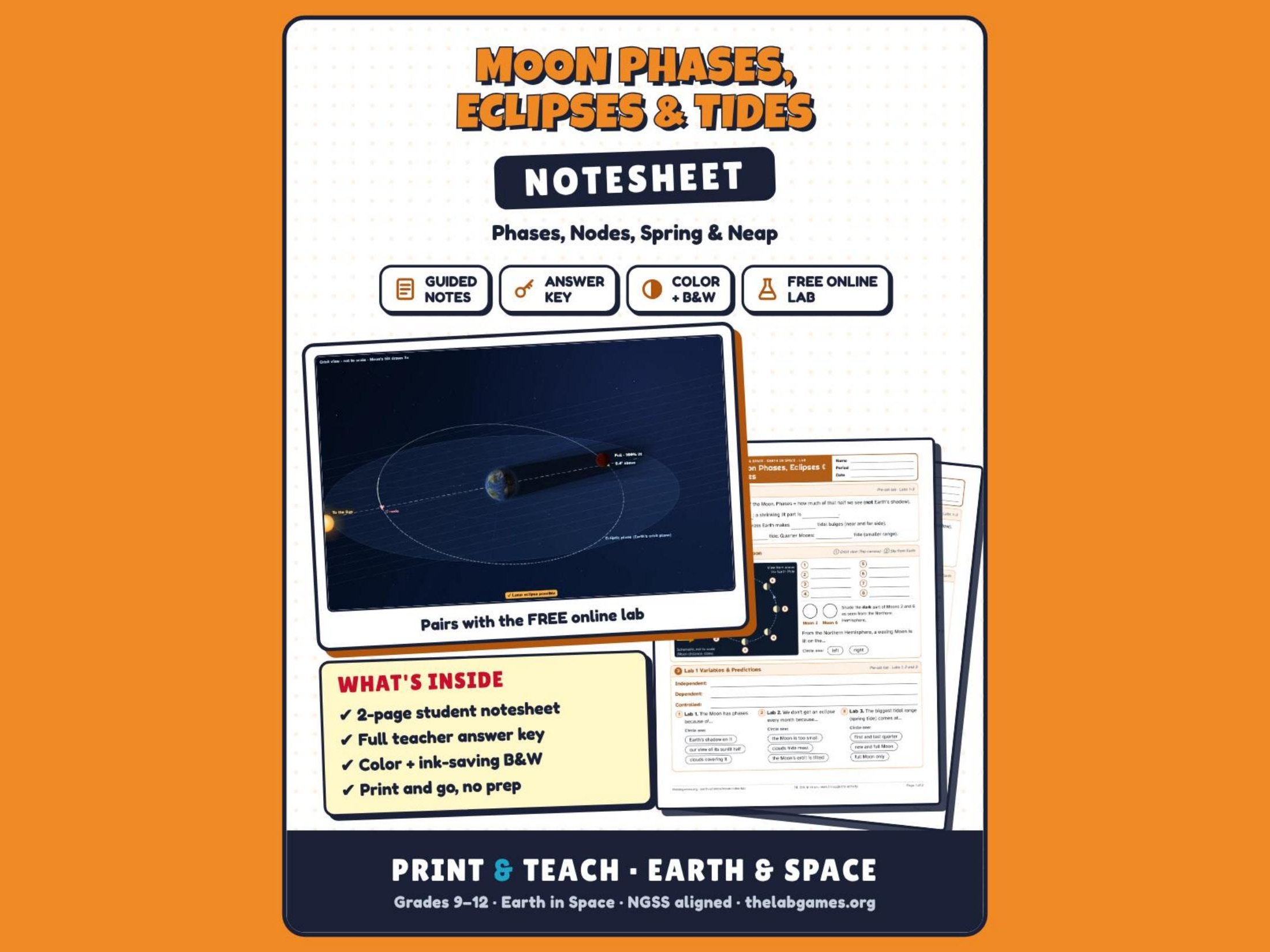
Help students see why the Moon changes shape, why eclipses are rare and why some tides are bigger than others. In this roomy, student-friendly 2-page lab notesheet, students fill in the background on the Moon’s always-half-lit face, waxing and waning, tidal bulges and spring and neap tides, name all eight phases on a top-down orbit diagram, shade how a waxing crescent and a waning gibbous Moon look from Earth, label the variables and make three predictions. On page 2 they record lit fraction, Sun–Moon angle and the Moon’s latitude across a month, compare the sidereal and synodic months, test eclipses with the line of nodes in different directions (and with no orbit tilt), compare tide sizes at new, quarter and full Moon, and write a claim, evidence and reasoning.
It pairs with Moon Phases, Eclipses & Tides, a free online lab at thelabgames.org where students move the Moon around Earth, watch it from the Northern Hemisphere, turn the line of nodes and watch an idealised tide gauge. Use it in class, for absent-student makeups, or on sub days. A complete teacher key is included.
What’s Included
- Student notesheet (2 pages) in full color AND black & white
- Teacher answer key (red answers) in full color AND black & white
What Students Do
- Background fill-in: the half-lit Moon, waxing and waning, two tidal bulges, spring and neap tides
- Name the Phase at Each Moon: name eight Moon positions on a top-down orbit diagram, shade two phases as seen from Earth and say which side of a waxing Moon is lit
- Variables & Predictions: independent, dependent and controlled variables for Lab 1, plus one prediction for each of the three labs
- Lab 1 Data: elapsed time, Sun–Moon angle, latitude and lit fraction at new, waxing crescent, first quarter and full Moon; sidereal versus synodic month
- Labs 2 and 3 Data: the Moon’s latitude and whether an eclipse is possible for different node directions and a no-tilt what-if; tide amplitude and range type at four Sun–Moon angles
- AP Environmental Science box: the synodic-month equation, a full Moon’s latitude 30° from a node, and the combined tide amplitude
- Claim, Evidence, Reasoning on what causes phases and why the phase cycle is longer than one orbit against the stars
Skills & Standards
- Moon phases, waxing and waning, lit fraction, sidereal and synodic months, solar and lunar eclipses, the Moon’s 5.1° orbit tilt and nodes, tidal bulges, spring and neap tides
- Supports NGSS HS-ESS1-4, MS-ESS1-1
- Grades 9–12 Earth and Space Science (with an AP Environmental Science extension)
Great For
- Earth in Space and Moon units
- Absent-student makeups
- Sub plans
- Lab stations
- Test review
Something went wrong, please try again later.
This resource hasn't been reviewed yet
To ensure quality for our reviews, only customers who have purchased this resource can review it
Report this resourceto let us know if it violates our terms and conditions.
Our customer service team will review your report and will be in touch.
$4.00