


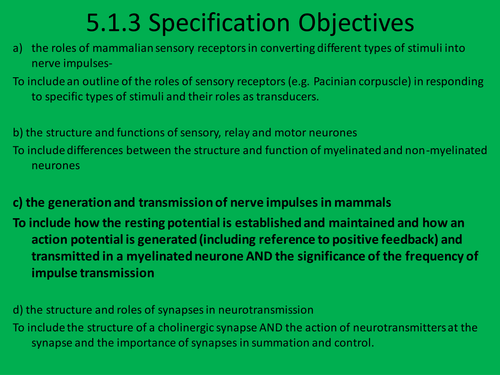


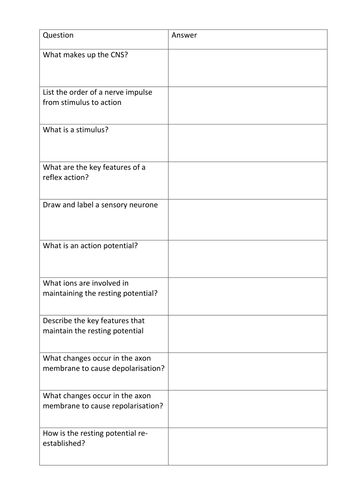
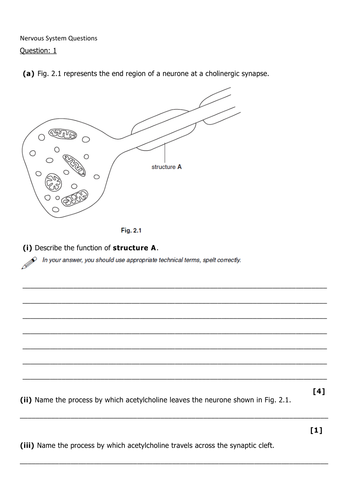
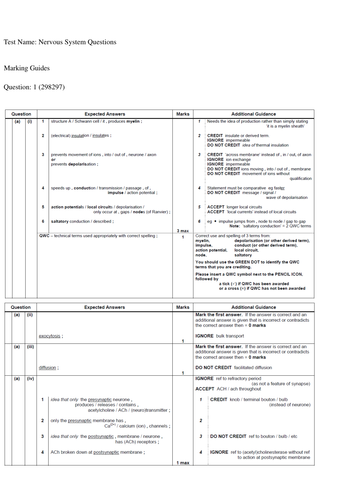
This set of resources covers the whole nervous system topic. I teach OCR A, so it covers 5.1.3 Neuronal Control, but I have previously taught AQA and there isn't much difference, so these resources could be a good starting point.
I teach in a different order to the specification. I cover receptors after studying resting potential, action potential and propagation of an action potential. I have found that the change in membrane potential to create a generator potential makes more sense to students when they have studied it in the context of an action potential.
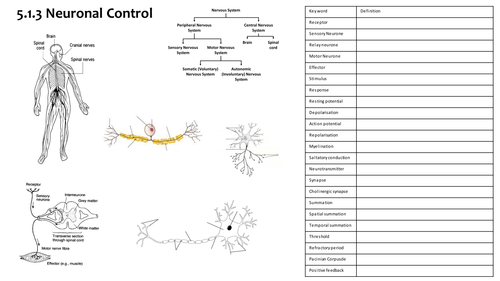
I give students the topic maps at the start of the topic, and they are free to annotate as they wish as we cover each section. The topic map is the grouping of all the key diagrams from the topic.
Interspersed in the powerpoints are tasks, AfL activities, e.g whiteboard questions and exam questions. There are also student tasks, such as 'pass it on' writing sequence, or a cut and stick with extension tasks built in. It should be fairly obvious what the activities are and I have written, where appropriate, instructions into the notes sections of powerpoints.
1: Structure of Neurones
Approx 1hr
Students can label diagrams on laminates and then on their topic maps. I use a kahoot as a final AfL and whiteboard questions.
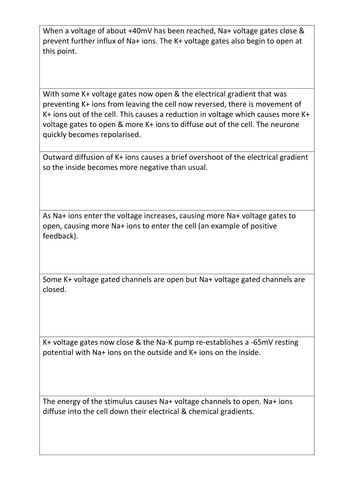
2: Action potential
Approx 2 hrs
Starts with the resting potential and how it is established
Then covers depolarisation, repolarisation and hyperpolarisation
There is the action potential card sort to accompany this activity. Instructions in the powerpoint.
3: Action potential propagation in an myelinated and non-myelinated axon.
Approx 3 hours
This lesson covers action potential propagation, factors affecting propagation, the refractory period and the all or nothing principle
4: Receptors
Approx 45mins
This lesson covers how a generator potential is initiated in a pacinian corpuscle
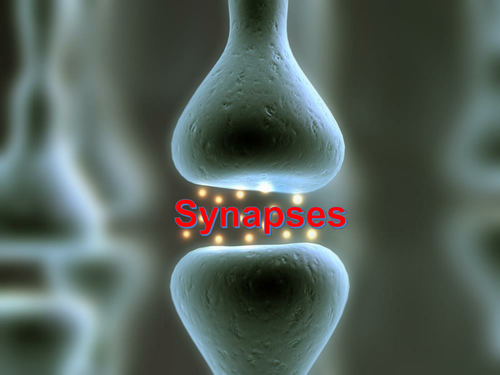
5: Synapses
Approx 2 hours
The initial powerpoint is what happens at a synapse, including summation.
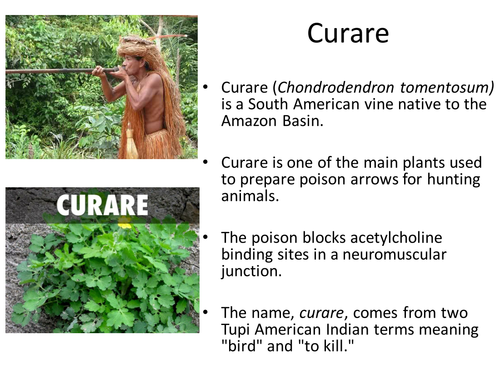
For the second half of the lesson, there is an application activity, where students read information about different drugs and apply their knowledge of synapses to explain the effect of the drugs. Use the 'drugs info cards ppt', you can make laminated info cards for each drug and the students complete the activity as a circus. I made this activity for a job interview lesson, and got the job! This resource is available to buy separately, under synapses lesson.
This is one of my favourite topics because it is so challenging for students, and once they get it, they feel so proud.
Happy Teaching!
I teach in a different order to the specification. I cover receptors after studying resting potential, action potential and propagation of an action potential. I have found that the change in membrane potential to create a generator potential makes more sense to students when they have studied it in the context of an action potential.
I give students the topic maps at the start of the topic, and they are free to annotate as they wish as we cover each section. The topic map is the grouping of all the key diagrams from the topic.
Interspersed in the powerpoints are tasks, AfL activities, e.g whiteboard questions and exam questions. There are also student tasks, such as 'pass it on' writing sequence, or a cut and stick with extension tasks built in. It should be fairly obvious what the activities are and I have written, where appropriate, instructions into the notes sections of powerpoints.
1: Structure of Neurones
Approx 1hr
Students can label diagrams on laminates and then on their topic maps. I use a kahoot as a final AfL and whiteboard questions.
2: Action potential
Approx 2 hrs
Starts with the resting potential and how it is established
Then covers depolarisation, repolarisation and hyperpolarisation
There is the action potential card sort to accompany this activity. Instructions in the powerpoint.
3: Action potential propagation in an myelinated and non-myelinated axon.
Approx 3 hours
This lesson covers action potential propagation, factors affecting propagation, the refractory period and the all or nothing principle
4: Receptors
Approx 45mins
This lesson covers how a generator potential is initiated in a pacinian corpuscle
5: Synapses
Approx 2 hours
The initial powerpoint is what happens at a synapse, including summation.
For the second half of the lesson, there is an application activity, where students read information about different drugs and apply their knowledge of synapses to explain the effect of the drugs. Use the 'drugs info cards ppt', you can make laminated info cards for each drug and the students complete the activity as a circus. I made this activity for a job interview lesson, and got the job! This resource is available to buy separately, under synapses lesson.
This is one of my favourite topics because it is so challenging for students, and once they get it, they feel so proud.
Happy Teaching!
Something went wrong, please try again later.
This resource hasn't been reviewed yet
To ensure quality for our reviews, only customers who have purchased this resource can review it
Report this resourceto let us know if it violates our terms and conditions.
Our customer service team will review your report and will be in touch.
£5.00