


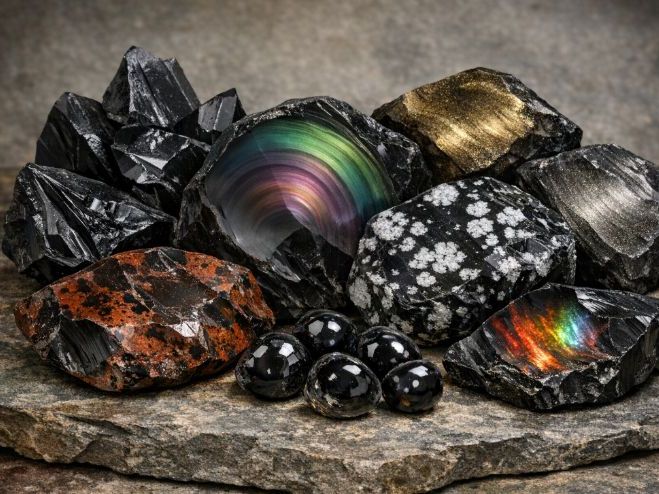
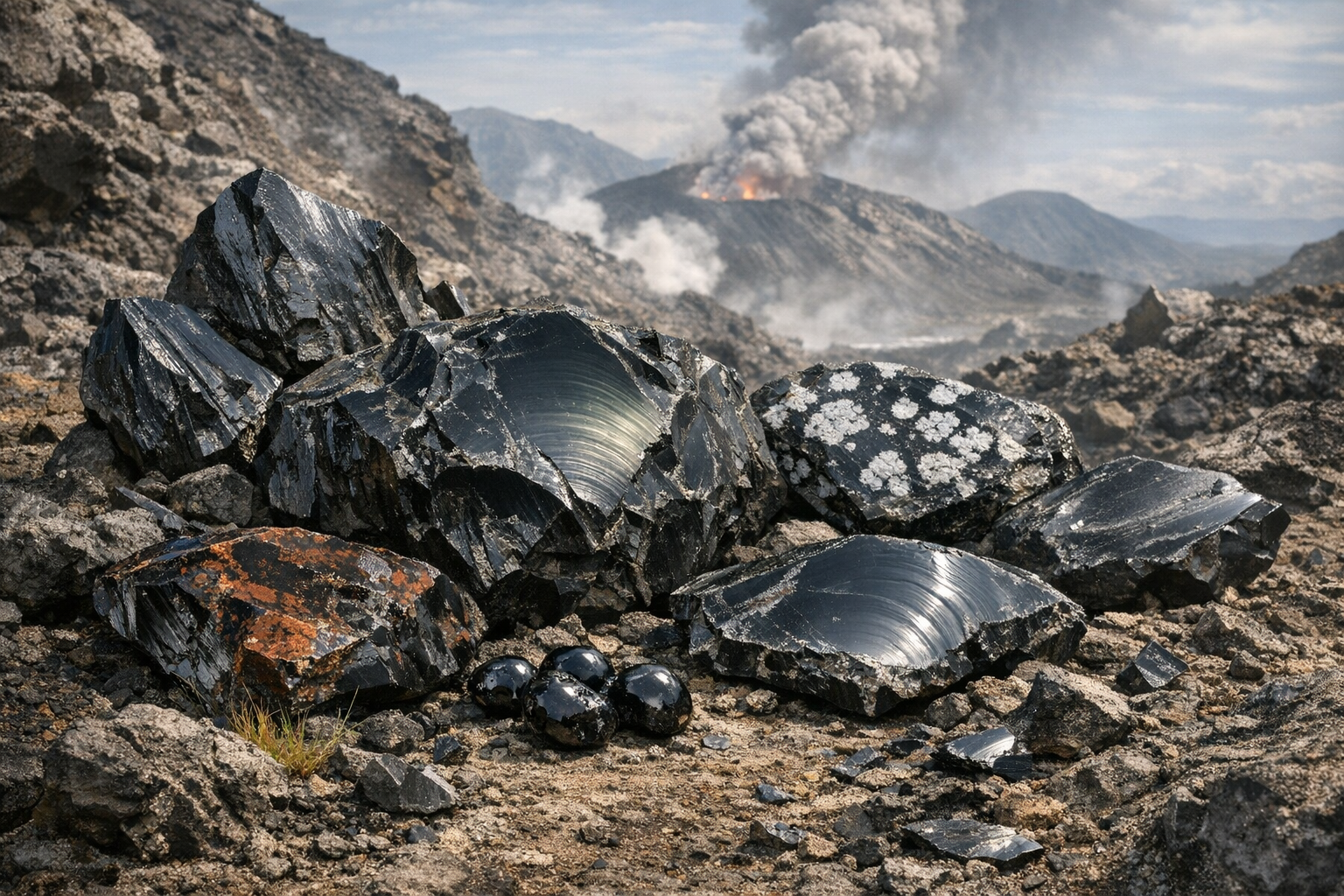
Obsidian is a naturally occurring volcanic glass formed when lava cools so quickly that crystals don’t have time to grow. The result is a smooth, glassy, extremely sharp rock with a long human history and striking visual variety.
What Obsidian Is
Obsidian is an igneous rock created from rapidly cooled felsic lava, rich in silica (SiO₂). Because it cools so fast, it becomes amorphous—a glass rather than a crystalline mineral.
Key traits:
Volcanic glass with a smooth, vitreous texture
Conchoidal fracture that produces razor‑sharp edges
Hardness: 5–6 on the Mohs scale
Color: usually black, but can be brown, green, red, yellow, or even iridescent depending on impurities
How Obsidian Forms
Obsidian forms when high‑silica lava cools extremely fast—often at the edges of lava flows, volcanic domes, dikes, or when lava meets water or air. The high viscosity of the lava prevents crystal formation, locking it into glass.
Types and Variants
Obsidian comes in many visually distinct varieties, each shaped by trace elements or inclusions:
Black Obsidian — the classic deep‑black glass
Mahogany Obsidian — black with reddish‑brown swirls
Rainbow Obsidian — iridescent colors from microscopic crystals
Snowflake Obsidian — white/gray spherulites resembling snowflakes
Historical and Modern Uses
Because of its sharpness and workability, obsidian has been used for:
Cutting tools and weapons by ancient cultures (Aztec, Greek, Native American)
Mirrors and ornaments
Experimental surgical blades, which can be sharper than steel
Where Obsidian Is Found
Obsidian occurs in volcanic regions worldwide. Well‑known sources include:
Mount Hekla, Iceland
Eolie Islands, Italy
Obsidian Cliff, Yellowstone (USA)
where does the name come from
Short answer: The name obsidian comes from a Roman named Obsius, who was said to have discovered the stone in Ethiopia. The Latin term lapis obsidianus (“Obsius’s stone”) eventually became obsidianus, then obsidian in English.
Where the name actually comes from
The story traces back to Pliny the Elder, a Roman author who wrote Naturalis Historia. In it, he mentions a volcanic glass called “obsidianus lapis”, named after Obsius, a Roman traveler who supposedly found the material in Ethiopia. Over time:
lapis obsianus → “stone of Obsius”
A manuscript error changed obsianus to obsidianus
English adopted obsidian in the 1600s
This is why the modern word looks slightly different from the original Latin.
Something went wrong, please try again later.
This resource hasn't been reviewed yet
To ensure quality for our reviews, only customers who have downloaded this resource can review it
Report this resourceto let us know if it violates our terms and conditions.
Our customer service team will review your report and will be in touch.
$0.00