


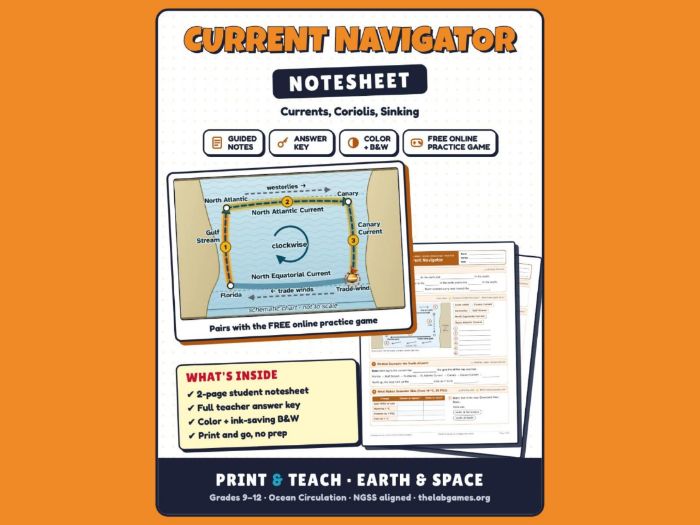
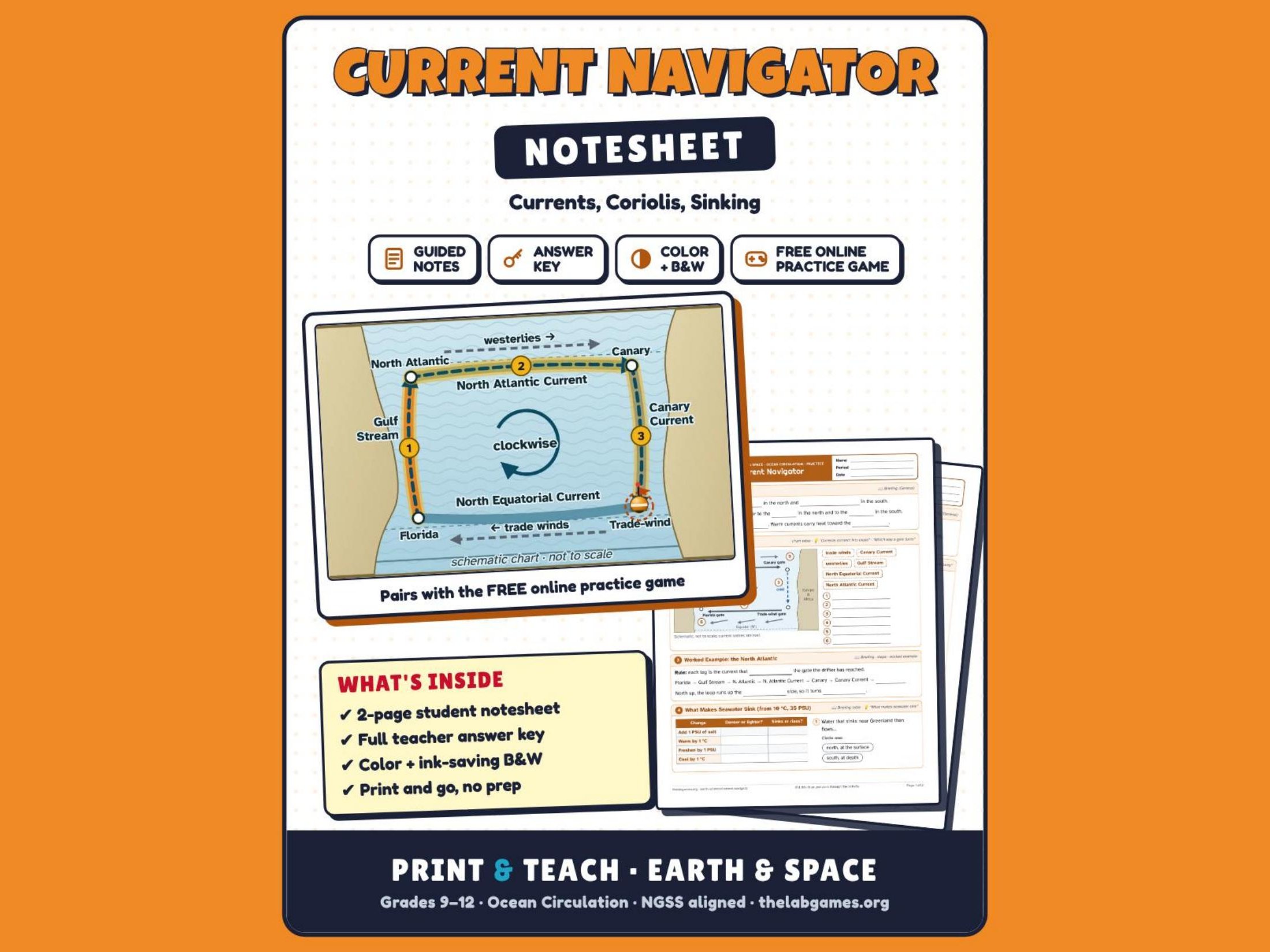
Students learn how the ocean’s surface currents connect into giant loops and why some seawater sinks. In this roomy, student-friendly 2-page notesheet, they fill in the background on gyre direction, Coriolis deflection, density and heat transport, label a North Atlantic gyre chart (Gulf Stream, North Atlantic Current, Canary Current, North Equatorial Current, westerlies and trade winds), follow a worked drifter route, and decide whether colder, warmer, saltier or fresher water sinks or rises. On page 2 they route drifter buoys around the South Atlantic and North Pacific gyres, decide whether a water sample sinks below the reference water, and (AP) calculate a density difference with a linear equation of state.
It pairs with Current Navigator, a free online practice game at thelabgames.org where students run a research ship’s chart room, route drifter buoys around ocean gyres, say which way they turn, and test whether seawater sinks. Use it in class, for absent-student makeups, or on sub days. A complete teacher key is included.
What’s Included
- Student notesheet (2 pages) in full color AND black & white
- Teacher answer key (red answers) in full color AND black & white
What Students Do
- Background fill-in: gyre direction in each hemisphere, Coriolis deflection, what makes water denser, heat transport toward the poles
- The North Atlantic Chart: label four currents and two wind belts on a schematic gyre map
- Worked Example: route a drifter from Florida three legs and decide which way the gyre turns
- What Makes Seawater Sink: denser or lighter, sinks or rises for cooling, warming, salting and freshening, and where North Atlantic deep water flows
- Chart-Room Requests: two drifter routes (South Atlantic and North Pacific), a sink-or-stay water sample, and an AP density-difference calculation
- Key Ideas: what the westerlies do and which way warm western boundary currents carry heat
- My Runs: a log for tracking practice scores
Skills & Standards
- Surface currents, subtropical gyres, Gulf Stream, Kuroshio, Canary, California and Benguela Currents, westerlies and trade winds, Coriolis effect, seawater density, temperature and salinity, deep-water formation, global conveyor, heat transport
- Supports NGSS MS-ESS2-6, HS-ESS2-4
- Grades 9–12 Earth and Space Science, with an AP Environmental Science order
Great For
- Ocean circulation and climate units
- Absent-student makeups
- Sub plans
- Homework or stations
- Test review
Something went wrong, please try again later.
This resource hasn't been reviewed yet
To ensure quality for our reviews, only customers who have purchased this resource can review it
Report this resourceto let us know if it violates our terms and conditions.
Our customer service team will review your report and will be in touch.
$2.49