


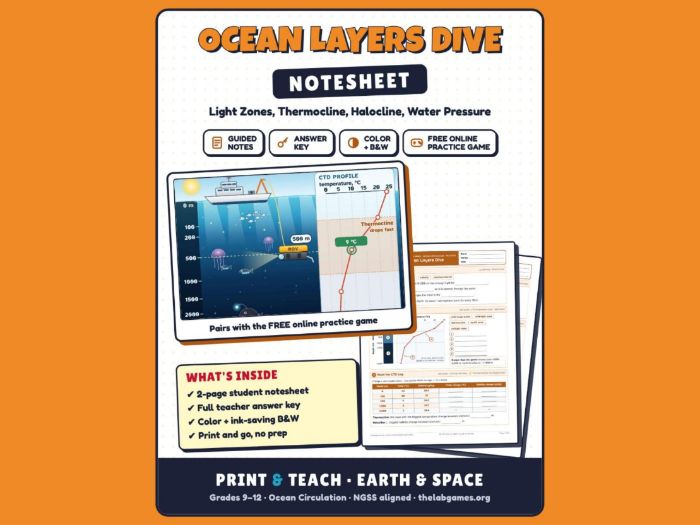
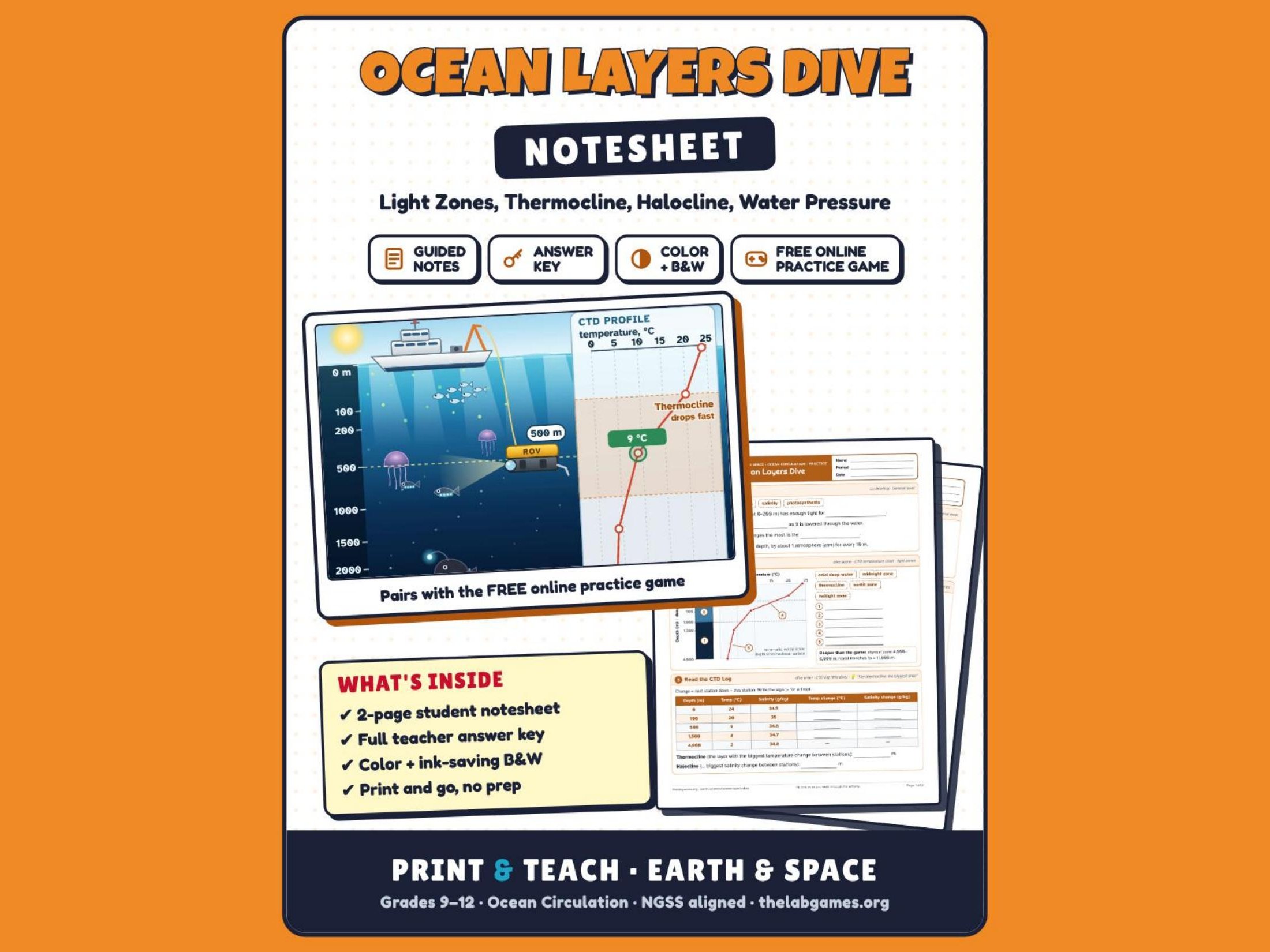
Take students on a dive through the ocean’s layers. In this roomy, student-friendly 2-page notesheet, students fill in the background on the sunlit zone and photosynthesis, the CTD probe, the thermocline and water pressure, label a water-column diagram (sunlit, twilight and midnight zones, the thermocline and cold deep water on a real CTD temperature profile), and work through the CTD log station by station to find the thermocline and the halocline. On page 2 they complete four dive orders: read the CTD log, name the light zone and the life that fits it, find the pressure the water adds with the 1 atm per 10 m rule, and an AP order that calculates absolute and gauge pressure in MPa.
It pairs with Ocean Layers Dive, a free online practice game at thelabgames.org where students run the dive desk on a research ship, read the CTD profile, name the light zone and (AP) find the pressure on the ROV. Use it in class, for absent-student makeups, or on sub days. A complete teacher key is included.
What’s Included
- Student notesheet (2 pages) in full color AND black & white
- Teacher answer key (red answers) in full color AND black & white
What Students Do
- Background fill-in: the sunlit zone and photosynthesis, the CTD probe and salinity, the thermocline, and how pressure changes with depth
- The Water Column: label the light zones, the thermocline and cold deep water on a CTD temperature profile (depth increasing downward)
- Read the CTD Log: find the temperature and salinity change between stations, then name the thermocline and halocline layers
- Dive Orders: read CTD values, name a light zone and the living thing that fits, find the pressure added by the water, and an AP absolute vs. gauge pressure calculation
- Key Ideas: salinity in this profile, why phytoplankton need the sunlit zone, gauge pressure, and the pycnocline
- My Runs: a log for tracking practice scores
Skills & Standards
- Ocean light zones (sunlit, twilight, midnight), photosynthesis, CTD temperature and salinity profiles, thermocline, halocline, pycnocline, water pressure (about 1 atm per 10 m), absolute vs. gauge pressure (P = P_air + ρgz)
- Supports NGSS HS-ESS2-5
- Grades 9–12 Earth and Space Science (with an AP Environmental Science order)
Great For
- Oceans and ocean circulation units
- Absent-student makeups
- Sub plans
- Homework or stations
- Test review
Something went wrong, please try again later.
This resource hasn't been reviewed yet
To ensure quality for our reviews, only customers who have purchased this resource can review it
Report this resourceto let us know if it violates our terms and conditions.
Our customer service team will review your report and will be in touch.
$2.49