


Course: OCR Level 3 Alternative Academic Qualification Cambridge Advanced Nationals in Applied Science.
Unit F181: Science in society
Topic Area 2: Handling scientific data
2.4.1 Identifying patterns and
relationships to:
Draw conclusions
Accept or reject a hypothesis
Inform further scientific investigation
Mathematical skills include:
- Calculate the mean, median, mode, range (e.g. height of group of organisms, number of stomata in a plant).
- Determining the intercept and/or gradient using y = mx + c.
- Calculating the rate of change from a graph with a linear relationship (e.g. rate of transpiration).
- Drawing a tangent to a curve on a graph to calculate the rate of change (e.g. amount of product produced against time, at a fixed concentration of enzyme).
- Calculate the standard deviation of a set of data.
Get this resource as part of a bundle and save up to 20%
A bundle is a package of resources grouped together to teach a particular topic, or a series of lessons, in one place.
Bundle
AAQ in Applied Science - Unit F181: Science in society
Course: OCR Level 3 Alternative Academic Qualification Cambridge Advanced Nationals in Applied Science. Unit F181: Science in society **Topic Area 1.1 The skills of scientists** **Topic Area 2: Handling scientific data** 2.1 Types of scientific data 2.2 Collecting scientific data 2.3 Storage and presentation of scientific data 2.4 Interpreting data **Topic Area 3: Scientific developments** 3.1 Hypothesis, theory, and law 3.1.1 Scientific use of terms 3.1.2 Scientific theory vs scientific law 3.2 Using new technologies in science 3.2.1 New technologies play an important part in continuing scientific development 3.2.2 Limitations and risks of new technologies in society 3.3 Implications and limitations of scientific developments 3.3.1 Considerations for scientific developments 3.3.2 Contemporary issues that science will need to solve in the future **Topic Area: 4 Communicating science** 4.1 Methods of communication 4.1.1 Communicating science to the public using the media 4.1.2 Communicating science between experts: 4.2 Plagiarism 4.3 Using science to inform decision making 4.4 Problems with communicating science 4.4.1 Public trust in the scientific community and developments 4.4.2 Bias in science communication
£29.60
Bundle
OCR AAQ in Applied Science: Handling scientific data
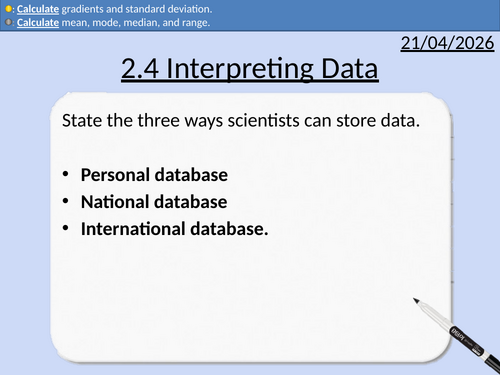
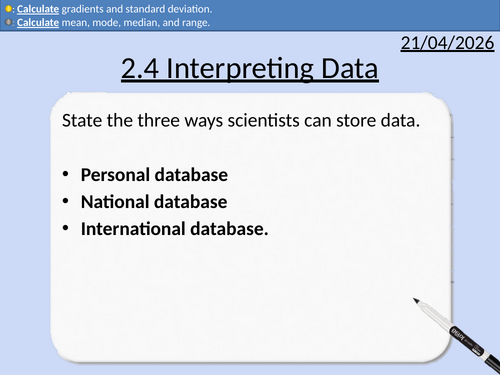
Course: OCR Level 3 Alternative Academic Qualification Cambridge Advanced Nationals in Applied Science. **Unit F181: Science in society Topic Area 2: Handling scientific data** **2.1 Types of scientific data 2.2 Collecting scientific data 2.3 Storage and presentation of scientific data 2.4 Interpreting data** * Qualitative and quantitative data * Continuous and discrete data * Data from observations and * measurements * Primary and secondary data * Observation and measurement * from experiments * Surveys * Sampling * Random * Systematic * Estimation * Cohort studies * Meta-studies * Computer modelling * Personal database * National database * International database * Scatter and line graph * Bar chart * Histogram * Pie chart * Kite diagram * Cumulative graph * Box and whisker plots * Draw conclusions * Accept or reject a hypothesis * Inform further scientific * investigation Mathematical skills include: * Calculate the mean, median, mode, range (e.g. height of group of organisms, number of stomata in a plant). * Determining the intercept and/or gradient using y = mx + c. * Calculating the rate of change from a graph with a linear relationship (e.g. rate of transpiration). * Drawing a tangent to a curve on a graph to calculate the rate of change (e.g. amount of product produced against time, at a fixed concentration of enzyme). * Calculate the standard deviation of a set of data.
£12.75
Something went wrong, please try again later.
This resource hasn't been reviewed yet
To ensure quality for our reviews, only customers who have purchased this resource can review it
Report this resourceto let us know if it violates our terms and conditions.
Our customer service team will review your report and will be in touch.
£5.00