


Paris Anthology: Places & Representation (AQA)
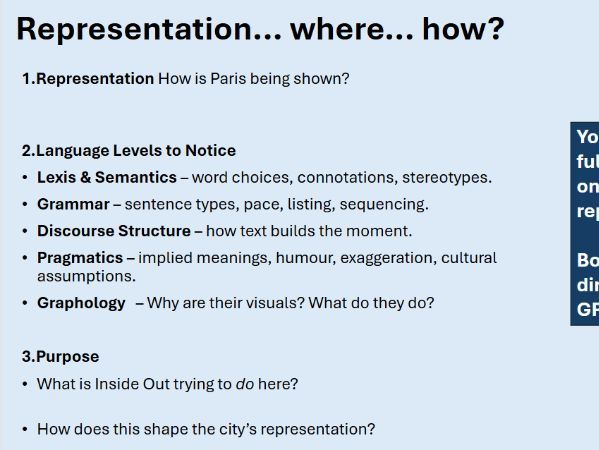
This KS5 lesson is designed for AQA A Level English Literature and Language (Paris Anthology) and focuses on the representation of place through Inside Out: Kids (Paris) and Bill Bryson’s Neither Here Nor There. The lesson is intended to follow a previous Bryson-focused lesson (also attached to this TES profile), and builds directly on that groundwork by moving students into integrated comparison, with a specific emphasis on places in Paris, particularly the Pompidou Centre.
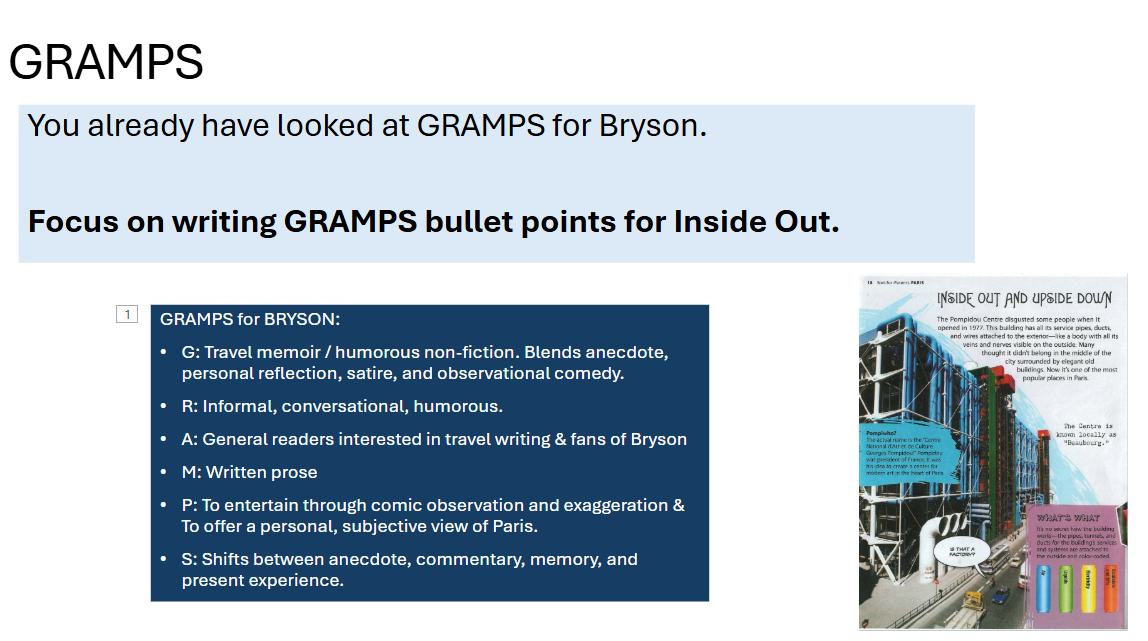
The lesson is deliberately student-focused and task-driven. Students are reminded of GRAMPS in relation to Bryson to reactivate prior learning, before independently applying GRAMPS to the Inside Out: Kids text. Rather than re-teaching content, the lesson assumes familiarity with Bryson and prioritises analytical independence. A short GRAMPS recap is provided by the teacher for Bryson, while students are expected to construct their own GRAMPS framework for Inside Out: Kids, reinforcing AO3 understanding of genre, audience, and purpose.
Students then move into comparative analytical writing at paragraph level by producing a GRAMPS-style introduction, modelling how contextual and structural awareness can be embedded at the start of an exam response. While an exemplar student introduction may be shown in class to support modelling, this is not included within the resource itself, allowing you to adapt this to you cohort. Students subsequently annotate both texts with a focus on representation of place, drawing connections between GRAMPS, language levels, and meaning-making. Exemplars of effective annotation are provided within the resource (slide-based), with flexibility for teachers to decide whether these are shared before or after students annotate independently.
Language analysis is integrated rather than isolated, with students encouraged to link language choices to the writers’ differing representations of Parisian places. This supports AO2 and AO4 by ensuring that analysis remains comparative and conceptually driven rather than feature-led. The lesson concludes with a Paris-style comparative question focused on places across both texts. Students are given time to either plan or write a response, depending on lesson timing and cohort needs.
This resource is best suited to Year 12 or Year 13 students studying the Paris Anthology who are developing confidence with comparative non-fiction analysis. It is not a content-heavy PowerPoint and is intentionally structured around independent reading, annotation, and analytical decision-making. The lesson supports exam preparation while strengthening transferable skills in comparison, representation, and integrated language analysis.
Something went wrong, please try again later.
This resource hasn't been reviewed yet
To ensure quality for our reviews, only customers who have purchased this resource can review it
Report this resourceto let us know if it violates our terms and conditions.
Our customer service team will review your report and will be in touch.
£2.50