


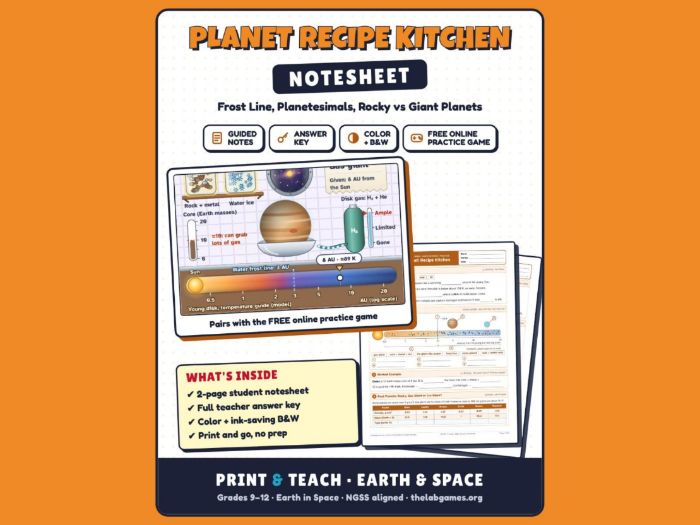
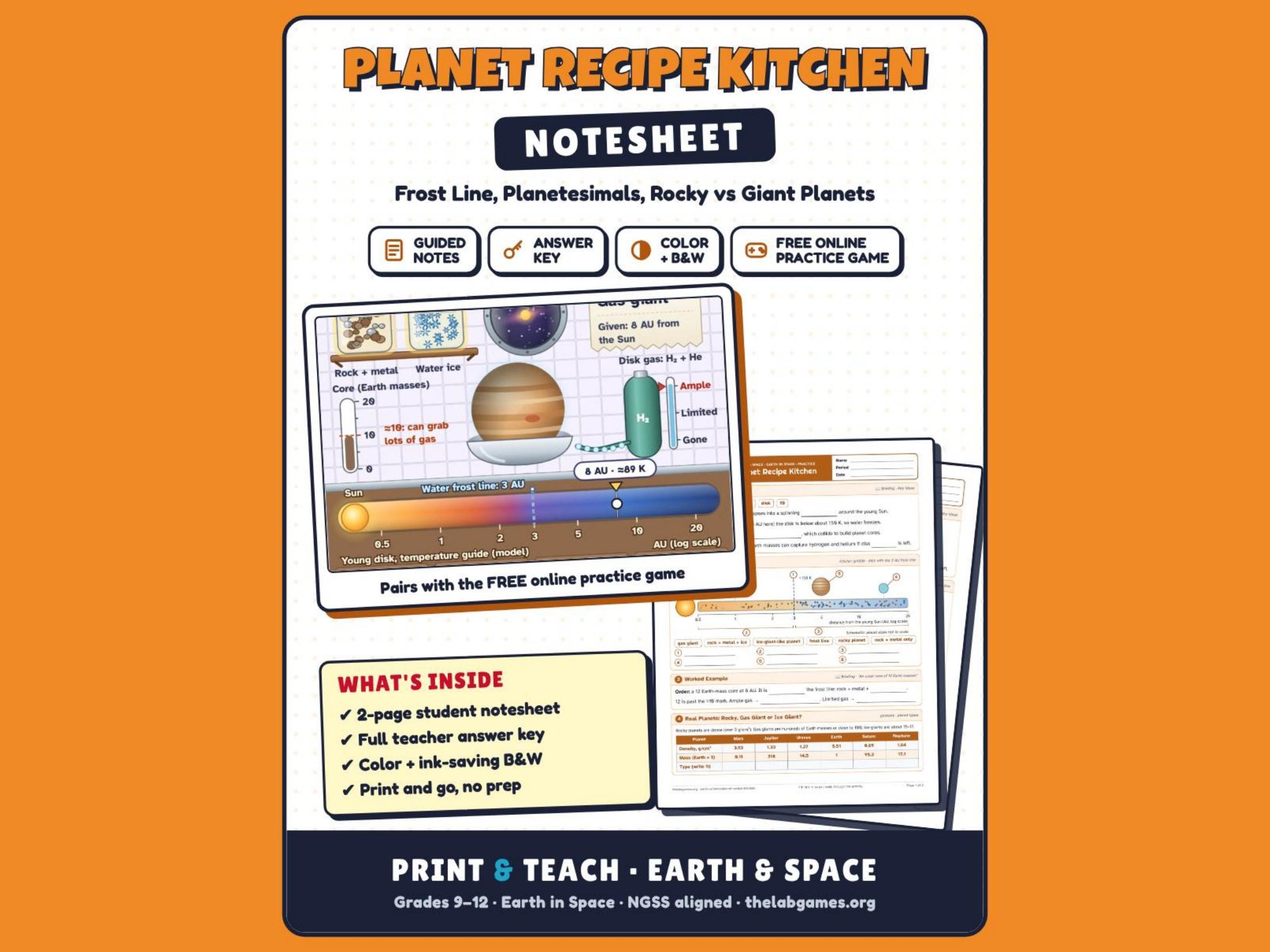
Why are the inner planets small and rocky while the outer planets are giants? In this roomy, student-friendly 2-page notesheet, students fill in the background on the young Sun’s spinning disk, the water frost line, planetesimals and the core mass needed to capture hydrogen and helium, label a diagram of the young Sun’s disk (frost line, the two solid zones, and where rocky, gas giant and ice-giant-like planets form), work an example that turns a 12 Earth-mass outer core into a gas giant or an ice-giant-like planet, and classify six real planets using their densities and masses. On page 2 they work four kitchen orders built from the activity’s own generator: a stock check of the local solids, a gas giant recipe, an ice-giant-like recipe and the four early assembly steps in causal order. An AP box asks why the inner planets are small and dense.
It pairs with Planet Recipe Kitchen, a free online practice game at thelabgames.org where students cook planets from the young solar system’s pantry by choosing the distance, local solids, core size and disk gas. Use it in class, for absent-student makeups, or on sub days. A complete teacher key is included.
What’s Included
- Student notesheet (2 pages) in full color AND black & white
- Teacher answer key (red answers) in full color AND black & white
What Students Do
- Background fill-in: the spinning disk, the water frost line, planetesimals, the ≈10 Earth-mass core and disk gas
- The Young Sun’s Disk: label the frost line, the rock + metal zone, the rock + metal + ice zone and where rocky, gas giant and ice-giant-like planets form
- Worked Example: an outer core of 12 Earth masses at 8 AU with ample or limited gas
- Real Planets: classify Mars, Jupiter, Uranus, Earth, Saturn and Neptune as rocky, gas giant or ice giant using their densities and masses
- Kitchen Orders: a stock check at 2 AU, a gas giant recipe, an ice-giant-like recipe at 16 AU and the four assembly steps in causal order
- AP Extension: why the inner planets are small and dense, and why a 10 Earth-mass core is not a guaranteed gas giant
- My Runs: a log for tracking practice scores
Skills & Standards
- Solar nebula and protoplanetary disk, the water frost line, condensation, planetesimals and core accretion, rocky planets, gas giants and ice giants, planet densities, the astronomical unit
- Supports NGSS HS-ESS1-6
- Grades 9–12 Earth and Space Science (with an AP Environmental Science extension)
Great For
- Solar system formation units
- Absent-student makeups
- Sub plans
- Homework or stations
- Test review
Something went wrong, please try again later.
This resource hasn't been reviewed yet
To ensure quality for our reviews, only customers who have purchased this resource can review it
Report this resourceto let us know if it violates our terms and conditions.
Our customer service team will review your report and will be in touch.
$2.49