


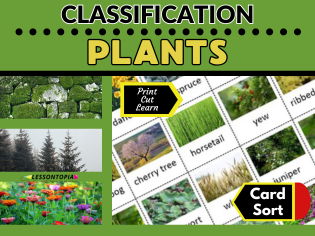
Make plant classification visual, hands-on and easy to differentiate with this real-photo Plant Classification Card Sort for KS2–KS3 science.
Students work with 24 real-photo plant examples as they explore several ways to classify plants, including vascular and nonvascular plants, spore-bearing and seed-bearing plants, and major plant groups.
With four card options, four sorting options, category labels, an answer key and full-colour and printer-friendly black-and-white versions, this low-prep activity can be adapted for science centres, partner work, independent practice, review or assessment.
What’s Included
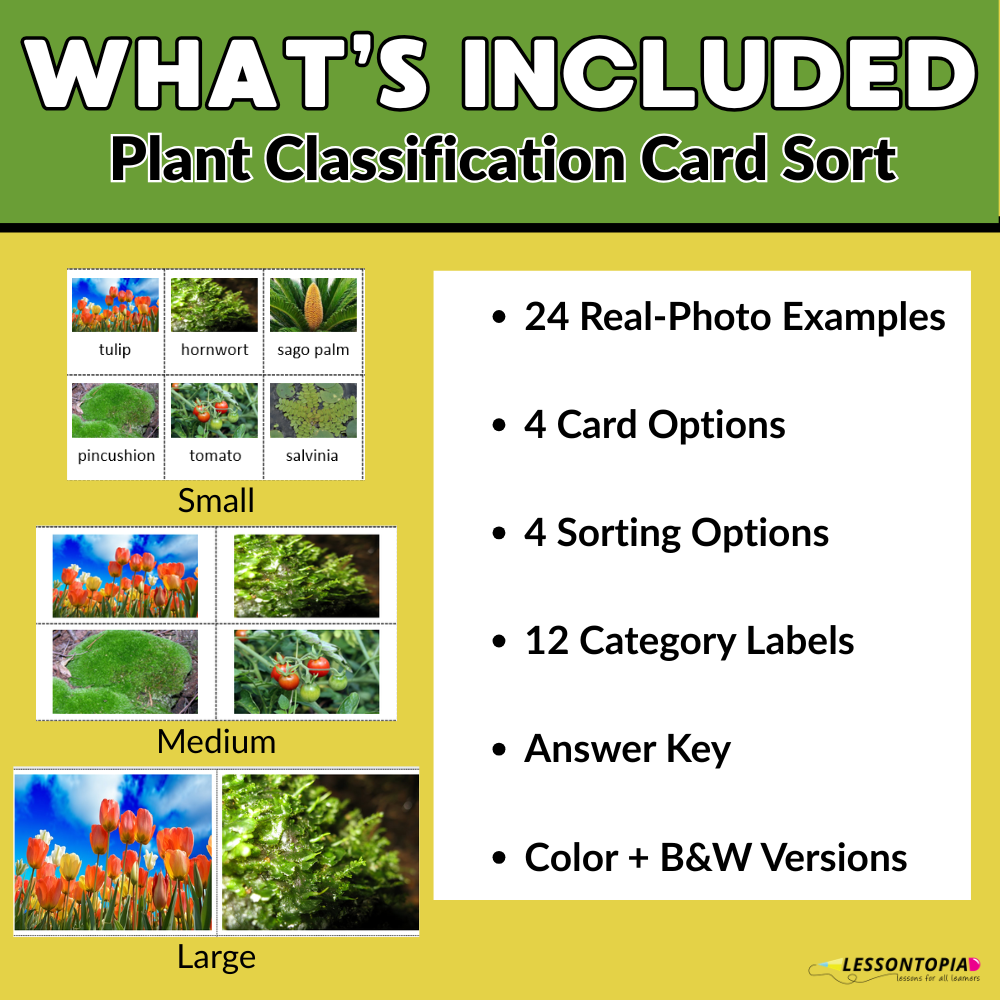
• 24 real-photo plant examples
• 4 card options – small captioned, small uncaptioned, medium and large
• 4 sorting options for different levels of classification
• 12 category labels
• Answer key
• Full-colour and printer-friendly black-and-white versions
• Teacher Guide & How to Use with classroom-use and differentiation ideas
Four Ways to Classify Plants
Students can classify the same 24 plant examples in several ways:
• Bryophytes, Pteridophytes, Gymnosperms and Angiosperms
• Nonvascular Plants, Seedless Vascular Plants, Nonflowering Seed Plants and Flowering Plants
• Nonvascular and Vascular Plants
• Spore-Bearing and Seed-Bearing Plants
These different sorting options make it easy to adjust the level of challenge while using the same core set of cards.
Flexible Classroom Use
Use this plant classification activity for:
• Science centres and stations
• Partner and small-group work
• Interactive notebooks
• Independent practice
• Homework and review
• Formative assessment
The different card sizes and formats make it easy to choose the setup that best suits your pupils. Larger cards work well for table, floor or collaborative sorting, while the smaller formats are useful for notebooks and individual work.
Differentiate With Ease
Use broader classification categories with pupils who need additional support, or move to more detailed plant groups with pupils ready for a greater challenge.
Captioned cards provide vocabulary support, while uncaptioned cards add challenge.
Why You’ll Love This Resource
Students use real photographs to observe, compare and classify plants rather than simply memorising classification vocabulary.
The combination of multiple card sizes, captioned and uncaptioned options, four sorting levels and colour/black-and-white versions makes this a flexible resource that can be reused in different classroom settings and with pupils working at different levels.
Ideal for KS2–KS3 plant science, classification and life science topics.
You may also like:
Land Biomes | Ecosystems | Card Sort
Photosynthesis Model | Plants | Lesson Plan
Get this resource as part of a bundle and save up to 13%
A bundle is a package of resources grouped together to teach a particular topic, or a series of lessons, in one place.
Bundle
Classification Card Sort Bundle | Six Kingdoms, Plants & Animal Phyla | KS2–KS3 Science
Make classification visual, hands-on and easy to differentiate with this bundle of three real-photo card sorts for KS2–KS3 science. Students explore Six Kingdoms, Plant Classification, and Animal Phyla using 72 real-photo examples across three complete activities. With four card options, nine sorting options, category labels, answer keys, and full-colour and printer-friendly black-and-white versions, this bundle provides flexible classification practice across a range of life science topics. **What’s Included** • 3 complete card sorts – Six Kingdoms, Plant Classification, and Animal Phyla • 72 real-photo examples – 24 in each resource • 4 card options – small captioned, small uncaptioned, medium and large • 9 sorting options across the three resources • Category labels and sorting materials • Answer keys for all included sorting options • Full-colour and printer-friendly black-and-white versions • Teacher guides with classroom-use and differentiation ideas **Six Kingdoms** Students classify organisms using three levels of challenge: • Prokaryotes and Eukaryotes • Archaea, Bacteria and Eukarya • Six Kingdoms – Archaebacteria, Eubacteria, Protista, Fungi, Plantae and Animalia **Plant Classification** Students classify plants using four different sorting options: • Bryophytes, Pteridophytes, Gymnosperms and Angiosperms • Nonvascular Plants, Seedless Vascular Plants, Nonflowering Seed Plants and Flowering Plants • Nonvascular and Vascular Plants • Spore-Bearing and Seed-Bearing Plants **Animal Phyla** Students classify animals using two levels: • Vertebrates and Invertebrates • Nine Animal Phyla The nine phyla included are Annelida, Arthropoda, Chordata, Cnidaria, Echinodermata, Mollusca, Nematoda, Platyhelminthes and Porifera. **Flexible Classroom Use** Use these classification activities for: • Science centres and stations • Partner and small-group work • Interactive notebooks • Independent practice • Homework and review • Formative assessment The different card sizes and formats make it easy to choose the setup that best suits your pupils. Larger cards work well for table, floor or collaborative sorting, while smaller formats are useful for notebooks and individual work. **Differentiate With Ease** Each card sort includes multiple levels of classification so you can adjust the challenge for different pupils. Use broader categories for pupils who need additional support, or move to more detailed classification systems for pupils ready for greater challenge. Captioned cards provide vocabulary support, while uncaptioned cards add challenge. **Why You’ll Love This Bundle** Students use real photographs to observe, compare, sort and classify organisms rather than simply memorising classification vocabulary. With three complete classification topics, 72 examples, four card formats and nine sorting options, this bundle provides a flexible way to reinforce classification concepts across life science. Ideal for KS2–KS3 biology, classification, plants, animals and living-organism topics. **You may also like:** [Consumer Producer Decomposer | Ecosystems | Card Sort](https://www.tes.com/teaching-resource/resource-12563723) [Land Biomes | Ecosystems | Card Sort](https://www.tes.com/teaching-resource/resource-12583318)
$6.50
Bundle
Plant Card Sort Bundle | Plant Classification & Seed Dispersal | KS2–KS3 Science
Make plant science visual, hands-on and easy to differentiate with this bundle of two real-photo card sorts for KS2–KS3 science. Students explore both Plant Classification and Seed Dispersal using 48 real-photo examples across two complete activities. With four card options, seven sorting options, category labels, answer keys and full-colour and printer-friendly black-and-white versions, this bundle provides flexible plant science practice for a range of classroom settings and ability levels. **What’s Included** • 2 complete card sorts – Plant Classification and Seed Dispersal • 48 real-photo examples – 24 in each resource • 4 card options – small captioned, small uncaptioned, medium and large • 7 sorting options across the two resources • Category labels and sorting materials • Answer keys for the included sorting options • Full-colour and printer-friendly black-and-white versions • Teacher guides with classroom-use and differentiation ideas **Plant Classification** Students classify 24 real-photo plant examples using four different sorting options: • Bryophytes, Pteridophytes, Gymnosperms and Angiosperms • Nonvascular Plants, Seedless Vascular Plants, Nonflowering Seed Plants and Flowering Plants • Nonvascular and Vascular Plants • Spore-Bearing and Seed-Bearing Plants **Seed Dispersal** Students explore five methods of seed dispersal using 24 real-photo examples: • Wind • Water • Animals • Fire • Explosion Three sorting options allow the activity to be adapted for different levels of challenge. **Flexible Classroom Use** Use these plant science activities for: • Science centres and stations • Partner and small-group work • Interactive notebooks • Independent practice • Homework and review • Formative assessment The different card sizes and formats make it easy to choose the setup that best suits your pupils. Larger cards work well for table, floor or collaborative sorting, while smaller formats are useful for notebooks and individual work. **Differentiate With Ease** Both resources include several ways to adjust the activity for pupil readiness. Use broader sorting categories for pupils who need additional support, or move to more detailed classification systems and dispersal methods for pupils ready for a greater challenge. Captioned cards provide vocabulary support, while uncaptioned cards add challenge. **Why You’ll Love This Bundle** Students use real photographs to observe, compare, sort and classify rather than simply memorising vocabulary. With two complete plant science topics, 48 examples, four card formats and seven sorting options, this bundle provides a flexible way to reinforce plant classification and seed dispersal throughout your science teaching. Ideal for KS2–KS3 plant science, classification and seed dispersal topics. **You may also like:** [Land Biomes | Ecosystems | Card Sort](https://www.tes.com/teaching-resource/resource-12583318) [Photosynthesis Model | Plants | Lesson Plan](https://www.tes.com/teaching-resource/resource-12191076)
$4.50
Something went wrong, please try again later.
This resource hasn't been reviewed yet
To ensure quality for our reviews, only customers who have purchased this resource can review it
Report this resourceto let us know if it violates our terms and conditions.
Our customer service team will review your report and will be in touch.
$2.50