


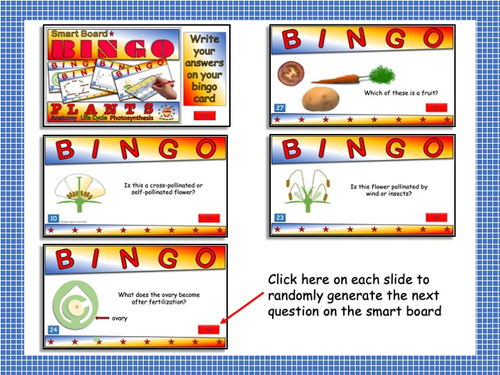
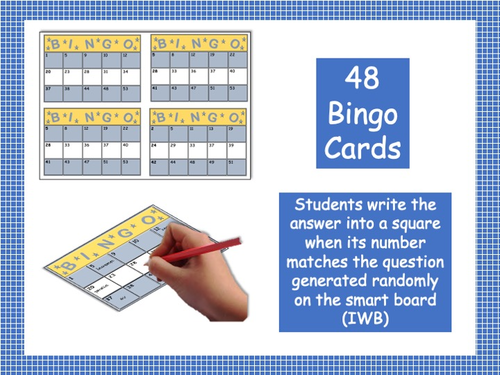

Smart board bingo includes questions on the anatomy and life cycle of the flowering plant and photosynthesis. A numbered question is generated randomly and, if that number is on their bingo card, students write in the answer. So much fun students don’t realise they are learning!
What is Included
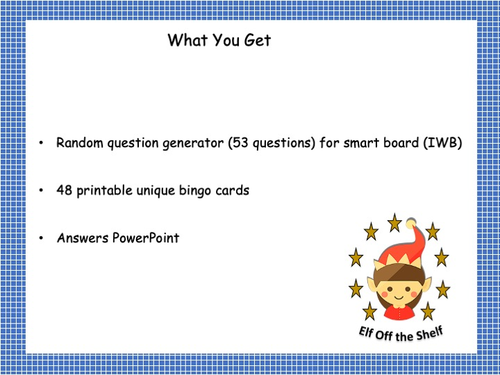
- Random question generator for smart board (interactive white board) – 54 questions
- 48 bingo cards
- Answers PowerPoint
- Answer sheet
Suggested Lesson Plan
- Play bingo – students write the answers into the square on their bingo card which matches the question number in the smart board.
- Teacher uses answer sheet to check card of winners of lines and full house
- Pupils use answer PowerPoint to check their answers at end of game.
Prior Knowledge
- Root, stem, leaf and flower are plant organs.
- Function of root, stem and leaf.
- Transpiration.
- Labelling parts of a flower.
- Carpel and stamen are the female and male reproductive organs.
- Role of played by xylem, phloem, guard cells, stomata and chloroplasts in photosynthesis.
- Graphing rate of photosynthesis against, carbon dioxide concentration, light intensity and temperature.
- Word equations for photosynthesis and respiration.
- Comparison of photosynthesis and respiration.
- Paraffin heaters as sources of carbon dioxide in greenhouses.
- Use of glucose in plants.
- Gas exchange in plants at different times of day.
- Testing a leaf for starch – investigation.
- Effect of light intensity on rate of photosynthesis – investigation.
- Pollination, self-pollination and cross-pollination explained.
- How some plants prevent self-pollination and why.
- Comparing the features of flowers pollinated by insects and wind.
Get this resource as part of a bundle and save up to 29%
A bundle is a package of resources grouped together to teach a particular topic, or a series of lessons, in one place.
Bundle
Plant Anatomy Life Cycle Photosynthesis Complete Module 5 Lessons 7 Games Plus Revision Lesson
Plant anatomy, photosynthesis and life cycle of the flowering plant from pollination through fertilisation and seed dispersal to germination are explained in these five engaging fully resourced lessons which make up the complete module on plants for middle school students. Each lesson comes with an animated PowerPoint to make teaching and learning very easy. There are, in total, a collection of over fifty engaging worksheets, guided notes, activities and homework. For each topic, a one – page flow chart lesson plan shows where logical choices can be made between resources if time requires and a separate answer/mark scheme PowerPoint enables easy self and peer-assessment. Also included is a quiz-base test prep lesson which produces a personalised review sheet for each student to take away with them. This pack includes two virtual investigations which take the student through prediction, planning drawing a graph and conclusion. They can be used as instructions for the student to follow to perform their own experiment or the scientifically accurate animations themselves can be used to obtain results. To reinforce learning or for test prep, this pack comes with seven enjoyable games which are suitable for all abilities. Many of the games could be used for cover lessons, as they come with a hard-copy and/or PowerPoint of the answers. These are also ideal end of term/year activities. So much fun, students will not realise they are learning. Lessons Included Plant anatomy – naming and learning the function of the main parts of the flowering plant Photosynthesis facts - how the leaf makes glucose; factors which affect the rate of photosynthesis; how plants use glucose; the relationship between respiration and photosynthesis. Virtual investigation 1 – Does photosynthesis require light? Virtual investigation 2 – Does light intensity affect the rate of photosynthesis? Life Cycle of the Plant – Pollination, fertilisation, seed dispersal and germination Test Prep Lesson – Quiz based and produces a personal review sheet for each student **What’s Included** **Lessons** * Plant Parts * Photosynthesis facts * Virtual investigation 1 – does light intensity affect the rate of photosynthesis * Virtual investigation 2 – testing a leaf for starch * Life Cycle of the Flowering Plant – pollination, fertilization, dispersal, germination **Games** * Find the Pair - anatomy and photosynthesis * Find the Pair - anatomy and life cycle * Smart Board Bingo – anatomy, life cycle and photosynthesis * Forces Board Game - anatomy, life cycle and photosynthesis * Dominoes - anatomy and photosynthesis * Dominoes - anatomy and life cycle * Save the Substitute Teacher Escape Room - anatomy, life cycle and photosynthesis **What’s Covered** * Root, stem and leaf are plant organs. * Flower is an organ system. * Function of root, stem and leaf. * Transpiration. * Labelling parts of a flower. * Carpel and stamen are the female and male reproductive organs. * Role of played by xylem, phloem, guard cells, stomata and chloroplasts in photosynthesis. * Graphing rate of photosynthesis against, carbon dioxide concentration, light intensity and temperature. * Word equations for photosynthesis and respiration. * Comparison of photosynthesis and respiration. * Paraffin heaters as sources of carbon dioxide in greenhouses. * Use of glucose in plants. * Gas exchange in plants at different times of day. * Testing a leaf for starch – investigation. * Effect of light intensity on rate of photosynthesis – investigation. * Pollination, self-pollination and cross-pollination explained. * How some plants prevent self-pollination and why. * Comparing the features of flowers pollinated by insects and wind. * Fertilization - how it happens. * What is a fruit with examples. * Why seed dispersal is essential for reducing competition. * Seed dispersal by wind, exploding pods, animal and water. * Germination explained. **Lesson Printables** * Animated PowerPoints for teaching with exit ticket quiz + 2 virtual investigations (x3) * Answer/mark scheme PowerPoint (x3) * Flip its (pupil writes questions to given answers) (x3) * Anticipation Guides(combined starter and plenary) (x3) * Foldables (students use to make their own notes) (x4) * Cut-and-stick activities pupil uses to make their own notes) (x4) * Worksheets to support the PowerPoint (x 5) * Fact sheet (x3) * Homework (x6) * Fact share worksheet (x3) * 12 Taboo cards (x3) * Pupil progress self-assessment checklist (3) * Exit Ticket * Suggested lesson plan showing choices possible between resources (x5)
£25.50
Bundle
Plant Anatomy Life Cycle Photosynthesis - The Complete Module Plus 7 Game Compendium KS3
Plant anatomy, photosynthesis and life cycle from Plant anatomy, photosynthesis and life cycle of the flowering plant from pollination through fertilisation and seed dispersal to germination are explained in these five engaging fully resourced lessons which make up the complete module on plants for middle school students. Each lesson comes with an animated PowerPoint to make teaching and learning very easy. There are, in total, a collection of fifty engaging worksheets, guided notes, activities and homework. For each topic, a one – page flow chart lesson plan shows where logical choices can be made between resources if time requires and a separate answer/mark scheme PowerPoint enables easy self and peer-assessment. This pack includes two virtual investigations which take the student through prediction, planning drawing a graph and conclusion. They can be used as instructions for the student to follow to perform their own experiment or the scientifically accurate animations themselves can be used to obtain results. To reinforce learning or for test prep, this pack comes with seven enjoyable games which are suitable for all abilities. Many of the games could be used for cover lessons, even when taken by a non-specialist as they come with a hard-copy and/or PowerPoint of the answers. It is also the ideal end of term/year pack. **Lessons Included** * Plant anatomy – naming and learning the function of the main parts of the flowering plant * Photosynthesis facts - how the leaf makes glucose; factors which affect the rate of photosynthesis; how plants use glucose; the relationship between respiration and photosynthesis. * Virtual investigation 1 – Does photosynthesis require light? * Virtual investigation 2 – Does light intensity affect the rate of photosynthesis? * Life Cycle of the Plant – Pollination, fertilisation, seed dispersal and germination **Games Included** * Find the Pair - anatomy and photosynthesis * Find the Pair - anatomy and life cycle * Smart Board Bingo – anatomy, life cycle and photosynthesis * Forces Board Game - anatomy, life cycle and photosynthesis * Dominoes - anatomy and photosynthesis * Dominoes - anatomy and life cycle * Save the Substitute Teacher Escape Room - anatomy, life cycle and photosynthesis **What’s Covered** * Root, stem and leaf are plant organs. * Flower is an organ system. * Function of root, stem and leaf. * Transpiration. * Labelling parts of a flower. * Carpel and stamen are the female and male reproductive organs. * Role of played by xylem, phloem, guard cells, stomata and chloroplasts in photosynthesis. * Graphing rate of photosynthesis against, carbon dioxide concentration, light intensity and temperature. * Word equations for photosynthesis and respiration. * Comparison of photosynthesis and respiration. * Paraffin heaters as sources of carbon dioxide in greenhouses. * Use of glucose in plants. * Gas exchange in plants at different times of day. * Testing a leaf for starch – investigation. * Effect of light intensity on rate of photosynthesis – investigation. * Pollination, self-pollination and cross-pollination explained. * How some plants prevent self-pollination and why. * Comparing the features of flowers pollinated by insects and wind. * Fertilization - how it happens. * What is a fruit with examples. * Why seed dispersal is essential for reducing competition. * Seed dispersal by wind, exploding pods, animal and water. * Germination explained. **Lesson Printables** * Animated PowerPoints for teaching with exit ticket quiz + 2 virtual investigations (x3) * Answer/mark scheme PowerPoint (x3) * Flip its (pupil writes questions to given answers) (x3) * Anticipation Guides(combined starter and plenary) (x3) * Foldables (students use to make their own notes) (x4) * Cut-and-stick activities pupil uses to make their own notes) (x4) * Worksheets to support the PowerPoint (x 5) * Fact sheet (x3) * Homework (x6) * Fact share worksheet (x3) * 12 Taboo cards (x3) * Pupil progress self-assessment checklist (3) * Exit Ticket * Suggested lesson plan showing choices possible between resources (x5)
£23.00
Bundle
Plant Anatomy, Life Cycle and Photosynthesis - 7 Game Compendium
Plant anatomy, photosynthesis and life cycle from pollination through fertilisation and seed dispersal to germination, this compendium of seven enjoyable and engaging games for middle school is suitable for all abilities. Each game comes with full instructions and is easy to run. The games can be used to reinforce learning after the relevant sections have been taught or as test prep. **Games Included:** * Find the Pair - anatomy and photosynthesis * Find the Pair - anatomy and life cycle * Smart Board Bingo – anatomy, life cycle and photosynthesis * Forces Board Game - anatomy, life cycle and photosynthesis * Dominoes - anatomy and photosynthesis * Dominoes - anatomy and life cycle * Save the Supply Teacher Escape Room - anatomy, life cycle and photosynthesis This versatile pack can be used to reinforce each section of the current electricity module as it is taught or for revision. Many of the games could be used for cover lessons, even when taken by a non-specialist as they come with a hard-copy and/or PowerPoint of the answers. It is also the ideal end of term/year pack. **Prior Knowledge** * Root, stem, leaf and flower are plant organs. * Function of root, stem and leaf. * Transpiration. * Labelling parts of a flower. * Carpel and stamen are the female and male reproductive organs. * Role of played by xylem, phloem, guard cells, stomata and chloroplasts in photosynthesis. * Graphing rate of photosynthesis against, carbon dioxide concentration, light intensity and temperature. * Word equations for photosynthesis and respiration. * Comparison of photosynthesis and respiration. * Paraffin heaters as sources of carbon dioxide in greenhouses. * Use of glucose in plants. * Gas exchange in plants at different times of day. * Testing a leaf for starch – investigation. * Effect of light intensity on rate of photosynthesis – investigation. * Pollination, self-pollination and cross-pollination explained. * How some plants prevent self-pollination and why. * Comparing the features of flowers pollinated by insects and wind.
£13.00
Something went wrong, please try again later.
This resource hasn't been reviewed yet
To ensure quality for our reviews, only customers who have purchased this resource can review it
Report this resourceto let us know if it violates our terms and conditions.
Our customer service team will review your report and will be in touch.
£3.50