


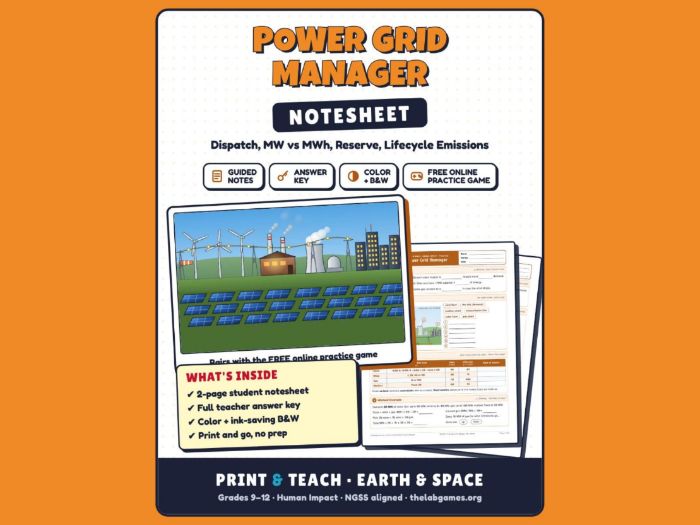
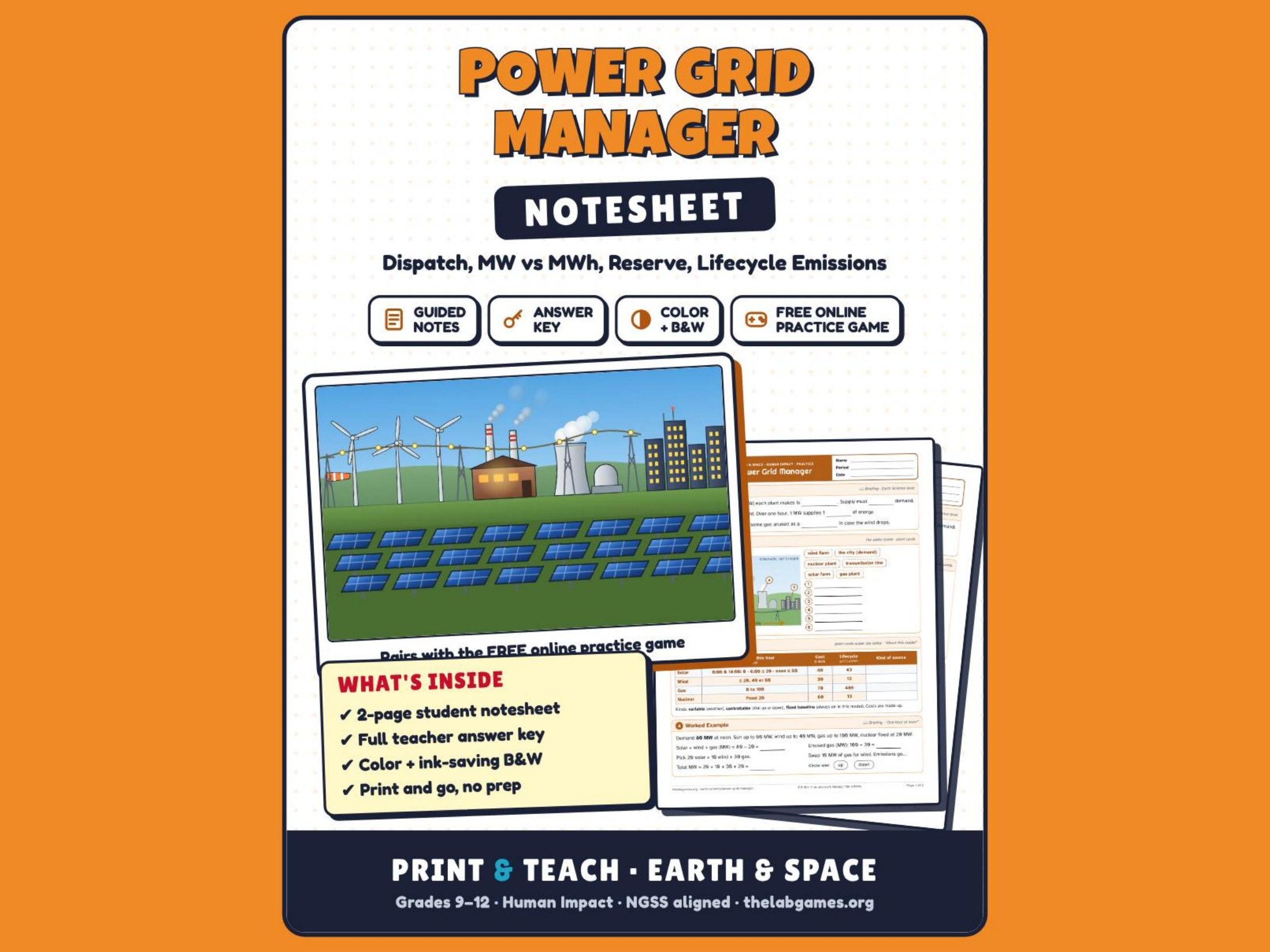
Keep the lights on for one hour. In this roomy, student-friendly 2-page notesheet, students fill in the background on dispatch, supply and demand, megawatts and megawatt-hours and gas reserve, label a valley grid with solar, wind, gas and nuclear plants, sort each source as variable, controllable or a fixed baseline, and follow a worked example that balances an 80 MW noon demand. On page 2 they work four grid orders: a dispatch mix, an emissions comparison for a wind-to-gas swap, a reserve check for a wind drop, and an AP order that checks a mix against a budget and totals its lifecycle tonnes of CO2e.
It pairs with Power Grid Manager, a free online practice game at thelabgames.org where students dispatch solar, wind, gas and nuclear to meet a city’s demand, keep a reserve for a wind drop and total the emissions. Use it in class, for absent-student makeups, or on sub days. A complete teacher key is included.
What’s Included
- Student notesheet (2 pages) in full color AND black & white
- Teacher answer key (red answers) in full color AND black & white
What Students Do
- Background fill-in: dispatch, supply equals demand, solar at night, 1 MW for 1 hour = 1 MWh, gas reserve
- The Valley Grid: label the solar farm, wind farm, gas plant, nuclear plant, transmission line and city
- Plant Cards: classify each source as variable, controllable or fixed baseline, with cost and lifecycle CO2e per kWh
- Worked Example: balance an 80 MW noon demand, find the unused gas and judge a gas-to-wind swap
- Dispatch Orders: build a valid mix, compare emissions after a swap, check a reserve for a wind drop, plus an AP cost and lifecycle-tonnes order
- Key Ideas: capacity factor vs. an hourly forecast, MW vs. MWh, nuclear’s fixed baseline, what lifecycle emissions count
- My Runs: a log for tracking practice scores
Skills & Standards
- Electricity supply and demand, power (MW) vs. energy (MWh), renewable and nonrenewable sources, intermittency, capacity factor, reserve capacity, lifecycle greenhouse gas emissions (g CO2e/kWh), unit conversion
- Supports NGSS HS-ESS3-2, HS-ESS3-4
- Grades 9–12 Earth and Space Science (with an AP Environmental Science order)
Great For
- Energy resources and human impact units
- Absent-student makeups
- Sub plans
- Homework or stations
- Test review
Something went wrong, please try again later.
This resource hasn't been reviewed yet
To ensure quality for our reviews, only customers who have purchased this resource can review it
Report this resourceto let us know if it violates our terms and conditions.
Our customer service team will review your report and will be in touch.
$2.49