


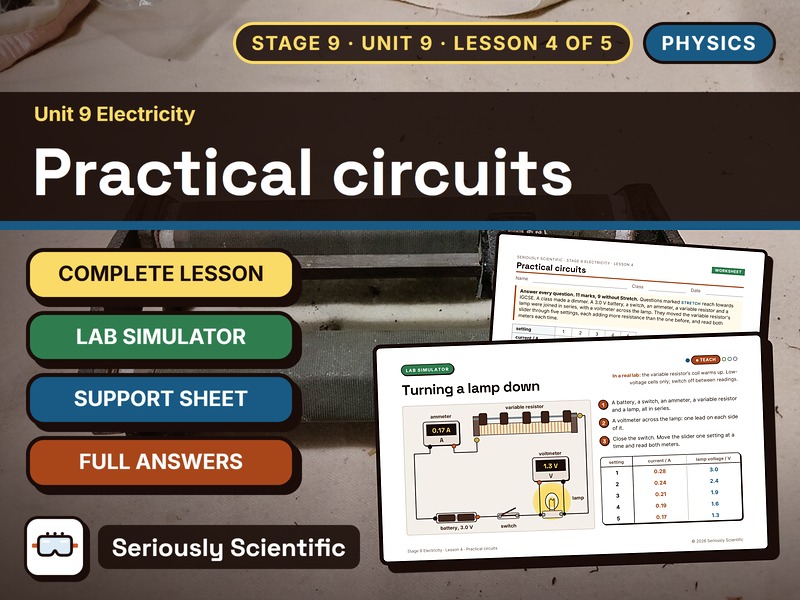
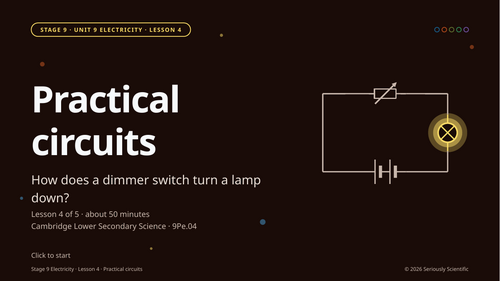
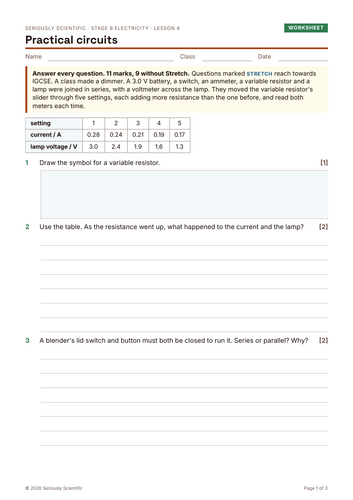
A complete, editable 50-minute lesson on practical circuits for Cambridge Lower Secondary Science Stage 9: a PowerPoint with teacher notes, a differentiated worksheet, homework and full answers.
Lesson 4 of 5 in Unit 9 Electricity, covering framework code 9Pe.04. Its 17 slides open with a finish-the-sentence recall, the success criteria and key vocabulary to check with a click. In the Lab simulator, a lamp is dimmed in five steps with a variable resistor, then students design and compare circuits. After a hinge question and practice, the lesson ends with an exit ticket and a confidence check.
By the end, students can:
- Draw and recognise the symbols for the parts of a circuit.
- Describe how a variable resistor dims a lamp.
- Design circuits with switches in series or in parallel.
- Compare circuits and plan a fair test of one.
- Work out a variable resistor’s resistance from readings (Stretch).
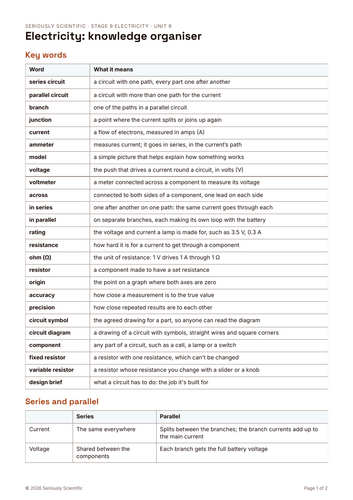
Key vocabulary
- circuit symbol: the agreed drawing for a part, so anyone can read the diagram.
- Also: circuit diagram, component, fixed resistor, variable resistor and design brief.
What’s in the download
- PowerPoint deck, 17 slides, with teacher notes on every slide.
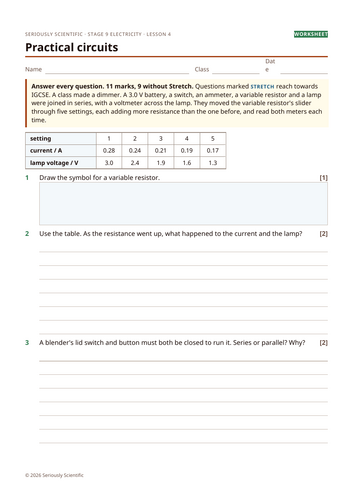
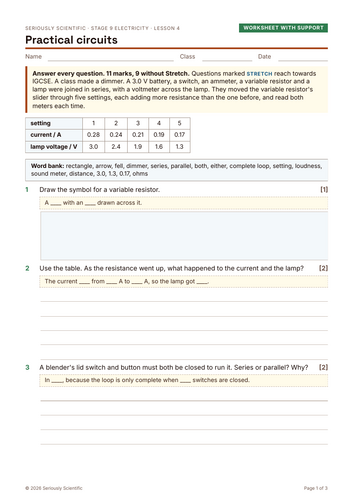
- Worksheet, 11 marks (9 without Stretch), with mark scheme.
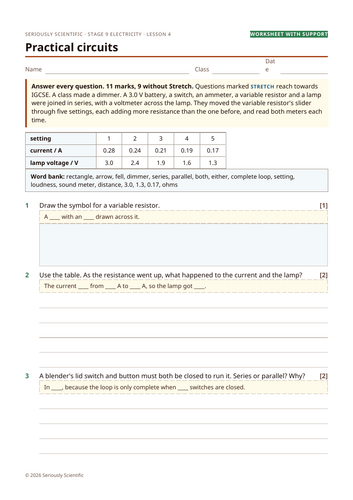
- The same worksheet with support, with a word bank and sentence starters.
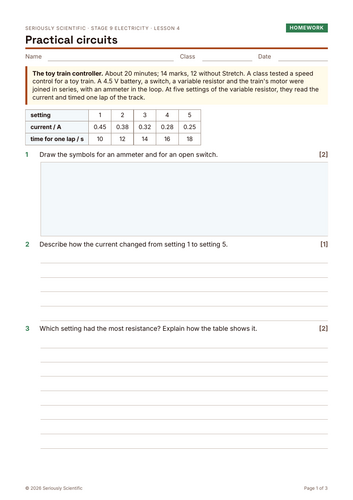
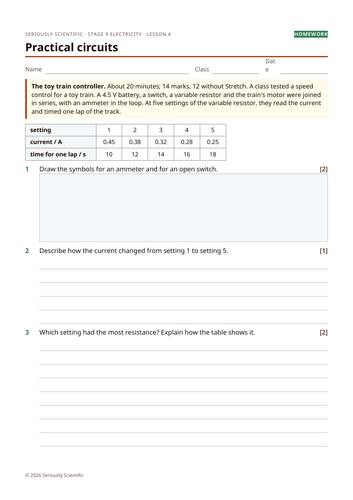
- Homework, about 20 minutes: the toy train controller, 14 marks (12 without Stretch), with mark scheme.
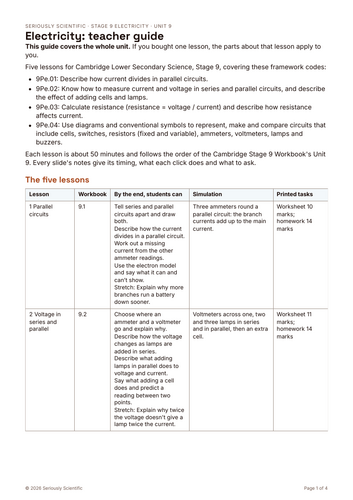
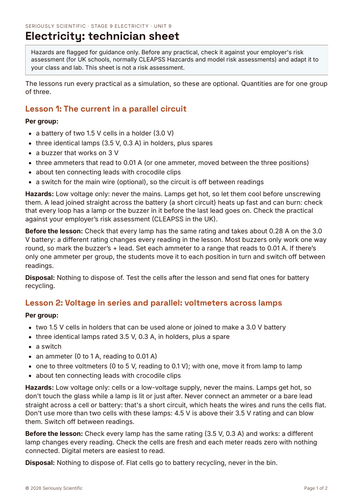
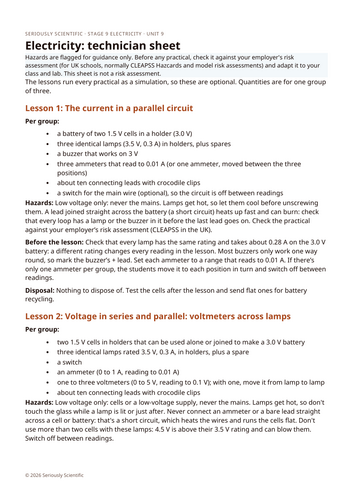
- The unit’s teacher guide, knowledge organiser and technician sheet.
- The worksheets, homework and technician sheet come as editable Word and PDF; the teacher guide and knowledge organiser come as PDF.
Cambridge Lower Secondary Science framework codes
- 9Pe.04: use diagrams and conventional symbols to represent, make and compare circuits that include cells, switches, resistors (fixed and variable), ammeters, voltmeters, lamps and buzzers.
- 9Pe.03 (revisited).
Thinking and Working Scientifically
- 9TWSm.03: symbols and formulae for scientific ideas.
- 9TWSc.02: choosing equipment and using it well.
- 9TWSp.04: planning investigations to test hypotheses.
- 9TWSa.04: evaluating experiments and suggesting improvements.
Science in Context
- 9SIC.02: how science is applied in societies, industry and research.
Outside Cambridge
- England’s KS3 programme covers resistance but doesn’t name circuit symbols or variable resistors.
- For IGCSE, the Stretch part (work out a variable resistor’s resistance from readings) reaches towards it; this is a Stage 9 lesson, not an IGCSE resource.
Good to know
The animations, clicks and sound need desktop PowerPoint; Google Slides and Keynote drop most of them. Written in UK English.
All the questions, data, drawings and animations are my own work. Independent resource, not produced or endorsed by Cambridge University Press & Assessment.
I keep my packs up to date. If it works for your class, a review helps other teachers find it.
Something went wrong, please try again later.
This resource hasn't been reviewed yet
To ensure quality for our reviews, only customers who have purchased this resource can review it
Report this resourceto let us know if it violates our terms and conditions.
Our customer service team will review your report and will be in touch.
£3.50