


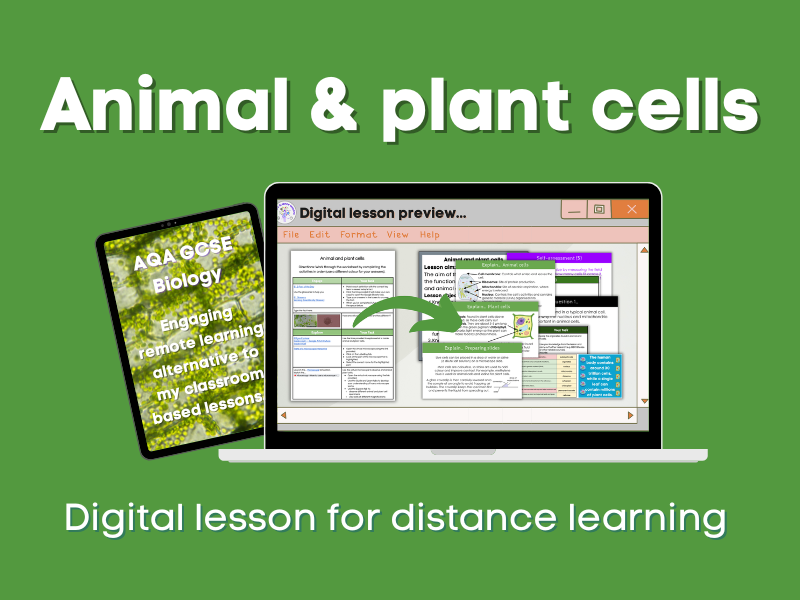
This GCSE Biology distance learning lesson on Animal and plant cells helps students develop their understanding of the function of organelles in plant and animal cells through clear explanations, digital activities, and structured independent tasks.
This is the 2nd in a series of lessons and covers the content from the AQA GCSE 4.1.1 Cell structure & 4.1.3 Transport in cells topics and OUP Kerboodle Scheme B1.2 Animal and plant cells lesson.
The worksheets are fully editable so you can adapt the tasks to your students and the time available.
This adaptable resource is ideal for:
● Distance learning: Independent, structured activities to support remote teaching.
● Missed work recovery: Help students catch up at their own pace.
● Home-schooling: Provide a complete learning sequence for homeschooled students.
Aimed at a mixed ability GCSE class.
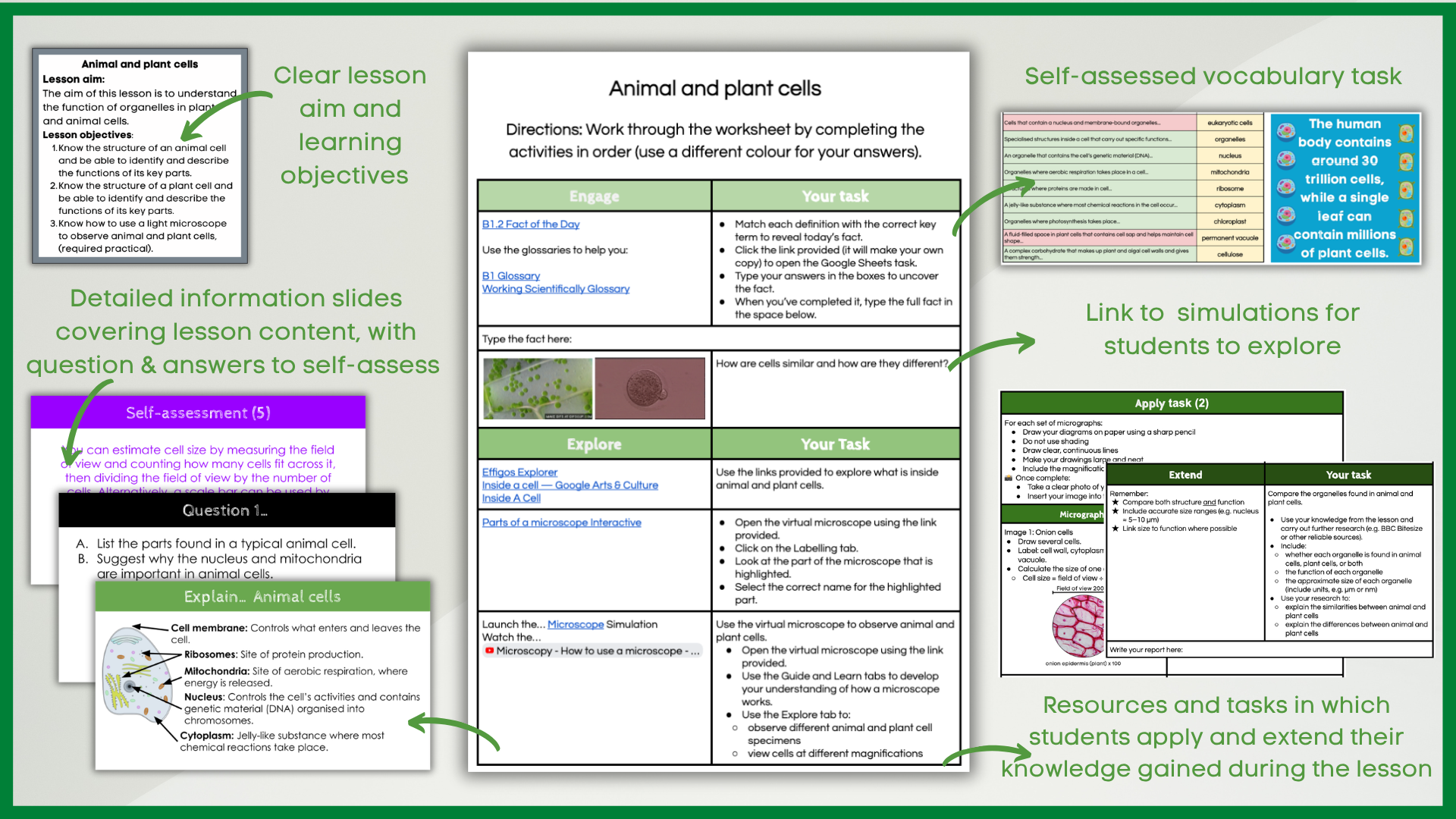
This editable resource includes (8 pages):
● Teacher guidance and answer key – Step-by-step instructions and fully worked solutions to support remote teaching, assessment, and feedback.
● Engage – A vocabulary activity (Google Sheets™) to introduce or reinforce key terms.
● Explore – Guided discovery tasks using interactive simulations and virtual microscopes, including:
○ Exploring cell structure using interactive models
○ Labelling parts of a microscope using a virtual lab
○ Observing cells at different magnifications and recording observations
● Explain – An embedded Google Slides™ presentation with clear explanations and comprehension questions, including:
○ Cell structures and their functions
○ Differences between animal and plant cells
○ Preparing slides and using a microscope
○ Estimating cell size
● Apply – Differentiated tasks allowing students to demonstrate and practice their learning.
○ Labelling animal and plant cells and describing organelle functions
○ Drawing, labelling, and analysing micrographs
○ Calculating cell size using magnification, field of view, and scale bars
● Extend – A challenge task designed to deepen understanding.
○ Comparing organelles in animal and plant cells, including their function, size, and differences
Important:
● Internet Access: Students will need access to a computer with internet access.
● Google Doc™ Format: This resource works best in Google Docs™. Some tasks may not function correctly in Word/Excel versions.
This lesson is also available as a:
● Teacher-led lesson: A fully resourced PowerPoint with instructions, activities, and worksheets.
Animal and plant cells
● Cover lesson worksheet: A ready-to-use version suitable for cover teachers.
Animal and plant cells Cover lesson
If you require more assistance, please contact me at-
info@cmgsciencelessons.com
Get this resource as part of a bundle and save up to 38%
A bundle is a package of resources grouped together to teach a particular topic, or a series of lessons, in one place.
Bundle
B1 Cell structure and transport Distance learning
**10 digital worksheets covering the AQA 9-1 GCSE Biology B1: Cell structure and transport chapter. Students work through the digital worksheets to develop their understanding of microscopy, cell structure, specialised cells, diffusion, osmosis, and active transport.** *Ideal for independent & distance learning / home-school / covering missed content after absence / non-specialist cover lesson* Aimed at a mixed ability class covering content 1-8 **Each digital worksheet includes**: * Explore- Links to articles, video clips, virtual labs, and simulations for students to explore. * Explain- Embedded Google Slides™ presentation (includes lesson objectives, information slides, self-assessed questions). * Apply- Resources and task in which students apply their knowledge gained during the lesson. * Extend- Resources and task for students to extend their learning. *Important: Students must have access to PC with internet to use this document* This resource works best as a Google Doc. with Google Classroom- upload to your Google Drive, right click and select make a copy (this will convert back into Google Doc. format and enable Google Draw and other Google features). This document can also be used with Microsoft Teams, SMHW or sent to students via email, but please note some features (fact of the day, Google Draw) will not be available.
£15.00
Bundle
Animal and plant cells Lesson bundle
**This 3-in-1 GCSE Biology lesson bundle on Animal and plant cells provides everything you need to teach the function of organelles in plant and animal cells in the classroom, support cover teachers, and guide students learning remotely**. Each format is fully editable, allowing you to adapt the resources to suit your teaching style, class needs, and the time available. This lesson is the 2nd in a series of lessons and covers the content from the AQA GCSE 4.1.1 Cell structure & 4.1.3 Transport in cells topics and OUP Kerboodle Scheme B1.2 Animal and plant cells lesson. **Bundle includes**: **1. Teacher-led lesson** (PowerPoint Presentation): ○ Engaging, ready-to-use presentation. ○ Includes everything needed for an effective lesson: teaching notes, activities, worksheets, and guidance. ○ Fully editable to tailor the difficulty and delivery. **2. Cover lesson** (Word Document): ○ A ready-to-use worksheet designed for students to work independently during staff absences. ○ Minimal prep required – just print and go! ○ Fully editable to suit your students and classroom routines. **3. Digital worksheet** (Google Doc™ recommended): ○ Ideal for distance learning, independent study, or catching up on missed work. ○ Guides students through clear explanations and structured tasks. ○ Best used in Google Docs™ to ensure full functionality; some interactive tasks may not work in Word/Excel. ** All three formats come with the required resources, making them easy to use and simple to adapt. This bundle is suitable for mixed-ability GCSE classes**. If you require more assistance, please contact me at- info@cmgsciencelessons.com
£5.00
Something went wrong, please try again later.
This resource hasn't been reviewed yet
To ensure quality for our reviews, only customers who have purchased this resource can review it
Report this resourceto let us know if it violates our terms and conditions.
Our customer service team will review your report and will be in touch.
£3.00