


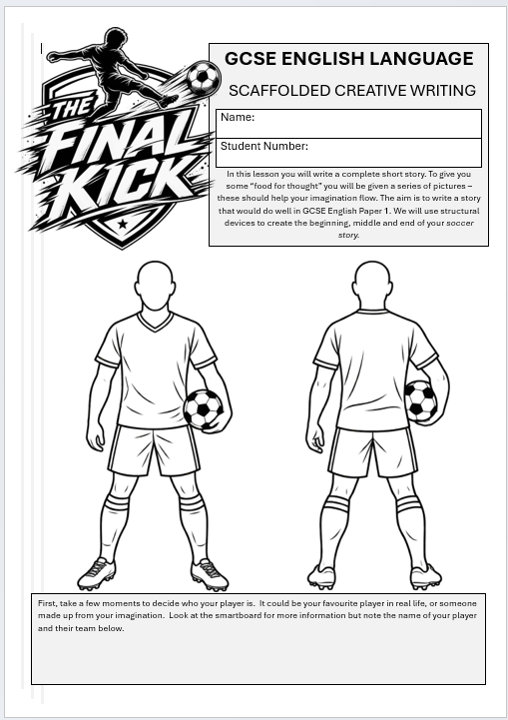
Welcome to “The Final Kick”. This is an editable set of resources, but PDFs are included too.
I really enjoyed creating this and it has gone down very well with my students, both male and female. It is focused entirely on a few moments in a football match – the penalty shoot-out. It may seem like it’s not going to go down too well with those who don’t like football, but I have found that these students have enjoyed it, and the soccer-mad boys and girls love it.
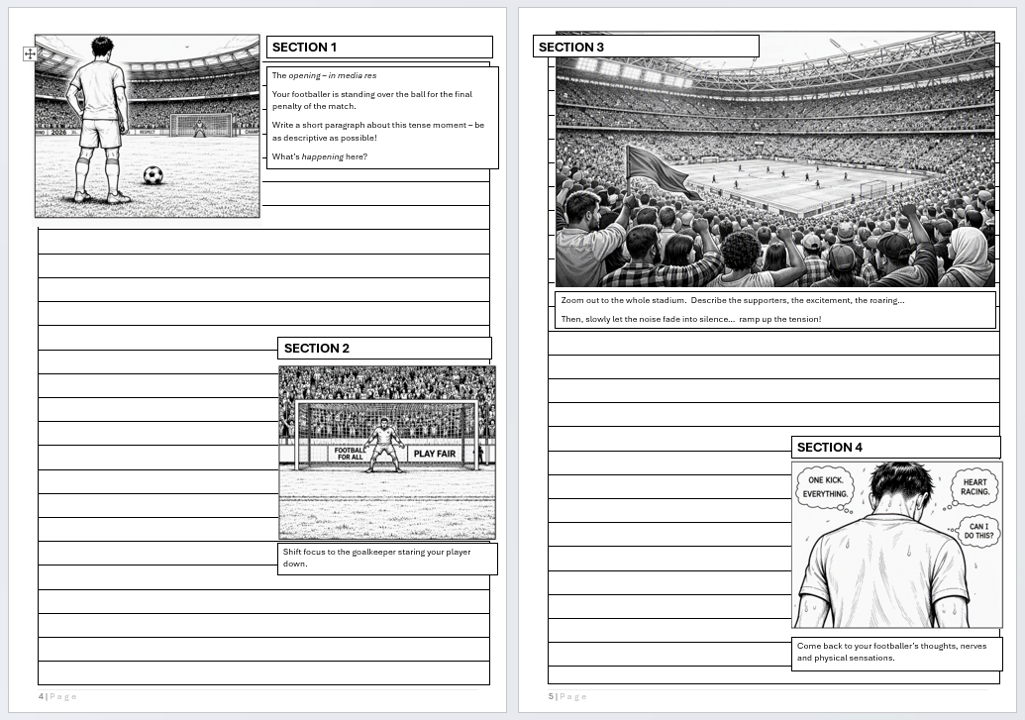
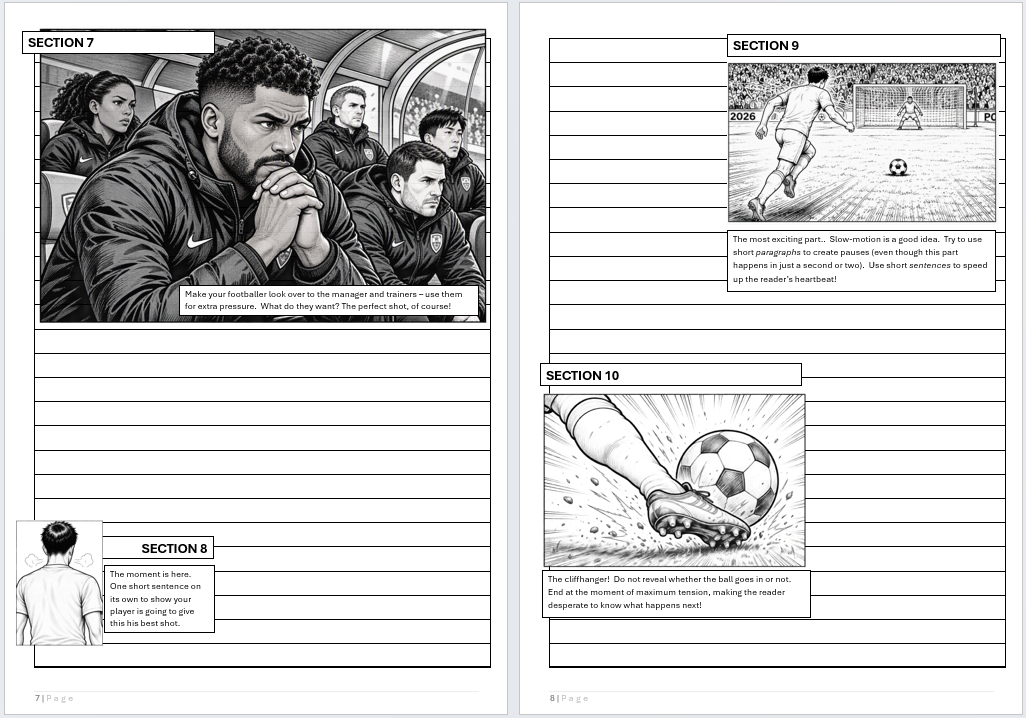
This is a VERY scaffolded resource, using 10 picture prompts (created with AI so no copyright issues), as well as written ones. It also comes with a PowerPoint presentation which can be used to accompany the resource (or on its own if you want to use exercise books). The prompts indicate what they should write. There is also plenty of time for sharing and class discussions between each section.
I often find that I think I have delivered brilliant classes about how to write stories, but then when my learners sit down to write their own, they are left baffled and bewildered about how to start, plan and see a story through to “the end”.
Using a scaffolded approach is one way to encourage students to write good stories which are suitable for GCSE English. It is very much a starting point – and you may still have to persuade reluctant writers to engage – but responses at all grades can be produced using this.
The resource is designed as a 60-90 minute class and it focuses on a FULL RESPONSE for a story featuring a variety of different structural features.
The story is divided into 10 sections of varying lengths. The students build up the story of a footballer approaching a penalty kick and how he feels in the run up to “The Final Kick”.
So, the first (major) prompts, for example, are:
The opening - a picture of a footballer facing the goal mouth for the penalty kick.
Shift of focus - a shift to the goalkeeper staring him down.
Zoom out to the crowd (and a description of them).
…and so on. The story is then further developed with more pictures and prompts which then progress, enabling the students to create a complete response which includes all of the skills descriptors for Paper 1 Question 5. Your students should end up with a piece containing a minimum of 10 paragraphs of varying length with structural features and language devices used throughout. I often give an extension task – asking the students to create a word-processed second draft for homework.
This lesson could also be used as a ‘snap’ creative writing session or a cover class. In fact it’s a highly adaptable (and editable!) resource which you can turn to many things.
Something went wrong, please try again later.
This resource hasn't been reviewed yet
To ensure quality for our reviews, only customers who have purchased this resource can review it
Report this resourceto let us know if it violates our terms and conditions.
Our customer service team will review your report and will be in touch.
£5.00