pptx, 158.36 KB
pptx, 158.36 KB

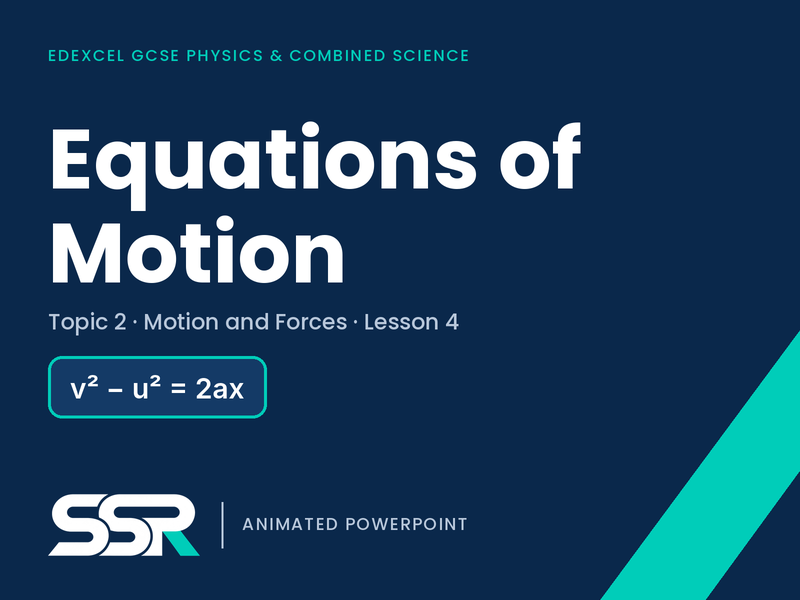
Animated equations of motion PowerPoint for Edexcel GCSE Physics and Combined Science: using v² − u² = 2ax, Topic 2 Lesson 4. Foundation and Higher.

This PowerPoint is written for KS4 classes taking Edexcel GCSE Physics (1PH0) or Combined Science (1SC0), and it takes about 60 minutes. The equation is often typed as v^2 − u^2 = 2ax, and on the Edexcel equation sheet it reads (final velocity)² − (initial velocity)² = 2 × acceleration × distance. Every slide reveals on click, and the deck is fully editable.

What the lesson covers

Spec 2.8–2.9: choosing the right equation, and why no time in the question points to v² − u² = 2ax
Spec 2.9: using the equation for uniform acceleration, with v, u, a and x and their units
Spec 2.9: rearranging to find a distance or an acceleration
Spec 2.9: finding a final velocity and finishing with the square root
Spec 2.9: slowing to a stop, where v = 0 and the acceleration is negative, as a first look at braking distance

What’s inside the 27 slides

A retrieval starter on acceleration from Lesson 3
A recap of squares and square roots, the maths this lesson depends on
Three concept blocks, each with a hinge question and an I do / We do / You do sequence of Edexcel-style exam questions
Model answers that build line by line, with “thinking aloud” prompts that show how to list u, v, a and x first
An exam-answer slide on how Edexcel awards the marks for substitution, rearrangement and the answer
Mini-whiteboard quick-fire checks, a summary slide and an exit ticket

Common mistakes covered

Students can usually use the equation once they know to. They go wrong choosing when to use it, squaring the wrong term, or stopping at v² without taking the square root. The lesson gives a simple test (does the question give a time?) and a fixed order: list the knowns, substitute, rearrange, then square root if the question asks for v. The braking examples lead into stopping distances in Lesson 12.

Part of a complete unit

This is Lesson 4 of 12 in my Edexcel GCSE Physics Motion and Forces unit. Every lesson uses the same structure, so your class learns the routine once and then spends its time on the content.

Previous lesson: Acceleration Calculations Lesson | Edexcel GCSE Physics https://www.tes.com/teaching-resource/resource-13690639

Next lesson: Velocity-Time Graphs Lesson | Edexcel GCSE Physics https://www.tes.com/teaching-resource/resource-13690653

The full unit: all 12 lessons, a revision lesson and two end of topic tests in the Motion and Forces Unit bundle https://www.tes.com/teaching-resource/motion-and-forces-unit-edexcel-gcse-physics-13695559

Last updated: November 2026

Get this resource as part of a bundle and save up to 40%

A bundle is a package of resources grouped together to teach a particular topic, or a series of lessons, in one place.

Bundle

Motion and Forces Unit | Edexcel GCSE Physics

Complete Motion and Forces unit for Edexcel GCSE Physics and Combined Science Topic 2: 12 animated lessons, a revision lesson and two end of topic tests. This bundle is written for KS4 classes taking Edexcel GCSE Physics (1PH0) or Combined Science (1SC0), Foundation and Higher. It covers every specification point in Topic 2 (2.1–2.33P) across 13 lessons and a test. Higher-only and Physics-only content is labelled throughout, so one set of resources works for every group you teach. **What's included** Scalars and Vectors (spec 2.1–2.6, 2.12) Distance-Time Graphs and Measuring Speed (2.7, 2.11) Acceleration (2.8, 2.13) Equations of Motion: v² − u² = 2ax (2.9) Velocity-Time Graphs (2.10) Resultant Force and Newton's First Law (2.14) Newton's Second Law, Weight and Mass (2.15–2.18, 2.22) Core Practical: Force, Mass and Acceleration (2.19) Circular Motion, Higher only (2.20–2.21) Newton's Third Law and Momentum (2.23–2.25) Force, Momentum and Crash Safety (2.26, 2.31) Reaction Times and Stopping Distances (2.27–2.30, 2.32P–2.33P) Motion and Forces Revision Lesson Two parallel end of topic tests (Papers A and B), 60 marks each, with mark schemes in Word and PDF **What every lesson includes** Each of the 13 lessons is an animated, click-to-reveal PowerPoint of 27–35 slides, fully editable, with: A retrieval starter Three or four concept blocks with hinge questions and I do / We do / You do sequences of Edexcel-style exam questions Model answers that build line by line, with "thinking aloud" prompts Exam-answer slides that show exactly what examiners reward Mini-whiteboard quick-fire checks, a summary slide and an exit ticket **Why buy the bundle** Every lesson uses the same structure, so students learn the routine once and spend their time on the content. The lessons build on each other: the acceleration equation from Lesson 3 returns in the core practical, crash safety and stopping distances. Retrieval starters revisit the previous lesson, so knowledge sticks. Levelled 6-mark questions appear throughout, on the skydiver, the core practical method, momentum and crash safety. The unit ends with a revision lesson and two parallel tests. Each test has four labelled routes (Combined Foundation, Combined Higher, Physics Foundation and Physics Higher), so mixed classes can sit the same paper. Use Paper B for resits after feedback. **Ideal for** Teaching Topic 2 for the first time, or rebuilding a scheme of work Departments that want one consistent lesson structure across several teachers Mixed classes with Combined Science and Physics students, or Foundation and Higher together **Save 40%** Lesson 1 is free, and the other 13 resources cost £47.00 bought separately. The bundle gives you the whole Edexcel GCSE Physics Motion and Forces unit for £27.99. If you buy it, I'd be grateful for a review. It helps other teachers find the resources. Last updated: November 2026

£27.99

Reviews

Something went wrong, please try again later.

This resource hasn't been reviewed yet

To ensure quality for our reviews, only customers who have purchased this resource can review it

Report this resourceto let us know if it violates our terms and conditions.
Our customer service team will review your report and will be in touch.