


Animated contact and non-contact forces PowerPoint for Edexcel GCSE Physics and Combined Science: fields, force pairs, vectors and lubrication.
This PowerPoint is Lesson 1 of 5 in Topic 9, Forces and their Effects, for KS4 classes taking Edexcel GCSE Physics (1PH0) or Combined Science (1SC0), Foundation and Higher. It is the only lesson in the topic that every route takes, including Combined Science Foundation. It takes about 60 minutes. Every slide reveals on click, and the deck is fully editable.
What the lesson covers
Spec 9.1a: non-contact forces (gravitational, electrostatic and magnetic) and the field each one acts through
Spec 9.1a and 2.16: weight as a gravitational force, and W = m × g rearranged for mass and g
Spec 9.1b: contact forces, including the normal contact force, friction and tension
Spec 9.10: friction between moving parts in machines, and how lubrication reduces unwanted energy transfer
Spec 9.1c: Newton’s third law, and drawing the pair of forces from one interaction as vectors
Spec 9.1c: telling a pair of forces from two balanced forces on the same object
Spec 9.2: vectors and scalars, including the pairs students often mix up
What’s inside the 24 slides
A retrieval starter on resultant force from the motion unit
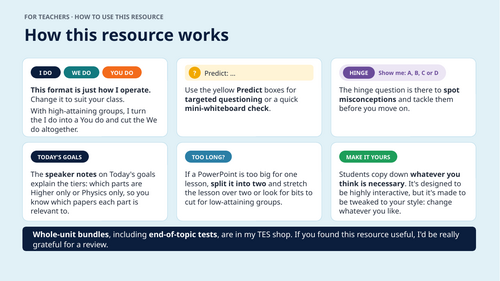
Seven concept slides, with hinge questions and I do / We do / You do sequences of Edexcel-style exam questions
A short You do on rearranging W = m × g
Worked questions on a child pulling a toy wagon, a climber hanging on a rope and a footballer kicking a ball
A We do with a word bank for naming forces and their fields
An exam-answer slide on testing whether two forces are a pair
Mini-whiteboard quick-fire checks, a summary slide and an exit ticket
Common mistakes covered
The weight of an object and the normal contact force on it are often called a Newton’s third law pair. They are equal and opposite, but they act on the same object, so they are not a pair. The lesson uses a laptop on a desk to separate the two ideas, and the exam-answer slide gives one test: which object does each force act on? Students also tend to name a non-contact force without its field, and to treat mass and weight as the same quantity. Both are covered on their own slides.
Part of a complete unit
This is Lesson 1 of 5 in my Edexcel GCSE Physics Forces and their Effects unit. Lessons 2 and 3 are Higher only, and Lessons 4 and 5 are Physics only, so each group can follow its own route through the unit.
Next lesson: Free Body Diagrams Lesson | Edexcel GCSE Physics (Higher) https://www.tes.com/teaching-resource/resource-13699159
The full unit: all 5 lessons, a revision lesson and two end of unit tests in the Forces and their Effects Unit bundle https://www.tes.com/teaching-resource/resource-13699186
Last updated: November 2026
Something went wrong, please try again later.
This resource hasn't been reviewed yet
To ensure quality for our reviews, only customers who have downloaded this resource can review it
Report this resourceto let us know if it violates our terms and conditions.
Our customer service team will review your report and will be in touch.
£0.00