


Animated free body diagrams PowerPoint for Edexcel GCSE Physics and Combined Science, Higher tier: resultant forces, systems and constant velocity.
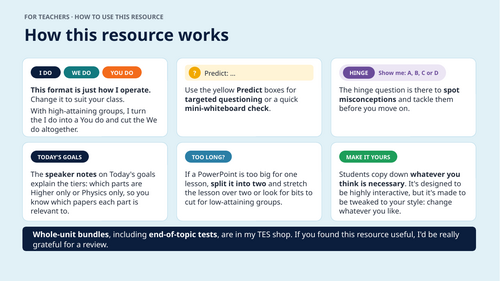
This PowerPoint is Lesson 2 of 5 in Topic 9, Forces and their Effects, for KS4 Higher tier classes taking Edexcel GCSE Physics (1PH0) or Combined Science (1SC0). All of this content is Higher only, and the slides say so. It takes about 60 minutes. Every slide reveals on click, and the deck is fully editable.
What the lesson covers
Spec 9.4: drawing a free body diagram with one object and only the forces acting on it, each arrow from the centre
Spec 9.4: reading a free body diagram to find the resultant force along each line
Spec 9.4: three forces on a block resting on a slope, with the weight straight down and the normal contact force at right angles to the slope
Spec 9.5: several forces on one object giving one resultant force
Spec 9.5: finding the resultant force on a whole system, such as a window cleaner standing in a cradle
Spec 9.5: balanced forces, a zero resultant and moving at a constant velocity
What’s inside the 24 slides
A retrieval starter on pairs of forces from Lesson 1
Six concept slides, with hinge questions and I do / We do / You do sequences of Edexcel-style exam questions
Worked questions on a hovering drone, a bucket pulled up a well and two movers pushing a piano
A recap of W = m × g before the system questions
A levelled 6-mark question on a block pulled across a table by a string over a pulley, modelled step by step
A slide showing where the 6 marks come from, level by level, with example answers
A 6-mark You do on a tram moving at a constant velocity
Mini-whiteboard quick-fire checks, a summary slide and an exit ticket
Common mistakes covered
Students often draw forces that the object exerts on something else, or start arrows from the edge of the object instead of its centre. For a block on a slope, many draw the weight acting down the slope. When they explain a constant velocity, answers tend to list forces without saying what balances what. The exam-answer slide gives an order to follow: the horizontal forces first, then the vertical ones, naming each force, its direction and the force that balances it.
Part of a complete unit
This is Lesson 2 of 5 in my Edexcel GCSE Physics Forces and their Effects unit. It leads into scale drawings and resolving forces in Lesson 3, which is also Higher only.
Previous lesson: Contact & Non-Contact Forces Lesson | Edexcel GCSE https://www.tes.com/teaching-resource/resource-13699155
Next lesson: Resolving Forces & Vector Diagrams Lesson | Edexcel GCSE https://www.tes.com/teaching-resource/resource-13699163
The full unit: all 5 lessons, a revision lesson and two end of unit tests in the Forces and their Effects Unit bundle https://www.tes.com/teaching-resource/resource-13699186
Last updated: November 2026
Something went wrong, please try again later.
This resource hasn't been reviewed yet
To ensure quality for our reviews, only customers who have purchased this resource can review it
Report this resourceto let us know if it violates our terms and conditions.
Our customer service team will review your report and will be in touch.
£3.50