


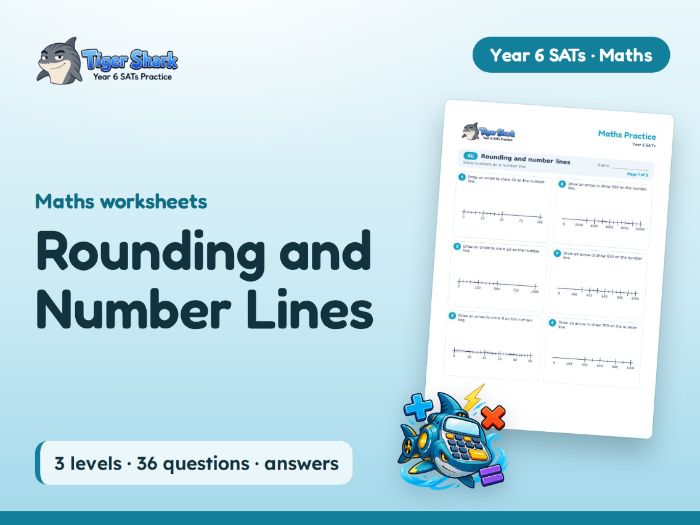
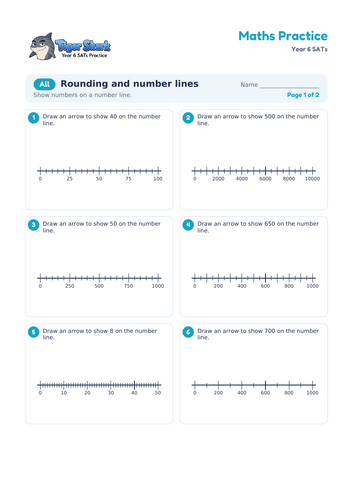
Year 6 SATs maths worksheets on rounding and number lines: 36 questions in three levels (All, Most, Some), with working space and answers. Free PDF.
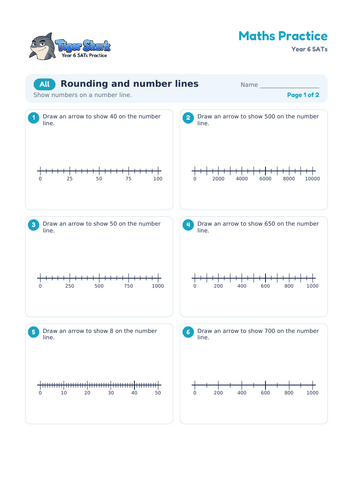
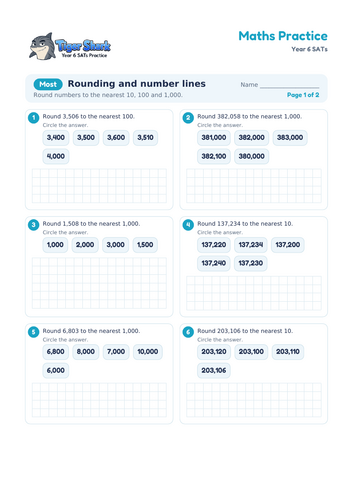
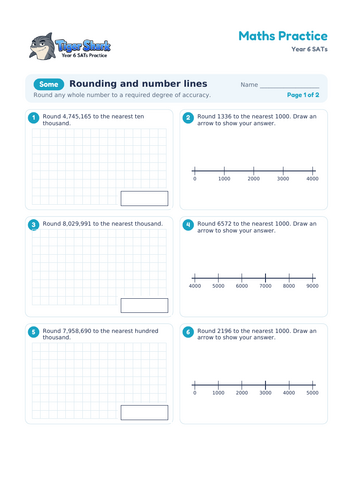
7-page A4 PDF from the Tiger Shark Education question bank. All: Show numbers on a number line. Most: Round numbers to the nearest 10, 100 and 1,000. Some: Round any whole number to a required degree of accuracy. Each level is two pages of six questions, each with its own diagram and space for working, and the last page has every answer, with the correct drawing for each “draw it” question. Each level is also available as its own 3-page PDF. Example questions from the Some level: Round 4,745,165 to the nearest ten thousand / Round 1336 to the nearest 1000. Draw an arrow to show your answer.
What is rounding and number lines? Rounding replaces a number with a simpler number close to it, to the nearest 10, 100, 1,000 or whole number, or to a number of decimal places. Number lines help children see which value a number is closest to. Year 6 pupils round any whole number to a required degree of accuracy and read scales with unlabelled divisions.
Common mistakes and tips: Children often round to the wrong place or look at the wrong digit when deciding whether to round up. The midpoint (exactly 5) causes confusion: it rounds up. On number lines, errors come from not working out what each division is worth. Ask children to find the value of one interval before reading or placing any number.
In the KS2 SATs, this topic can appear on the arithmetic paper, on the two reasoning papers, or both. Reasoning questions often wrap the skill in a context or ask children to explain an answer, so the three levels on this sheet build from fluency to the kind of problem pupils meet in the test.
Ways to use it: whole-class differentiation (three levels for the same lesson), focused intervention for children working towards the expected standard, homework, or targeted revision before the SATs. Set one level as a quick assessment and use the answers to decide who needs another lesson on the topic.
Building fluency over time: revisiting this topic little and often throughout the year, rather than only in one unit, helps children retain it for the SATs. A few questions from the All or Most level make a good retrieval starter several weeks after the topic was first taught.
Use All for children working towards the expected standard, Most for secure Year 5 skills and Some for SATs-standard practice: three entry points to the same lesson. Suits whole-class differentiation, intervention groups, homework and SATs revision, and upper KS2 generally.
Part of a set of 42 Year 6 maths topics.
Something went wrong, please try again later.
This resource hasn't been reviewed yet
To ensure quality for our reviews, only customers who have downloaded this resource can review it
Report this resourceto let us know if it violates our terms and conditions.
Our customer service team will review your report and will be in touch.
£0.00