


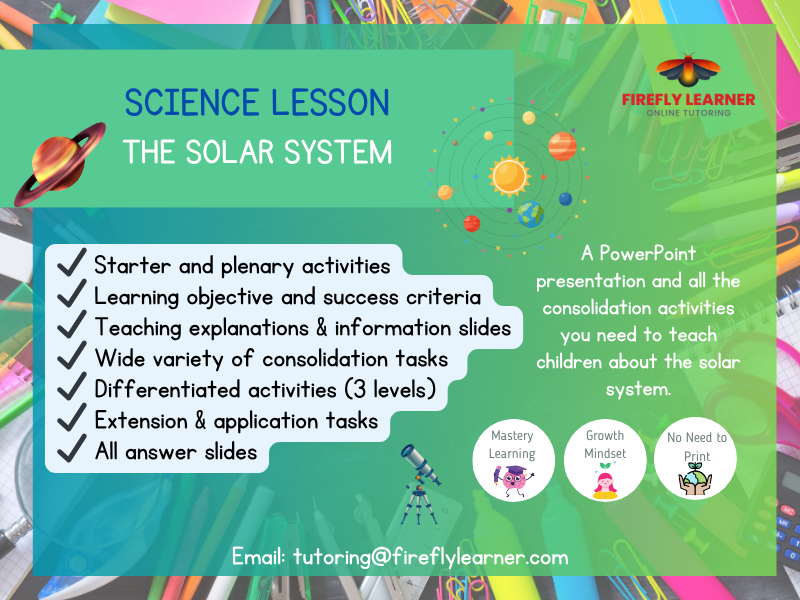
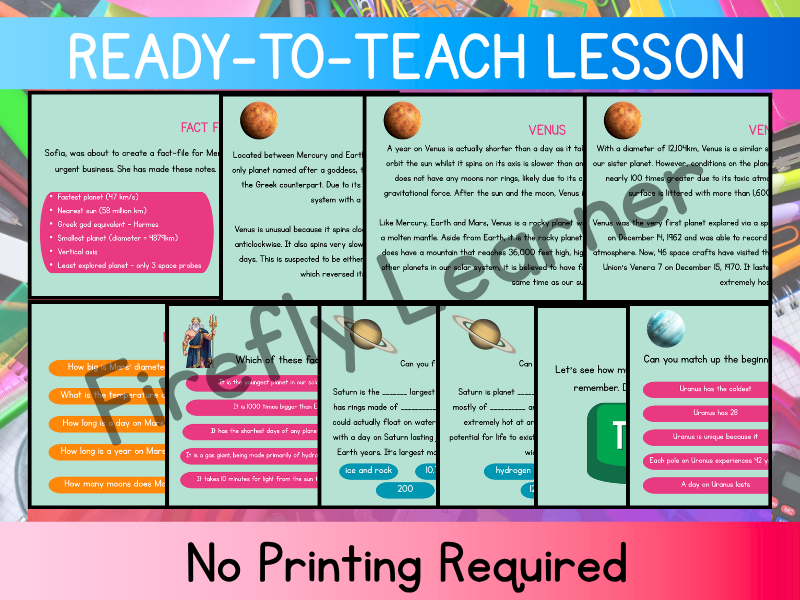
This resource is a PowerPoint presentation lesson which includes everything you need to teach children in KS2 and KS3 about the solar system.
It helps children name, identify and describe each of the planets, order them in terms of their distance from the sun and explain how they are held in their orbits by gravity. It covers the relationship between gravity, mass and distance as well as introducing children to other objects in the solar system (dwarf planets, moons, asteroids, comets etc.)
The lesson includes a wide range of consolidation activities (differentiated) for students to complete to show that they have understood the content of the lesson.
It is complete with:
√ Learning objective
√ Success criteria
√ Starter and plenary activities
√ Assessment of relevant prior learning
√ Teaching input/ information slides
√ A variety of consolidation tasks (differentiated)
√ Application, research and extension activities
√ All answer slides
Learning Objective:
LO: To describe the planets, explain how they are held in their orbits and also categorise other bodies in our solar system.
Success Criteria:
I can list objects that make up the solar system.
I can describe the planets in our solar system.
I can explain why the objects in our solar system are positioned and move in the way that they do.
I can list the planets in order in terms of their distance from the sun.
I can explain the relationship between mass, distance and gravity.
Vocabulary: Mercury, Venus, Earth, Mars, Jupiter, Saturn, Uranus, Neptune, solar system, the sun, moon, Pluto, Zeus, Kronus, Hermes, Poseidon, Ouranus, Ares, Aphrodite, distance, orbit, axis, day, year, temperature, probes, atmosphere, iron, core, dense, surface, clockwise, anticlockwise, collision, diameter, sister planet, pressure, sulfuric acid, carbon dioxide, hydrogen, helium, volcanoes, Mariner, NASA, Venera, Soviet Union, hostile, conditions, rings, gravity, molten, mantle, crater, Borealis Basin, gas giant, Europa, Ganymede, Io, Callisto, rotation, Titan, Enceladus, composition, dwarf planets, comets, asteroids, Apophis, Phobos, Vesta, Phoebe, Haumea, Gonggong, Eros, Ceres, Pallas, Davida, Miranda, Chiron, Quaoar, Eris, Deimos, Pluto, Hygiea, Sylvia, Ariel, Orcus, Makemake, Sedna
Consolidation tasks: match ups, question and answer tasks, research tasks, fill in the blanks, true or false tasks, word-searches, word select activities, anagrams, writing tasks, mneumonic creator activity, multiple choice questions, labeling tasks, ordering and categorising tasks etc.
This lesson is also suitable for being delivered remotely through online learning with some slight adaptations. It could combine very well with platforms such as Pear Deck.
Something went wrong, please try again later.
This resource hasn't been reviewed yet
To ensure quality for our reviews, only customers who have purchased this resource can review it
Report this resourceto let us know if it violates our terms and conditions.
Our customer service team will review your report and will be in touch.
£3.00