

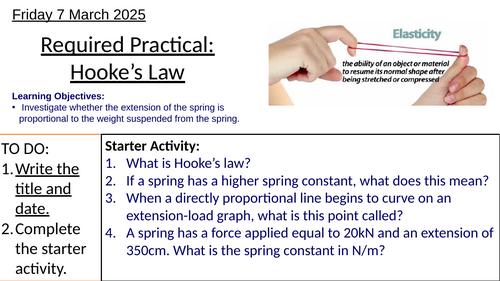

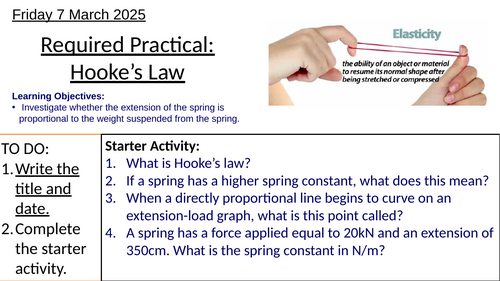
This PowerPoint resource is a detailed and interactive lesson designed to investigate the relationship between the weight applied to a spring and its extension, in accordance with Hooke’s Law. It is ideal for high school physics lessons focusing on forces and elasticity.
Key learning objectives:
- Understanding Hooke’s Law and its mathematical expression: F=k×x, where F is the force, k is the spring constant, and x is the extension.
- Conducting a practical investigation to determine if the extension of a spring is proportional to the applied force.
- Analyzing experimental data to calculate the spring constant and identify the limit of proportionality.
Resource features:
The lesson begins with a starter activity to review foundational knowledge, including defining Hooke’s Law, interpreting extension-load graphs, and calculating the spring constant. The practical task involves setting up equipment, adding weights to a spring, measuring its extension, and recording data in a table.
Students are guided to:
- Plot extension versus weight on a graph.
- Draw a line of best fit through the origin to assess proportionality.
- Use the gradient of the graph to calculate the spring constant.
The resource emphasizes precision in measurements, such as using a ruler aligned with the spring’s zero mark and a splint to avoid parallax errors. It includes worked examples and questions to help students interpret results and understand the material properties influencing spring behavior.
File details:
This editable ‘.pptx’ file aligns with physics curricula and supports both practical sessions and theoretical learning. It features clear visuals, step-by-step instructions, and real-world applications, making it an excellent tool for teaching elasticity and forces.
Get this resource as part of a bundle and save up to 67%
A bundle is a package of resources grouped together to teach a particular topic, or a series of lessons, in one place.
Bundle
GCSE Physics Forces Bundle: 7-Lesson Unit
This resource bundle includes seven PowerPoint lessons designed to introduce and explore key concepts about forces. Aligned with high school physics curricula, these lessons provide a comprehensive framework for understanding foundational physics topics and applying them to real-world scenarios. Included Lessons: 1. Scalars and Vectors This lesson introduces scalar and vector quantities, emphasizing their differences and applications. Students learn to represent vectors using diagrams and solve basic vector problems with guided practice. 2. Introduction to Forces An engaging overview of forces, including contact and non-contact forces. Students explore common forces such as gravity, friction, and tension and learn to measure forces using a newton meter through practical activities. 3. Resultant Forces Students learn to calculate the resultant force when multiple forces act on an object. The lesson explains equilibrium, balanced and unbalanced forces, and how they affect motion, with interactive examples. 4. Parallelogram of Forces This lesson introduces the parallelogram method for calculating the resultant force when two forces act at an angle. It includes step-by-step instructions for drawing scale diagrams and solving vector problems. 5. Centre of Mass Students explore the concept of the center of mass, including how to find it in symmetrical and irregular objects. The lesson also covers the relationship between center of mass and stability, with hands-on activities and visual aids. 6. Forces, Elasticity and Hooke's Law This lesson examines elastic and inelastic deformation, Hooke’s Law, and force-extension graphs. Students practice calculating forces, spring constants, and extensions using real-world examples. 7. Springs Practical Hooke's Law A hands-on investigation of the relationship between force and extension in springs. Students apply Hooke’s Law, calculate spring constants, and analyze experimental data to understand material behavior. Resource Features: Each PowerPoint includes interactive starter activities, clear explanations, visual aids, and problem-solving tasks. Practical experiments and real-life applications reinforce theoretical concepts, ensuring comprehensive understanding. All files are editable '.pptx' formats, enabling customization for specific class needs. File Details: This resource bundle aligns with current physics curricula. It provides an engaging, structured, and practical approach to teaching forces, motion, and mechanics, making it an invaluable resource for educators.
£6.00
Bundle
GCSE Physics Forces and Motion Bundle: 15-Lesson Unit
This comprehensive resource bundle includes 15 PowerPoint lessons that cover the foundational principles of physics related to forces and motion. Designed for high school physics curricula, this bundle provides a structured and engaging approach to teaching these essential topics, blending theoretical knowledge with practical applications. Lessons Included: 1. Scalars and Vectors Introduces scalar and vector quantities, emphasizing their differences and real-world applications. Includes vector diagram representation and problem-solving tasks. 2. Introduction to Forces Explores contact and non-contact forces, measurement using newton meters, and the effects of forces like gravity, friction, and tension. 3. Resultant Forces Covers the calculation of resultant forces, equilibrium, and the effects of balanced and unbalanced forces on motion. 4. Parallelogram of Forces Teaches the parallelogram method for finding resultant forces acting at angles using scale diagrams. 5. Centre of Mass Explains the concept of the center of mass, how to locate it in objects, and its role in stability and equilibrium. 6. Forces, Elasticity and Hooke's Law Examines Hooke’s Law, force-extension graphs, and the distinction between elastic and inelastic deformation. 7. Springs Practical Hooke's Law A hands-on investigation of Hooke’s Law, focusing on calculating spring constants and analyzing experimental data. 8. Speed Introduces the speed formula and explores the relationships between speed, distance, and time through practical examples. 9. Distance-Time Graphs Teaches students how to interpret and analyze distance-time graphs, describing motion and calculating speed. 10. Acceleration Explains acceleration as the rate of change of velocity, including its calculation and real-world applications. 11. Velocity-Time Graphs Focuses on interpreting velocity-time graphs to calculate acceleration and distance traveled using gradients and areas under curves. 12. Force and Acceleration F = ma Covers Newton’s Second Law of Motion, guiding students through calculations of force, mass, and acceleration in various scenarios. 13. Acceleration Practical A hands-on investigation of how force affects the acceleration of a trolley, using a data logger and light gates. 14. Weight and Terminal Velocity Differentiates between mass and weight, explains terminal velocity, and examines forces acting on falling objects. 15. Thinking, Braking and Stopping Distance Investigates factors affecting stopping distances, such as speed, reaction time, and road conditions, with calculations of thinking and braking distances. Resource Features: Each PowerPoint lesson includes engaging starter activities, clear explanations, practical examples, visual aids, and problem-solving tasks. Lessons blend theoretical physics with real-world applications to ensure comprehensive understanding and student engagement. Hands-on experiments and interactive tasks help reinforce learning. File Details: This editable '.pptx' bundle aligns with current physics curricula. It provides a complete toolkit for teaching forces and motion in a structured, interactive, and practical manner, making it an essential resource for educators.
£10.00
Bundle
AQA GCSE Foundation Combined Science Physics: All Required Practicals
This bundle provides a comprehensive set of lessons covering all required practical investigations for the AQA GCSE Foundation Combined Science: Physics course. Each presentation includes step-by-step methods, clear diagrams, data analysis tasks, and exam-style questions to ensure students fully understand the scientific techniques and concepts behind each experiment. Practical work is an essential part of the AQA GCSE Physics specification, helping students develop data collection, analysis, and evaluation skills. This bundle provides structured guidance for each required practical, ensuring students can conduct experiments effectively and interpret their results with confidence. What’s Included in the Bundle? **1. Required Practical: Density** * Investigating the density of liquids, regular solids and irregular solids. * Measuring volume using a displacement method and mass using a balance. * Applying the density equation (Density = Mass ÷ Volume). **2. Required Practical: Specific Heat Capacity** * Using an electric heater and thermometer to measure the specific heat capacity of a material. * Applying the equation ΔE = m × c × Δθ. * Reducing heat loss and improving accuracy in experiments. **3. Required Practical: Resistance of a Wire** * Investigating how changing the length of a wire affects its resistance. * Using a voltmeter and ammeter to measure resistance. * Applying Ohm’s Law (V = IR) to calculate resistance. **4. Required Practical: Resistance in Series and Parallel Circuits** * Investigating how resistance changes when resistors are added in series and parallel. * Explaining why series circuits increase resistance while parallel circuits decrease it. * Using circuit simulations and real practicals. **5. Required Practical: Component Characteristics** * Measuring the current-voltage (I-V) characteristics of a fixed resistor, filament lamp, and diode. * Identifying ohmic and non-ohmic conductors. * Plotting I-V graphs to analyze resistance changes. **6. Required Practical: Waves – Measuring Wave Speed** * Investigating wave speed in a solid (string) and in water (ripple tank method). * Using the wave equation (v = fλ) to calculate wave speed. **7. Required Practical: Infrared Radiation – Absorption and Emission** * Using a Leslie cube and boiling tubes to measure how different surfaces absorb and emit infrared radiation. * Comparing black, shiny, and white surfaces. * Evaluating heat transfer and cooling rates. **8. Required Practical: Hooke’s Law (Springs Practical)** * Investigating how a spring extends under different forces. * Using Hooke’s Law (F = kx) to determine the spring constant. **9. Required Practical: Acceleration (Newton’s Second Law)** * Investigating the relationship between force, mass, and acceleration using trolleys and pulleys. * Applying F = ma to analyze results. Why Use This Resource? * Fully aligned with the AQA GCSE Foundation Combined Science: Physics specification. * Step-by-step methods with structured activities and clear diagrams. * Exam-style questions and data analysis tasks to prepare students for assessments. * Fully editable PowerPoint (.pptx) files to adapt for different lessons. Last updated: March 2025. This bundle is perfect for teachers, tutors, and students looking for a comprehensive and structured approach to GCSE Physics required practicals. Download now to support practical-based learning in the classroom!
£9.99
Something went wrong, please try again later.
This is an excellent resource. The video is great too.
Report this resourceto let us know if it violates our terms and conditions.
Our customer service team will review your report and will be in touch.
£2.00