


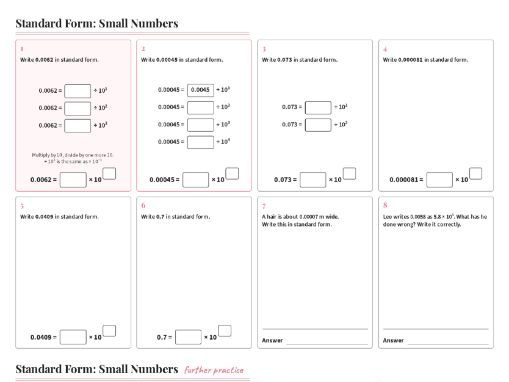
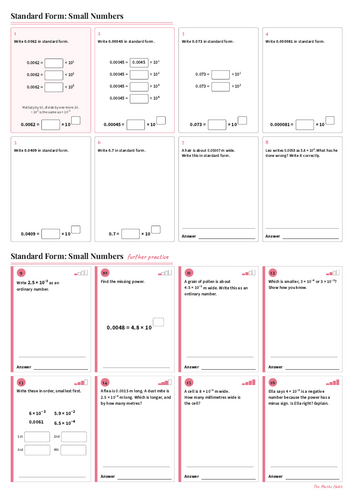
Write small numbers in standard form by seeing why it works: 0.0062 = 6.2 × 10⁻³ because you multiply by 10 and divide by one more 10, a line at a time. 16 questions, full answers included.
Worksheet (1 page): the first questions write out every step, multiplying by 10 and dividing by one more power of 10 until the number is between 1 and 10, with a reminder that ÷ 10³ is the same as × 10⁻³. The steps fade question by question until students write numbers like 0.0409 and 0.7 straight into standard form, then write the width of a hair in standard form and correct a common error (0.0058 written as 5.8 × 10³).
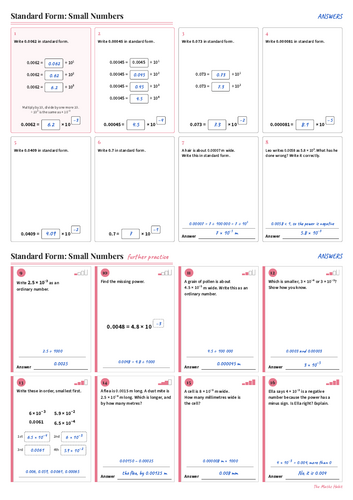
Further practice (1 page): graded by difficulty, with standard form back to ordinary numbers, finding a missing power, comparing and ordering numbers given in a mix of forms, and contexts such as pollen, a flea, a dust mite and a cell width in millimetres. It finishes with the misconception that a negative power makes a negative number.
Answers to all 16 questions are included as a separate file.
Suitable for GCSE Foundation (AQA N9) and for Key Stage 3 classes working on standard form.
AI was used to help create this resource, working from my own lesson design.
Something went wrong, please try again later.
This resource hasn't been reviewed yet
To ensure quality for our reviews, only customers who have downloaded this resource can review it
Report this resourceto let us know if it violates our terms and conditions.
Our customer service team will review your report and will be in touch.
£0.00