


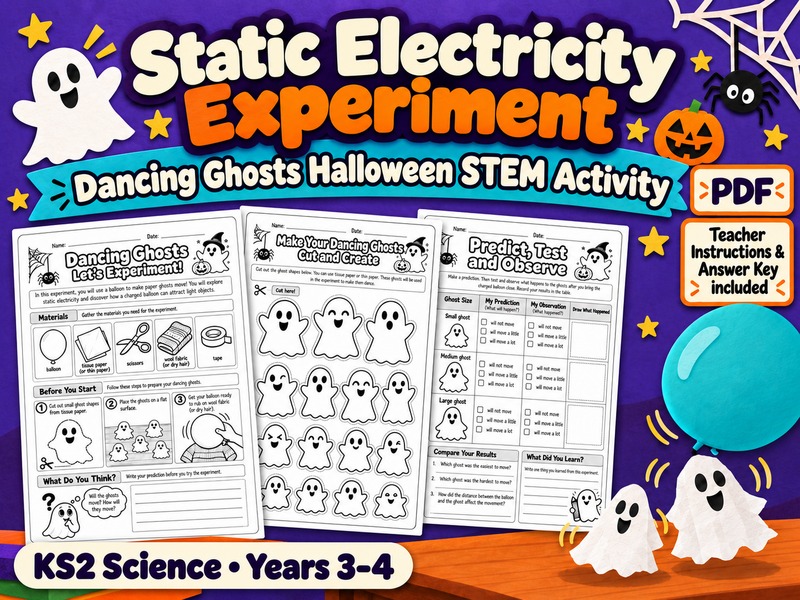
Bring science to life this Halloween with this fun and engaging Dancing Ghosts Static Electricity Experiment!
In this hands-on Halloween Science and STEM activity, children use a balloon and lightweight paper ghosts to explore how static electricity can attract objects without touching them.
Children create their own paper ghosts, make predictions, carry out a practical investigation, record their observations and explore how rubbing a balloon against wool or dry hair produces an electrostatic charge.
This engaging activity combines practical science, scientific enquiry, prediction, observation and a creative Halloween-themed craft.
Perfect for KS2 Science, Halloween classroom activities, October STEM lessons and practical investigations throughout the school year!
What’s Included?
6-Page Printable PDF Resource
-
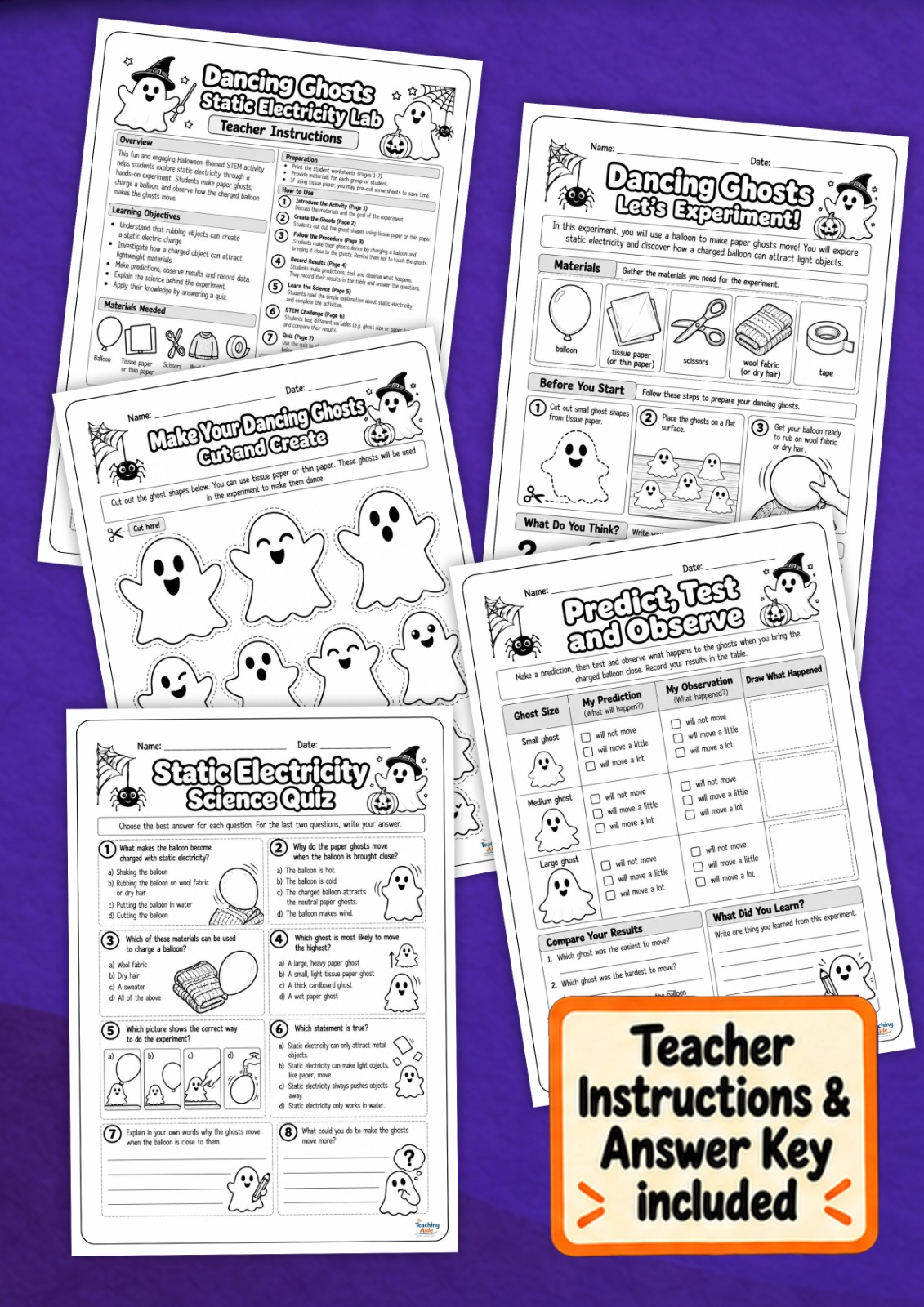
Teacher Instructions & Answer Key
-
Dancing Ghosts Experiment!
-
Make Your Dancing Ghosts – Cut and Create
-
Predict, Test and Observe
-
Static Electricity Science Quiz
6 multiple-choice questions
2 short-answer questions
Questions about static electricity, electrostatic attraction and experimental observations
Learning Objectives
Children will:
Understand that rubbing certain materials can produce static electric charge.
Investigate how a charged balloon attracts lightweight objects.
Make scientific predictions before conducting an experiment.
Carry out a simple practical investigation.
Observe and record experimental results.
Compare how different-sized paper ghosts respond to electrostatic attraction.
Explore how changing variables can affect experimental outcomes.
Develop scientific vocabulary and reasoning skills.
Curriculum Links – England
Key Stage 2 Science – Working Scientifically
This activity supports opportunities for children to:
Ask relevant scientific questions.
Make predictions based on scientific understanding.
Set up simple practical enquiries.
Make careful observations.
Record findings using tables and drawings.
Use results to draw simple conclusions.
Identify differences and patterns in experimental results.
This activity provides an enrichment opportunity for exploring electricity through electrostatic attraction.
Please note: Static electricity is not a specific statutory topic in the Year 4 electricity curriculum. This resource is best used as a supplementary practical investigation or STEM enrichment activity.
Safety Note: Adult supervision is recommended when using balloons and scissors. Keep uninflated or broken balloons away from young children. For best results, use dry, lightweight paper and a dry balloon.
Enjoyed this resource?
Please consider leaving a review. Your feedback helps other teachers discover useful teaching materials and supports the creation of more educational resources.
Follow Teaching Aide for more primary science worksheets, STEM challenges, practical investigations and seasonal teaching resources.
Something went wrong, please try again later.
This resource hasn't been reviewed yet
To ensure quality for our reviews, only customers who have purchased this resource can review it
Report this resourceto let us know if it violates our terms and conditions.
Our customer service team will review your report and will be in touch.
£3.00