


Jacob the Liar
by Jurek Becker
About_
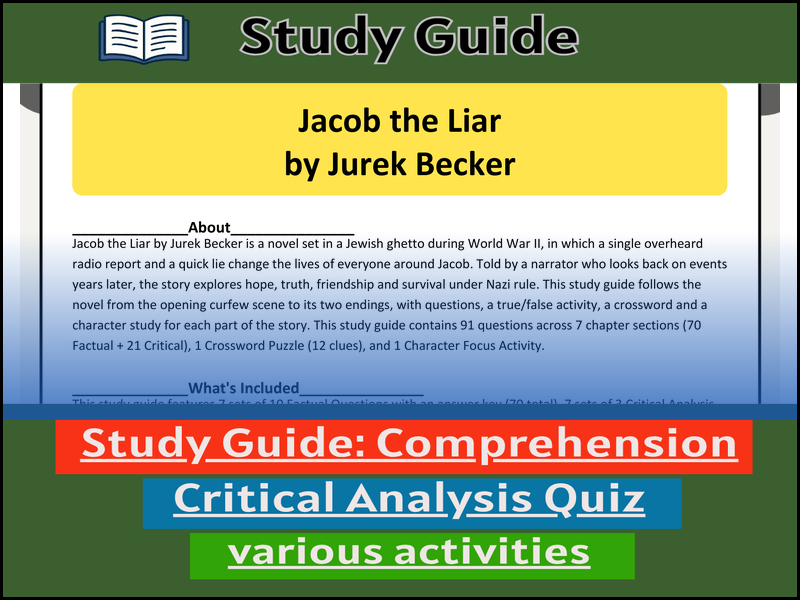
Jacob the Liar by Jurek Becker is a novel set in a Jewish ghetto during World War II, in which a single overheard
radio report and a quick lie change the lives of everyone around Jacob. Told by a narrator who looks back on events
years later, the story explores hope, truth, friendship and survival under Nazi rule. This study guide follows the
novel from the opening curfew scene to its two endings, with questions, a true/false activity, a crossword and a
character study for each part of the story. This study guide contains 91 questions across 7 chapter sections (70
Factual + 21 Critical), 1 Crossword Puzzle (12 clues), and 1 Character Focus Activity.
What’s Included_
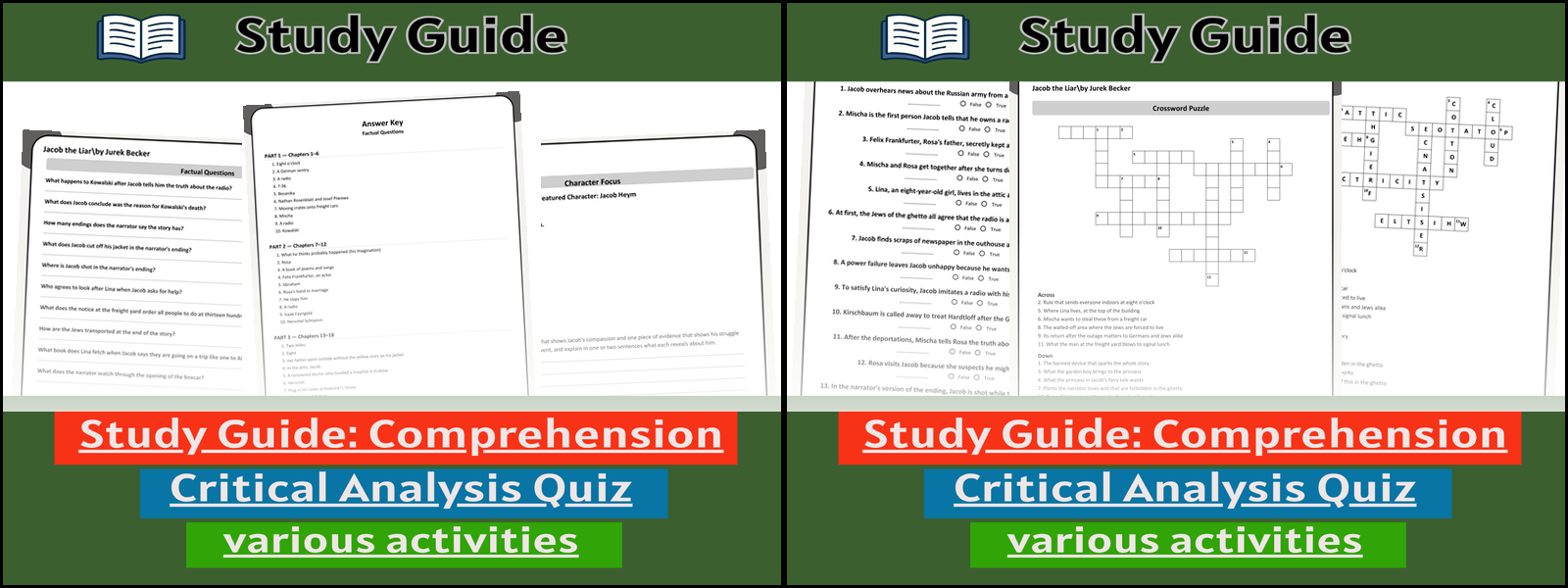
This study guide features 7 sets of 10 Factual Questions with an answer key (70 total), 7 sets of 3 Critical Analysis
Questions (21 total), 1 True/False activity (15 statements), 1 Crossword Puzzle (12 clues), and 1 Character Focus
Activity (8 traits + evidence prompt + critical thinking question).
Target Grades_
Grades 9-11
Teacher Note_
This guide helps students move from recalling key events to thinking critically about hope, honesty and survival,
using a mix of questions and activities. It has been prepared for you in advance, so you can spend less time
planning and more time discussing the novel’s big ideas with your class. Thank you for bringing such an important
story to your students.
About the Author
Jurek Becker was a German-Jewish writer born in Łódź, Poland, in 1937. As a child he lived in a ghetto and later in
concentration camps, and he moved to East Germany after the war. He published ‘Jacob the Liar’ in 1969, and it became one
of the best-known German novels about the Holocaust.
Life Inside a Ghetto
During World War II, the Nazis forced Jewish families into overcrowded, walled-off neighborhoods called ghettos. Residents
faced curfews, hunger, forced labor, and bans on everyday things like radios, trees, and newspapers. Understanding these
rules helps readers see how dangerous even small acts of defiance were.
Hope, Truth and Storytelling
This novel asks big questions about whether a lie can be kind and what role hope plays in survival. It is told by a narrator who
looks back on events from years later, so he sometimes admits he is imagining details. As you read, notice who is telling the
story, what they know, and how that shapes what you believe.
Something went wrong, please try again later.
This resource hasn't been reviewed yet
To ensure quality for our reviews, only customers who have purchased this resource can review it
Report this resourceto let us know if it violates our terms and conditions.
Our customer service team will review your report and will be in touch.
£2.90