


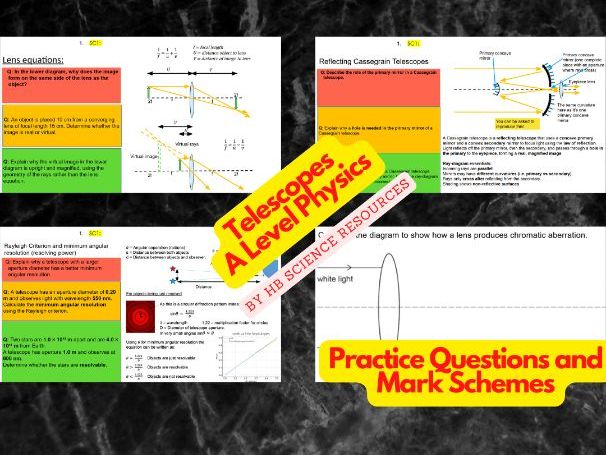

This is a lesson I used myself to teach the Telescopes concept of the Astronomy Unit - A level Physics, AQA specification.
Learning objective: To understand how lenses and mirrors form images, how different telescope designs gather and resolve light, and how detectors such as CCDs compare to the human eye in astronomical observations.
By the end of the lesson learners should be able to:
Success criteria:
SC1: I can construct and interpret ray diagrams for converging lenses and mirrors, explaining when images are real/virtual, inverted/upright, magnified/diminished, and how magnification is calculated.
SC2: I can compare refracting and reflecting telescopes, explain the roles of objective and eyepiece lenses/mirrors, and evaluate how aberrations, aperture size, collecting power, and resolving power affect image quality.
SC3: I can explain how CCDs, the human eye, and non-optical telescopes detect radiation, including why CCDs outperform the eye, why some wavelengths require space telescopes, and how telescope design depends on wavelength.
Contains past paper questions that target this topic, some questions require knowledge from prior lessons. The mark scheme is also included to verify answers.
Powerpoint contains 31 slides and 8 past paper questions.
Something went wrong, please try again later.
This resource hasn't been reviewed yet
To ensure quality for our reviews, only customers who have purchased this resource can review it
Report this resourceto let us know if it violates our terms and conditions.
Our customer service team will review your report and will be in touch.
£3.00