pptx, 1.65 MB
pptx, 1.65 MB
PNG, 67.31 KB
PNG, 67.31 KB
PNG, 236.5 KB
PNG, 236.5 KB

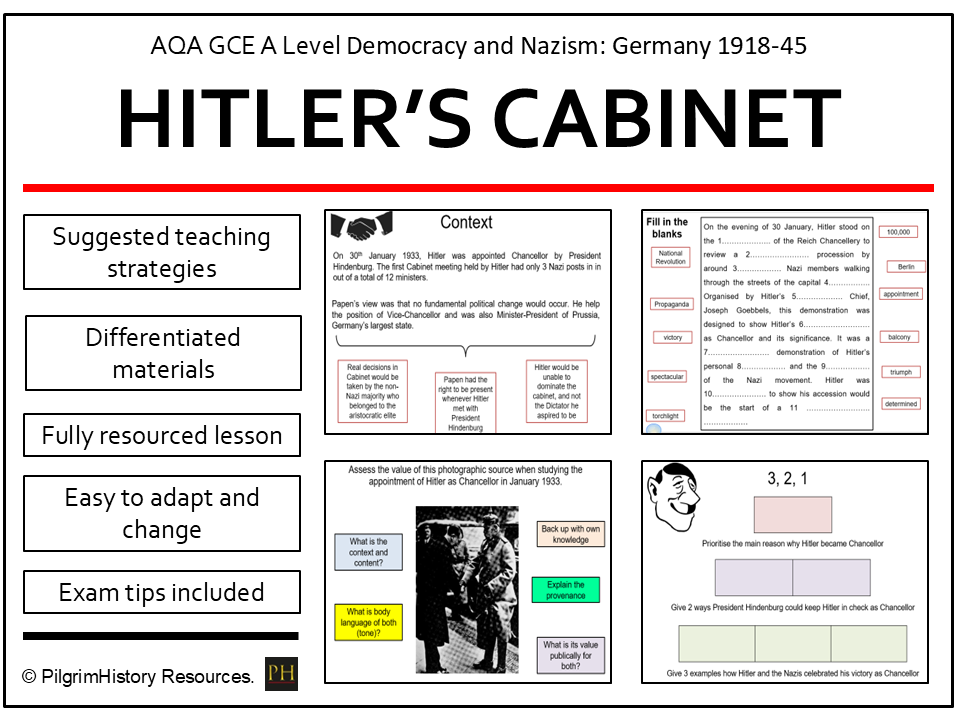
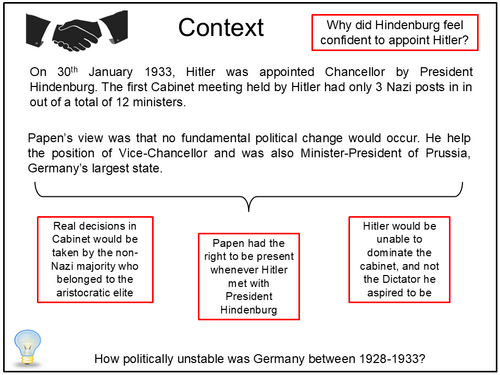
Students begin by exploring the events leading to Hitler’s appointment as Chancellor on 30 January 1933 and examining why Paul von Hindenburg believed Hitler could be safely appointed within a conservative-led government.

They consider the political calculations of leading conservatives and why they underestimated Hitler’s ambitions.

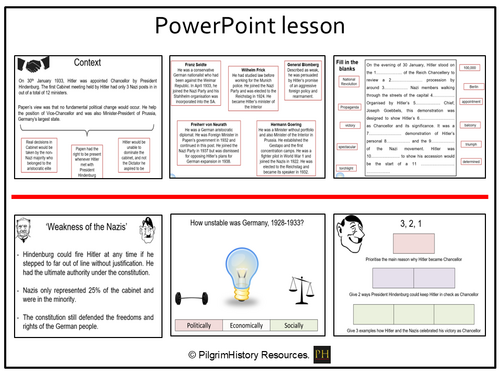
The lesson then examines the composition of Hitler’s first cabinet. Students investigate the key ministers, their political backgrounds and the balance of power within the new government, evaluating why many contemporaries believed Hitler would be constrained by experienced conservative politicians.

Students also analyse the constitutional and political obstacles facing Hitler in January 1933. Through structured activities, they assess the limitations imposed by the Weimar Constitution, the lack of a Nazi parliamentary majority and the challenges Hitler still faced in securing complete control of Germany.

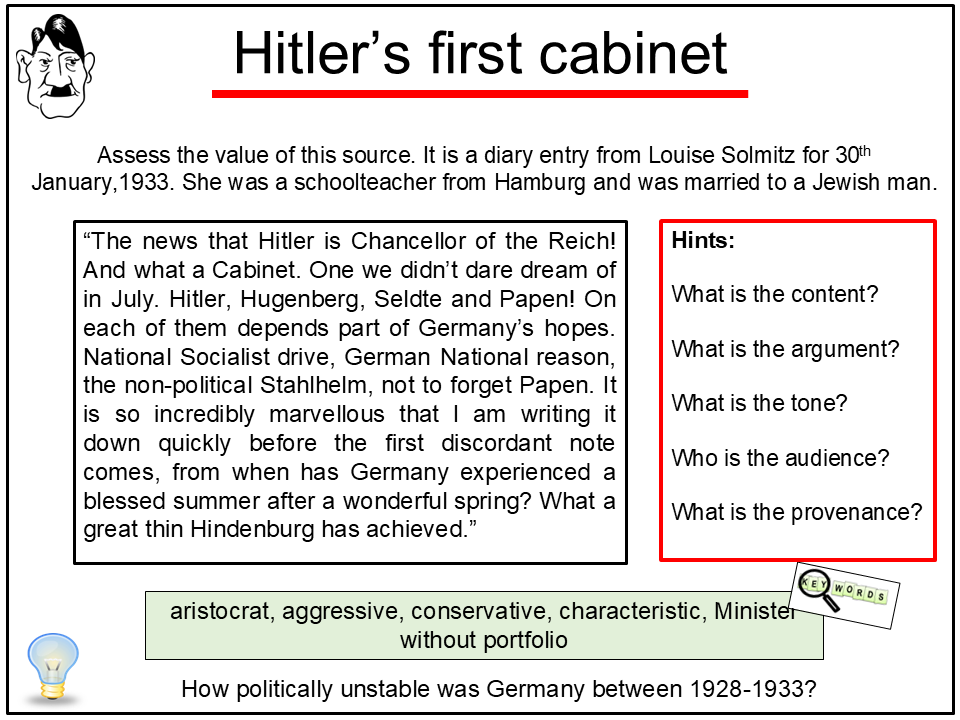
The lesson concludes with source analysis and exam-style activities, allowing students to evaluate contemporary evidence and develop the analytical skills required for A Level examinations.

A gap-fill exercise consolidates key knowledge before a 3-2-1 plenary reinforces the main themes and concepts from the lesson.

An enquiry question is introduced at the start of the lesson and revisited throughout, enabling students to monitor their progress and develop a deeper understanding across the wider unit of study.

Fully planned and ready to teach, the lesson develops political analysis, source evaluation, interpretation and exam technique

Included in this lesson:
Fully editable PowerPoint
Analysis of the members and significance of Hitler’s first cabinet
Tasks evaluating the constitutional and political constraints on Hitler
Source analysis and A Level exam-style activities
Gap-fill exercise and 3-2-1 plenary to consolidate learning
Fully differentiated throughout with suggested teaching strategies

Please leave a review if you find this resource useful. Your feedback is greatly appreciated

Creative Commons "Sharealike"

Get this resource as part of a bundle and save up to 26%

A bundle is a package of resources grouped together to teach a particular topic, or a series of lessons, in one place.

Bundle

Weimar Republic: Crisis and Collapse 1928–1933 Bundle | AQA A Level History: Democracy and Nazism, Germany 1918–1945

**AQA GCE 2O A Level Democracy and Nazism: Germany 1918-45** I have produced this bundle of resources on the collapse of democracy in Germany 1928-1933 to help A Level students gain a deeper understanding of Germany’s past and the collapse of democracy. The enquiry question throughout these lessons will be to evaluate how unstable Germany was, politically, socially and economically. Students will learn how the impact of the Wall Street Crash and the Depression a profound effect on the stability of the Weimar Republic and the significance of the rise of extremism as a direct consequence. They will also learn about the appeal of Communism as well as Nazism in Germany and how electoral support for them changed throughout the early 1930s. Students will evaluate backstairs intrigue as a succession of Chancellors failed to gain the support needed to effectively rule the country and how Hitler manipulated those around him to be appointed Chancellor in 1933. Finally students will analyse Hitler’s first Cabinet, the significance of the Reichstag Fire and how democracy ceased to exit as Nazis began to create a one party totalitarian state. The resources provided include detailed lesson suggestions, case studies, source documents for analysis, chronological tasks and exam practice questions. The lessons are as follows: L1 The Wall Street Crash and Great Depression L2 The Collapse of the Grand Coalition L3 The appeal of Nazis L4 The appeal of Communism L5 Papen’s Cabinet of Barons L6 General Schleicher and backstairs intrigue L7 Hitler’s first cabinet (free resource) L8 The use of terror in 1933 The lessons include the two types of exam question used, with examples of how to tackle them, using model answers, helpful hints and tips, structuring and scaffolding as well as markschemes. However, please refer to the AQA website for further assessment materials as they are subject to copyright. The lessons are also differentiated and fully resourced and allow students to reach the very top marks. If you have any questions about the lessons, please email me via my TES shop, or any other information about the course. I would also welcome any reviews, which would be gratefully appreciated. The Complete Scheme of Work for this unit of study can be found here: https://www.tes.com/teaching-resource/resource-13149508

£17.00

Reviews

Something went wrong, please try again later.

This resource hasn't been reviewed yet

To ensure quality for our reviews, only customers who have downloaded this resource can review it

Report this resourceto let us know if it violates our terms and conditions.
Our customer service team will review your report and will be in touch.