
ppt, 801.5 KB
ppt, 801.5 KB
pdf, 130.87 KB
pdf, 130.87 KB
pdf, 55.76 KB
pdf, 55.76 KB
pdf, 24.58 KB
pdf, 24.58 KB
zip, 61.29 KB
zip, 61.29 KB

A fully resourced, interactive GCSE lesson exploring how the chaotic Munich Putsch of 1923 — a confused, poorly executed attempt to seize power — became a surprising turning point in Hitler’s rise. Through enquiry-led activities, students investigate why an event that seemed like a total disaster on the day later helped reshape Nazi strategy, messaging and political ambition.

The lesson includes:
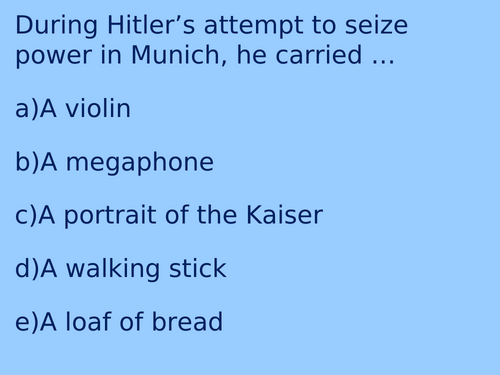
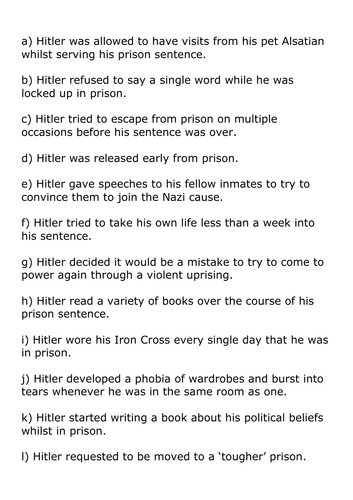
• A curiosity-driven register starter revealing a surprising detail from Hitler’s march through Munich
• A visual inference task using a stylised painting to explore heroic representation and propaganda
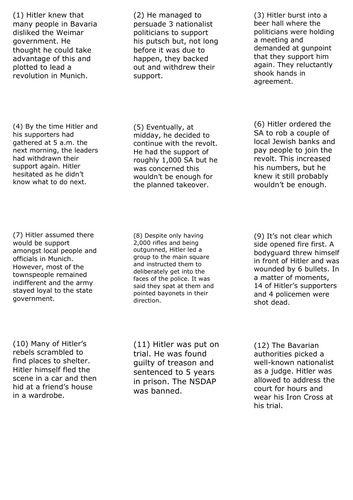
• A living graph activity in which students track Hitler’s fluctuating confidence across the two-day revolt
• A Likely/Unlikely continuum where students evaluate true, exaggerated and mythical consequences of the Putsch
• An exam-focused interpretation task analysing exaggerated tone and supporting judgements with evidence
• A plenary that revisits the opening painting to expose how political myths are constructed
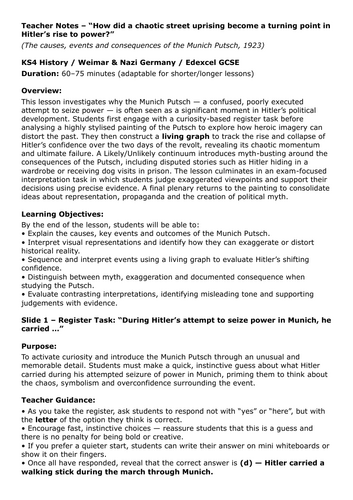
• Full teacher notes for every slide, including Purpose, Guidance, Insight, Differentiation and Timing

All worksheets, cut-out cards and detailed teacher notes are included.
Designed for Edexcel GCSE History (Weimar & Nazi Germany) but easily adaptable for AQA, OCR or Eduqas.

Ideal for developing inference, explanation, oracy, evaluative writing and causal reasoning, while deepening students’ understanding of how political failures can be reframed as moments of opportunity and myth-making.

Get this resource as part of a bundle and save up to 29%

A bundle is a package of resources grouped together to teach a particular topic, or a series of lessons, in one place.

Bundle

Rise of the Nazis 1919–1933: GCSE Weimar Germany Enquiry Lessons (5-Lesson Bundle)

Why did the Nazis fail, survive, recover – and ultimately take power? This fully resourced GCSE History bundle explores the rise of the Nazi Party from its early beginnings in 1919 to Hitler’s appointment as Chancellor in 1933, challenging the myth that Nazi success was inevitable and instead emphasising contingency, crisis, and political choice. Designed for the Weimar & Nazi Germany unit, these five enquiry-led lessons guide students through failure, recovery, popular support, and elite decision-making, helping them build secure chronological understanding alongside strong analytical and judgement skills. The bundle includes five complete lessons: Early development of the Nazi Party, 1919–1922 The Munich Putsch, 1923: causes, events and consequences Why were the Nazis still weak by 1928? Why did the Nazis grow in popularity after 1929? Did Hitler seize power – or was he allowed in? Hitler’s appointment as Chancellor Each lesson is fully resourced and includes: Engaging enquiry questions with clear historical focus Structured activities such as character match-ups, continuums, inference tasks and judgement questions Full slide-by-slide teacher notes with purpose, guidance, insight, differentiation and timings Printable worksheets and resources ready for classroom use This bundle is ideal for GCSE teachers seeking a coherent, enquiry-driven sequence that develops explanation, evaluation and supported judgement while addressing key exam misconceptions about Nazi popularity and the collapse of democracy. Aligned with Edexcel GCSE Weimar & Nazi Germany and easily adaptable for AQA, OCR and Eduqas. Perfect for both experienced teachers and non-specialists looking for high-quality, ready-to-teach lessons.

£16.00

Reviews

Something went wrong, please try again later.

This resource hasn't been reviewed yet

To ensure quality for our reviews, only customers who have purchased this resource can review it

Report this resourceto let us know if it violates our terms and conditions.
Our customer service team will review your report and will be in touch.