


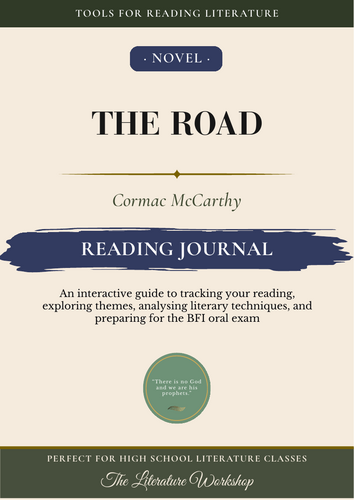
Aligned with GCSE / A-Level English Literature, IB English, BFI English, and Comparative Literature courses, this journal supports close reading and provides a structured evidence bank for essays, discussion, and oral assessment.
Students will:
Track key events, quotations, characters, and the Man’s development throughout the novel.
Explore characters, relationships, themes, and recurring issues surrounding survival, love, family, morality, violence, hope, memory, humanity, and the struggle between good and evil.
Identify and analyse literary techniques including imagery, symbolism, metaphor, repetition, contrast, foreshadowing, biblical allusion, irony, and narrative perspective.
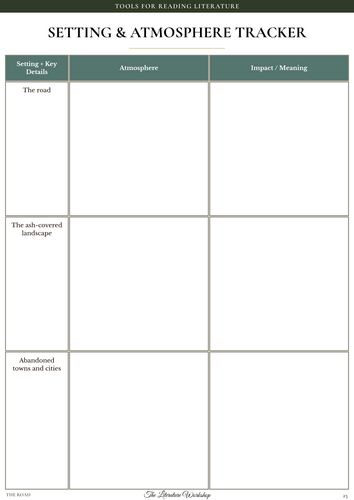
Explore how setting and atmosphere shape the Man and Boy’s experiences, particularly the devastated landscape, abandoned towns, forests, roads, and temporary places of refuge.
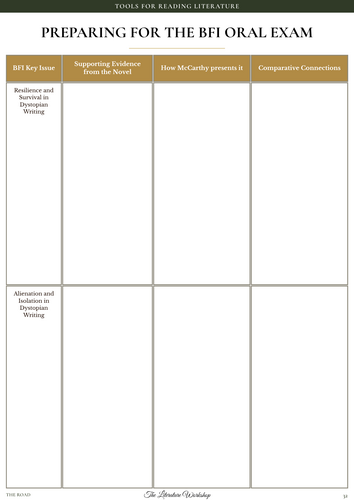
Build evidence for the 8 BFI Dystopian Writing key issues, including useful quotations, characters, relationships, settings, and literary techniques.
Develop connections with prescribed poems and other studied texts for comparative discussion.
Format:
32 pages
Self-paced reading support
Structured sections covering the full novel
Printable for classroom or independent study
It includes:
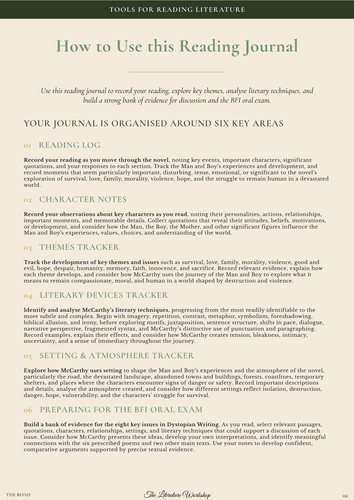
Reading Log by Sections
Character Notes
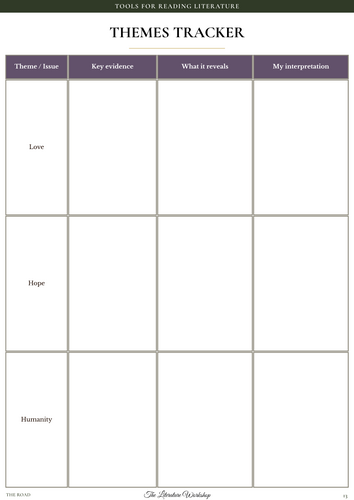
Themes & Issues Tracker
Literary Devices Tracker
Setting & Atmosphere Tracker
BFI Dystopian Writing Key Issues Evidence Grid (8)
Perfect for:
BFI English / Comparative Literature
GCSE & A-Level English Literature
Dystopian and post-apocalyptic literature
Students exploring survival, love, family, morality, violence, hope, memory, humanity, and good versus evil
Written and oral assessment preparation
A companion to the Interactive Literature Workbook, this journal gives students a structured place to record their reading and build evidence before developing it into deeper literary analysis.
Get this resource as part of a bundle and save up to 59%
A bundle is a package of resources grouped together to teach a particular topic, or a series of lessons, in one place.
Bundle
The Road – Complete Novel Study Toolkit (Mini Bundle)
**Description:** A comprehensive, student-friendly bundle for GCSE, A-Level, and BFI English Literature. Perfect for students and teachers who want a structured, all-in-one toolkit to read, track, and analyze The Road with confidence. **It includes:** The Road Reading Journal & Student Workbook – structured pages to record insights, reflections, and notes while reading Interactive Workbook: Key Quotes, Themes & Literary Devices – targeted exercises to reinforce understanding of the text Theme Tracker Worksheet – step-by-step guide to follow, analyze, and interpret key themes throughout the novel Literature Analysis Grid – templates to track characters, plot, setting, and narrative techniques **Perfect for:** Close reading, essay planning, homework, independent study, and developing confident analytical writing skills for essays and exams.
£6.99
Bundle
Dystopian Writing: 6 Main Text Mega Bundle | Reading Journals + Interactive Workbooks | BFI English Literature
*A comprehensive 12-resource bundle for studying six major works of dystopian fiction. Combining a complete reading journal with an interactive literature workbook for each text, this bundle provides students with structured support for reading, evidence collection, close analysis, literary interpretation, essay writing, revision, and BFI Oral Exam preparation.* **Resources included (12) ** **Reading Journals:** 1984 — George Orwell (35 pages) The Handmaid’s Tale — Margaret Atwood (35 pages) Parable of the Sower — Octavia Butler (34 pages) Never Let Me Go — Kazuo Ishiguro (36 pages) The Road — Cormac McCarthy (32 pages) Prophet Song — Paul Lynch (33 pages) **Interactive Literature Workbooks:** 1984 — George Orwell (31 pages) The Handmaid’s Tale — Margaret Atwood (32 pages) Parable of the Sower — Octavia Butler (36 pages) Never Let Me Go — Kazuo Ishiguro (32 pages) The Road — Cormac McCarthy (30 pages) Prophet Song — Paul Lynch (32 pages) **Total: 12 resources | 403 pages** **Each reading journal includes:** Reading Log — Record key events, characters, quotations, turning points, and personal responses as you move through the text. Character Notes — Explore personalities, motivations, relationships, development, conflicts, and responses to oppression, uncertainty, violence, and social change. Themes Tracker — Collect evidence and explore key ideas including power, control, freedom, oppression, identity, inequality, resistance, technology, violence, and survival. Literary Devices Tracker — Identify and analyse language, structure, imagery, symbolism, narrative perspective, and other literary techniques. Setting & Atmosphere Tracker — Explore significant settings, descriptions, and atmospheres and their contribution to characterisation, themes, relationships, and meaning. Preparing for the BFI Oral Exam — Build a bank of quotations, passages, characters, relationships, themes, settings, and literary techniques linked to the key issues in Dystopian Writing, supporting comparative discussion with the prescribed poems and other Main Texts. **Each interactive literature workbook includes:** Contextualising the Novel — Explore the historical, political, social, and literary contexts surrounding each text. Narrative Perspective Tracker — Analyse narrative voice, focalisation, internal thoughts, memories, dreams, ambiguity, irony, symbolism, foreshadowing, and what the narrative reveals or withholds. Character & Relationship Trackers — Explore characterisation, motivations, relationships, conflicts, development, and significant quotations. Key Quotations Bank — Record speaker, context, literary methods, significance, and connections to characters and themes. Key Turning Points Analysis — Examine major moments of change, conflict, revelation, loss, resistance, and development. Symbols & Motifs Tracker — Identify recurring symbols, images, objects, colours, settings, and motifs and explore their significance. Personal Critical Reflection — Develop individual interpretations and reflect critically on the novel’s characters, events, themes, methods, and overall impact. **Explore six major dystopian texts:** 1984 • The Handmaid’s Tale • Parable of the Sower • Never Let Me Go • The Road • Prophet Song **Ideal for:** British English BFI A Level English Literature IB English Literature Comparative Literature Dystopian Writing units Close reading and literary analysis Essay writing and revision Independent study and classroom teaching BFI Oral Exam preparation
£39.99
Bundle
The Road Literature Study Bundle | Reading Journal & Interactive Workbook | McCarthy
*A comprehensive two-resource bundle for studying Cormac McCarthy’s The Road. Students can track their reading, explore characters, themes, settings and literary techniques, build a detailed quotation and evidence bank, and develop ideas for literary analysis and essay writing.* **Includes:** 32-page Reading Journal 30-page Interactive Literature Workbook Reading and analysis activities covering the complete novel Character, theme, setting, quotation and literary device trackers Essay planning and critical reflection activities Exploration of survival, morality, fatherhood, love, hope, humanity, violence, death, memory, faith, isolation, environmental destruction, and the meaning of civilisation **Ideal for GCSE, A Level, British English BFI, IB and Comparative Literature.**
£7.99
Bundle
Dystopian Writing: 6 Main Text Reading Journals | BFI English Literature
**Each reading journal includes:** **Reading Log** — Record key events, important characters, significant quotations, and personal responses as you move through the text. Track character development, turning points, and the text’s exploration of dystopian societies, conflict, power, control, resistance, and survival. **Character Notes** — Record observations about key characters, including their personalities, actions, motivations, relationships, development, and significant quotations. Explore how characters respond to oppression, uncertainty, violence, social change, and the breakdown of established systems. **Themes Tracker** — Track the development of key themes and issues, collecting relevant evidence and exploring how the writer develops ideas about power, control, freedom, oppression, identity, technology, inequality, resistance, environmental crisis, violence, and other central concerns of dystopian writing. **Literary Devices Tracker** — Identify and analyse literary techniques, from more readily identifiable devices to subtler and more complex techniques. Record examples, explain their effects, and consider how the writer uses language, structure, imagery, symbolism, narrative perspective, and other techniques to construct dystopian worlds and shape meaning. **Setting & Atmosphere Tracker** — Explore how significant settings, descriptions, and atmospheres contribute to character development, relationships, themes, and the wider meaning of the text. Consider how writers construct unsettling, oppressive, fragmented, or threatening worlds. **Preparing for the BFI Oral Exam** — Build a bank of quotations, passages, characters, relationships, themes, settings, and literary techniques linked to the key issues in Dystopian Writing. Develop evidence and interpretations for comparative discussion with the six prescribed poems and, where required, other Main Texts. **The six journals included are:** 1984 — George Orwell (35 pages) The Handmaid’s Tale — Margaret Atwood (35 pages) The Parable of the Sower — Octavia Butler (34 pages) Never Let Me Go — Kazuo Ishiguro (36 pages) The Road — Cormac McCarthy (32 pages) Prophet Song — Paul Lynch (33 pages)
£21.99
Something went wrong, please try again later.
This resource hasn't been reviewed yet
To ensure quality for our reviews, only customers who have purchased this resource can review it
Report this resourceto let us know if it violates our terms and conditions.
Our customer service team will review your report and will be in touch.
£4.99